
As you’re planning a big move, knowing the average U-Haul mpg can help you build a realistic budget. There are often charges related to fuel, so when you’re driving a rental truck, high gas prices can strain your wallet even more than usual. Large trucks have a lower fuel economy than other types of vehicles, too — and when you load one up with all your belongings, the gas mileage drops even further.
But how low can it go? Well, a 15-foot U-Haul has a fuel economy of approximately 10 mpg. It’s no wonder people look for ways to save on gas when they rent one!
To put it in perspective, a move from Washington, D.C., to Portland, OR, covers about 2,800 miles. In 2025, driving a loaded U-Haul that distance while getting 10 mpg will cost you about $900. That’s a lot cheaper than the past few years, but fuel costs still make up a big part of your budget.
But don’t worry — we’ve got you covered. In this guide, we cover everything you need to know about rental truck gas policies, fuel economy, and ways to save money on your move in a rental truck.
Rental Truck Gas Policies: What You Need to Know
If this is your first time renting a moving truck, it’s important to understand how gas policies work. When you pick up a rental truck, it will usually have a full or almost full tank of gas. You’ll be responsible for filling it up as you drive.
What happens at the end of the trip? That depends on the rental company. Here’s what you can expect.
U-Haul

The U-Haul gas policy gives you two options for refueling at the end of your journey. The cheapest option is to fill the tank yourself. As long as the gas gauge is at or above the level it was when you picked up the truck, you’re good to go. Your rental contract will include the required fuel level and a guide for estimating how many gallons you need.
You can also choose the EZ-Fuel service, which allows you to return the truck without refilling the gas tank. It’s more convenient, but it’s also more expensive.
So how much does U-Haul charge for gas? The rate changes, but it’s often around $5 per gallon. Plus, if the truck has less than ¼ tank, they might also charge you a $30 fee.
Penske
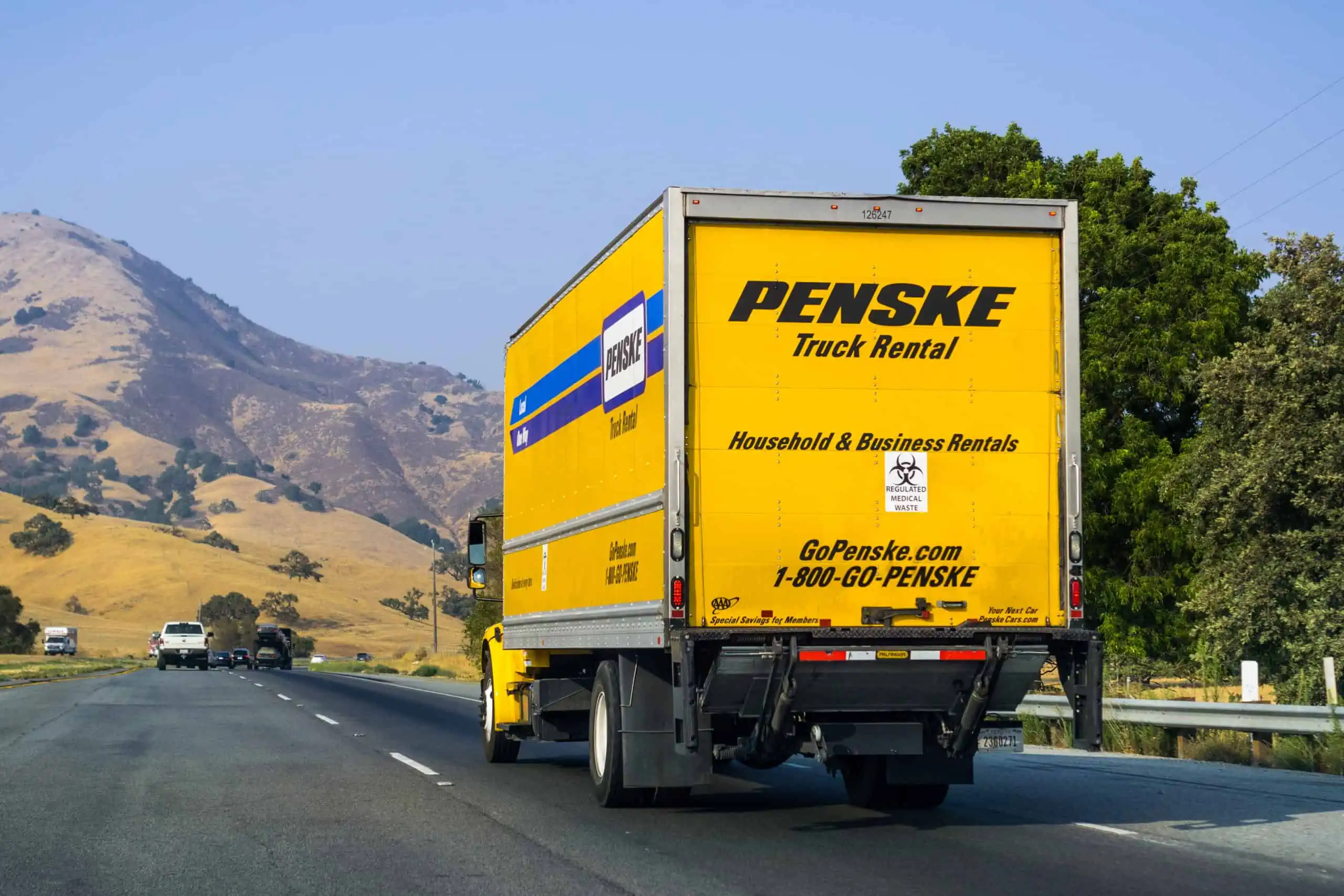
If you’re debating between Penske vs. U-Haul, the gas policies are similar, but unlike U-Haul, Penske doesn’t offer a company-refuel option. Penske asks you to return the truck with a full tank of gas, so it’s important to check the fuel level when you pick it up. If it’s not full, ask the representative to top it off. You’ll be charged a fee if the gas tank isn’t full, the vehicle is damaged, or you return the truck late.
Budget
Like U-Haul, Budget’s fuel policy requires you to return the truck with the same fuel level it had at pickup. The company typically fills the tanks completely, but not always. Your contract will note the fuel level for reference.
What Type of Fuel Do Rental Trucks Take?
Many rental trucks from U-Haul and Penske use standard unleaded fuel, but it depends on the company and the type of vehicle. Larger trucks from Budget and Penske may take diesel. Since diesel fuel is often more expensive, choosing an unleaded model can cut costs.
Rental Trucks and Fuel Economy
Here’s an overview of the available truck types, fuel types, gas mileage, and fuel tank economy for the major rental companies.
U-haul
| Fuel Economy | Fuel Type | Fuel Tank Capacity | |
| U-Haul Cargo Van | 18 mpg | Unleaded (87) | 25 gallons |
| U-Haul 26-foot truck | 10 mpg | Unleaded (87) | 60 gallons |
| U-Haul 20-foot truck | 10 mpg | Unleaded (87) | 40 gallons |
| U-Haul 15-foot truck | 10 mpg | Unleaded (87) | 40 gallons |
| U-Haul 10-foot truck | 12 mpg | Unleaded (87) | 31 gallons |
Penske
| Fuel Economy | Fuel Type | Fuel Tank Capacity | |
| Penske Cargo Van | 12 mpg | Unleaded (87) | 25 gallons |
| Penske 26-foot truck | 13 mpg | Diesel | 70 gallons |
| Penske 22-foot truck | 13 mpg | Diesel | 70 gallons |
| Penske 16-foot truck | 12 mpg | Unleaded (87) | 33 gallons |
| Penske 12-foot truck | 12 mpg | Unleaded (87) | 33 gallons |
Budget
| Fuel Economy | Fuel Type | Fuel Tank Capacity | |
| Budget Cargo Van | 8-14 mpg | Unleaded (87) | 25 gallons |
| Budget 26-foot truck | 8-10 mpg | Diesel | 50 gallons |
| Budget 16-foot truck | 6-10 mpg | Unleaded (87) | 33 gallons |
| Budget 12-foot truck | 8-14 mpg | Unleaded (87) | 35 gallons |
Fuel Efficiency in Rental Trucks
If fueling up a big moving truck seems intimidating, some of the major rental companies have added a few fuel-saving features to help reduce your gas costs.
“The less you have, the less the truck weighs, and the less fuel it burns. In other words, selling your massive sectional couch instead of moving it could save you some serious cash.”
The U-Haul mpg might be low, but the company uses a variety of clever design features to reduce drag and maximize fuel economy. Most vehicles have aerodynamic mirrors, chassis skirts, low deck heights, and rounded corners.
Tire air pressure can have a big impact on fuel economy, too, so Penske takes care to fill the tires before you pick up the truck. The company also uses aerodynamic cab designs, low-rolling resistance tires, and roof fairings to reduce wind resistance.
How to Estimate Your Fuel Cost
To estimate your fuel cost, divide the distance by the rental truck’s mpg rating. Then, multiply that number by the average price of fuel.
For example, let’s say you’re moving 1,000 miles in a vehicle with the average U-Haul truck gas mileage of 10 mpg. If gas is $3.20 per gallon, here’s how you’d calculate fuel costs:
1,000 miles / 10 mpg = 100 gallons of gas
100 gallons x $3.20 = $320
Of course, this is just an approximation. Your final fuel costs depend on traffic, the weather, how much you’re able to let the truck cost, and other miscellaneous factors. Still, an estimate like this is a great starting point for your budget planning.
How to Save Money on Your Rental Truck Gas
You can’t do much about the price of gas, but you can take steps to reduce how much you use. If you’re planning to rent a truck, here are some proven tactics you can use to save.
1. Lighten your load
The less you have, the less the truck weighs, and the less fuel it burns. In other words, selling your massive sectional couch instead of moving it could save you some serious cash. There are lots of ways to get rid of stuff before a move, too: here are some helpful decluttering tips to get you started.
2. Find the most efficient route
Before you leave, check for shortcuts. Taking the long way will cost you both time and money. And rush hour traffic in big cities is another gas-waster. Make sure you avoid metros along your route whenever possible.
3. A/C on the highway, windows down on the streets

Because A/C reduces your fuel economy, the U.S. Department of Energy advises you to skip it and roll down your windows instead. We recommend using this strategy when you’re in town, but turn on the A/C when you hit the highway. At higher speeds, open windows can create drag that’s as bad for fuel efficiency as the air conditioner.
4. Don’t have a lead foot
The USDoE also advises driving conservatively. Gunning it to beat the light or to pass someone eats up gas quickly. Heavy acceleration — especially in city traffic — can decrease your vehicle’s gas mileage by as much as 40%!
5. Avoid filling up at highway rest areas
Those rest areas are super-convenient, but they also have higher gas prices. While 10 cents extra per gallon doesn’t seem like a lot, it can add up over a long trip.
“Many rental trucks from U-Haul and Penske use standard unleaded fuel, but it depends on the company and the type of vehicle. Larger trucks from Budget and Penske may take diesel.”
Instead, go to a gas station a few miles off the highway. Plus, if you pop your location into Google Maps, you can see all the local stations and their current gas prices. The app can also let you know if the route you’re taking is the most eco-friendly and fuel-efficient. Just look for the leaf icon when planning a route.
6. Ask for the newest moving truck
Newer trucks tend to have better fuel mileage. So, in general, the fresher the model, the better your final gas price will be.
Penske has a reputation for having newer, better-maintained trucks than the other guys. And while Penske can be noticeably pricier for short moves, they’re price-competitive for long hauls. Add in the gas savings, and the difference could be significant.
7. Balance your load

The weight of your stuff isn’t the only thing affecting your truck’s gas mileage — the way it’s loaded matters, too. A balanced load is a stable load, meaning your truck doesn’t have to fight against excess momentum and gravity.
To get better mileage, keep the heavy core of your load in the middle of the truck, which is closer to the cab. If you’re not sure you’d be any good at playing furniture Tetris, professional hourly movers have this process down to an art.
Gas might be expensive, but it shouldn’t keep you from planning a cost-effective move. Pack carefully, practice good driving habits, and select smart routes. Your bank account will thank you!