

Budget vs. U-Haul: Moving Truck Prices, Reviews, Service
Posted in: Moving TrucksWhen it comes to convenience, U-Haul is usually the better option, while Budget is often the better pick for long-distance moves. U-Haul has more locations and truck sizes than anyone else, and they are perfect for local moves. Budget, on the other hand, has lower base pricing and can save you a good amount of money over longer distances.
If you need a rental truck, all your options might look pretty much the same at first glance. You book a truck, load your stuff, and drive it yourself. But when you dig into the details, like mileage costs, insurance options, and how the trucks actually handle, you’ll realize rental truck companies are very different.
In this guide, we break down our research on the real costs, fleet options, and what actual customers are saying for U-Haul and Budget, so you can decide which rental truck is right for you.
Table of Contents
- Budget vs U-Haul at a Glance
- How Budget and U-Haul Pricing Works
- Budget vs U-Haul: Cost Comparison by Move Type
- Budget vs U-Haul: Additional Fees and Hidden Costs
- Budget vs U-Haul: Truck Sizes and Options
- Budget vs U-Haul: Availability and Locations
- Budget vs U-Haul: Customer Experience and Brand Reputation
- Budget vs U-Haul: Service and Experience
- Budget vs U-Haul: Which Is Better for Your Move?
- Are There Alternatives to Budget and U-Haul?
- Final Verdict: Budget vs U-Haul
- Frequently Asked Questions
Budget vs U-Haul at a Glance
There’s a reason U-Haul and Budget are the heavyweights of DIY moving. They both give you the freedom to move on your own timeline, and on the surface, their pricing looks identical: a daily fee plus mileage. But the differences show up in the little things, like how easy it is to find a truck nearby or which extra fees appear on the final bill.
“While U-Haul is famous for that low starting price, our data shows that Budget actually came out cheaper across the board this year.”
U-Haul is the winner when you just need convenience. They have significantly more locations than Budget, which means you probably won’t have to drive far to find one. They also offer a massive variety of choices, from cargo vans and pickups to trailers, so you can grab exactly the right size for your load.
Budget, true to its name, tends to cost less for long-distance trips and usually comes with fewer fees. If you are willing to be a little flexible about when and where you pick up the truck, you can usually save a noticeable amount of money with them.
U-Haul vs. Budget Truck Rentals: Key Differences
| Factor | Winner | Details |
| Which is better overall | U-Haul | U-Haul is the better all-around option for most people because it offers unmatched availability and a wider range of truck sizes. |
| Which is cheaper | It Depends | U-Haul generally wins on local base rates, while Budget often wins on long-distance total costs. |
| Best for Local Moves | U-Haul | With thousands of locations, you can almost always find a truck nearby. |
| Best for Long Distance | Budget | Budget’s pricing model for one-way moves is often more competitive. |
How Budget and U-Haul Pricing Works
Pricing is one of the biggest deciding factors when you are choosing between Budget and U-Haul. To understand who is actually cheaper, you have to look at how they calculate the bill versus what you actually pay at the counter.
Base Rates and Mileage Policies
If you’re trying to figure out who is cheaper, you have to look at how they charge you, because the math changes depending on how far you’re driving.
- Local Moves: We’ve all seen the “$19.95” sticker on the side of a U-Haul. That’s their daily base rate for smaller trucks, but the real cost is in the mileage fees, which are added for every single mile you drive. Budget works the same way (a daily fee plus a per-mile charge). While U-Haul’s daily rate often looks lower, Budget’s total cost can actually be cheaper once you do the math.
- Long-Distance Moves: If you’re dropping the truck off in a different city, the pricing gets much simpler. Both companies typically give you a flat rate that bundles your days and mileage into one price.
Budget vs U-Haul: Cost Comparison by Move Type
To give you a real-world example of how these price differences play out, we crunched the numbers for three common moving scenarios. This data shows exactly how the math shifts as you add more miles to your trip. We compared the costs for a standard 2-bedroom home to find which company offers the best value for different distances.
While U-Haul is the king of convenience, our 2026 data shows Budget taking a clear lead on the total bottom line for longer treks.
Note: Prices below are estimates based on standard 2-bedroom moves. Real-time rates fluctuate based on demand and season.
| Move Distance | U-Haul | Budget |
| <50 miles (Local) | $130.50 | $79.20 |
| 50-250 miles (Regional) | $439.97 | $267.01 |
| Long-distance (Cross-country) | $1529.59 | $928.27 |
Who Wins: Budget
The numbers don’t lie: Budget takes the crown here.
While U-Haul is famous for that low starting price, our data shows that Budget actually came out cheaper across the board this year. Whether you are moving just down the street or all the way across the country, Budget offered the better bottom-line price in our testing.
Budget vs U-Haul: Additional Fees and Hidden Costs
The price on the side of the truck is rarely the price you pay. Or, for that matter, the baseline daily fee+mileage. There are some extra costs to consider, and here’s a look at what else you should budget for.
Insurance and Add-On Costs
Both companies offer optional protection plans. Since most personal auto insurance policies do not cover rental trucks, purchasing this coverage is usually a smart move.
- U-Haul: Offers plans like Safemove® and Safemove Plus®. These cover damage to the truck and your cargo, and can also provide medical/life coverage.
- Budget: Offers similar waivers for physical damage and supplemental liability insurance.
Extra Fees
Be on the lookout for these common fees from both providers:
- Environmental fees: A mandatory tax added to almost every rental.
- Mileage overages: If you exceed the allowed miles on a one-way trip, the per-mile fee can be steep.
- Fuel: You must return the truck with the same fuel level as when you left, or pay a premium refueling fee.
Discounts
- Budget: Budget is generally more aggressive with discounts. They often have promo codes available on their site, and they offer specific discounts for AARP members, military personnel (via Veterans Advantage), and Amazon customers (up to 30% off). You can also save up to 35% just by choosing the “Pay Now” option when booking online.
- U-Haul: U-Haul rarely offers standard percentage-off discounts. Instead, they focus on “value-adds,” such as a free month of self-storage with one-way rentals and a box buy-back program for unused supplies. They also partner with chains like Choice Hotels and Motel 6 to offer movers 15% off their hotel stays.
Who Wins: Budget
Budget wins this category. Their billing tends to be slightly more transparent, and they offer more direct monetary discounts that lower your bottom line.
Budget vs U-Haul: Truck Sizes and Options
The truck you choose can make or break your move, so the number of size options really matters. U-Haul takes the lead here, offering a wider range of sizes (including a 10-foot truck and a 20-foot family mover) plus trailers for odd-sized loads. Budget keeps things simpler, sticking to three core sizes that cover most standard moves.
Our data below comes directly from each company’s current rental listings and 2026 booking tests.
Truck Sizes and Availability
| Truck Size | U-Haul | Budget |
| Pickup Truck | ✅ | ✅* |
| Cargo Van | ✅ | ✅** |
| 10′ Truck (Studio/Dorm) | ✅ | ❌ |
| 12′ Truck (Studio/1-Bedroom) | ❌ | ✅ |
| 15′ – 16′ Truck (1-2 Bedroom) | ✅ | ✅ |
| 20′ Truck (2-3 Bedroom) | ✅ | ❌ |
| 26′ Truck (3-4+ Bedroom) | ✅ | ✅ |
| Trailers | ✅ | ❌ |
*This service is available exclusively at car rental branches rather than dedicated truck rental locations.
**Limited availability – not all locations.
Who Wins: U-Haul
U-Haul is the clear winner. While Budget covers the basics, U-Haul offers specific trucks (like the 10-foot mini-mover and the 20-foot truck) that bridge the gaps between sizes. If you are moving a small apartment, that 10-foot U-Haul is often much easier to park than Budget’s 12-foot truck. Plus, U-Haul’s massive inventory of trailers gives you flexibility that Budget simply doesn’t offer.
Budget vs U-Haul: Availability and Locations
Availability can make or break a move, especially if your schedule is tight or you live outside of a major metro.
- U-Haul: With over 24,000 locations across North America, U-Haul is everywhere. You can find them at dedicated centers, gas stations, and hardware stores.
- Budget: Budget has a smaller footprint, with around 2800 locations. They are often located alongside car rental agencies near airports or in major cities.
Who Wins: U-Haul
U-Haul wins by a landslide. Their massive network makes it incredibly easy to find a truck near your home, saving you time and gas money on moving day.
Budget vs U-Haul: Customer Experience and Brand Reputation
We combed through the latest feedback on Consumer Affairs and Trustpilot to see how these brands hold up when the pressure is on. Let’s be honest: truck rental reviews are usually pretty harsh. Most of us don’t log on to rave about a truck that simply worked, after all. But if you look past the venting, you start to see real patterns around reliability, beat-up equipment, and surprise charges.
Review Snapshot
- U-Haul: High praise for individual staff members and convenience, but frequent complaints regarding disputed fuel charges and equipment condition.
- Budget: Value-focused praise for pricing, but significant issues with honored reservations and inventory availability.
U-Haul Customer Experience
With a network as large as U-Haul’s, the customer experience is often defined by variability. Because many U-Haul locations are operated by independent dealers (gas stations, hardware stores, etc.), service quality changes from town to town.
- Service and Staff: When it works, it works well. Customers in locations like Knoxville, TN and Seattle, WA praised staff for “excellent communications” and going “above and beyond” to accommodate drop-off changes.
- Availability: U-Haul generally wins on volume. Even with reservation hiccups, their massive fleet means they can usually find a solution. However, customers in North Carolina and Minnesota noted that last-minute equipment swaps or location changes did cause delays.
- Billing and Fees: The most common source of frustration involves final receipts. Multiple reviewers mentioned unexpected charges for fuel, cleaning, or damage, with one customer in Leesburg, FL, noting a dispute over fuel gauge readings that led to extra fees.
The Verdict: U-Haul is the “convenient” choice. You are likely to find a truck and helpful staff, but you must document the truck’s condition and fuel level meticulously to avoid surprise bills.
Budget Customer Experience
Budget’s reputation centers on pricing appeal versus operational limitations. Customers often choose Budget to save money, but recent reviews highlight a struggle with inventory management that can disrupt moving plans.
- Inventory Issues: The most critical complaint facing Budget is reservation reliability. A customer in Peoria, AZ, reported arriving to find their reserved fleet rented out to a commercial client (Amazon) on moving day. Similar “no truck available” stories appeared in reviews from Florida, New Jersey, and South Carolina, where confirmed reservations were cancelled within 24–48 hours of pickup.
- Truck Condition: Renters often accept that Budget trucks may be older or have higher mileage in exchange for lower rates. Reviews from Broomfield, CO, and Zephyrhills, FL, mentioned dirty interiors or mechanical quirks, though some customers noted that the “price was unbeatable” despite the vehicle’s cosmetic condition.
- Customer Service: Experiences with support are mixed. While some local employees receive praise for resolving issues, many users reported difficulty reaching corporate support to resolve billing disputes or last-minute cancellations.
The Verdict: Budget is the “value” choice, but it carries a higher risk. It is best suited for movers with flexible schedules who can handle a potential delay or truck swap.
Who Wins: U-Haul
U-Haul takes the win for reliability.
While neither company is perfect, the most important job of a truck rental agency is to have a truck ready for you on moving day. Budget’s recurring issues with inventory availability — such as canceling reservations or running out of trucks due to commercial demand — pose a significant risk for movers on a tight schedule.
U-Haul’s sheer size and volume provide a safety net that Budget cannot match. Even if your preferred location is out of a specific size, U-Haul is far more likely to have a backup option nearby to keep your move on track.
Budget vs U-Haul: Service and Experience
Booking a truck from either brand feels familiar: you pick a size, choose dates, add coverage, and check out online. Day-plus-mileage pricing is clear on both sites.
Where they differ is the path to the quote and how smooth pickup and return feel. In our tests, U-Haul showed more choices and more prompts in the booking process.
Budget kept the process shorter, but we ran into a few hiccups when testing certain booking scenarios. The difference carries through to moving day: U-Haul wins on convenience and location options, while Budget feels easier to navigate and often cheaper if you plan ahead.
Booking and Using U-Haul

Reservation process
U-Haul’s online flow takes more clicks, mostly because there are lots of add-ons and upsells along the way. Our secret shopper had to pass through about ten screens before reaching a final number. The upside is that you can bundle almost everything in one place, including moving supplies and labor help.
Truck quality and reliability
Inventory is deep, which helps with last-minute needs, but the actual truck age and condition can vary by location. That’s pretty common with very large fleets. We found equipment when and where we needed it in all three markets we tested, including a one-way cross-country route.
Customer service quality
Support is available online and at thousands of partner locations. The flip side of a massive network is inconsistency from branch to branch, which matches what you see in public reviews. We did not hit form errors during checkout in our tests.
Refueling and return
Return the truck at the same fuel level to avoid per-gallon charges. Many locations support after-hours drop-off, which is handy if your unloading runs long. Late returns typically trigger another day’s charge. Learn more about booking U-Haul here.
Booking and Using Budget
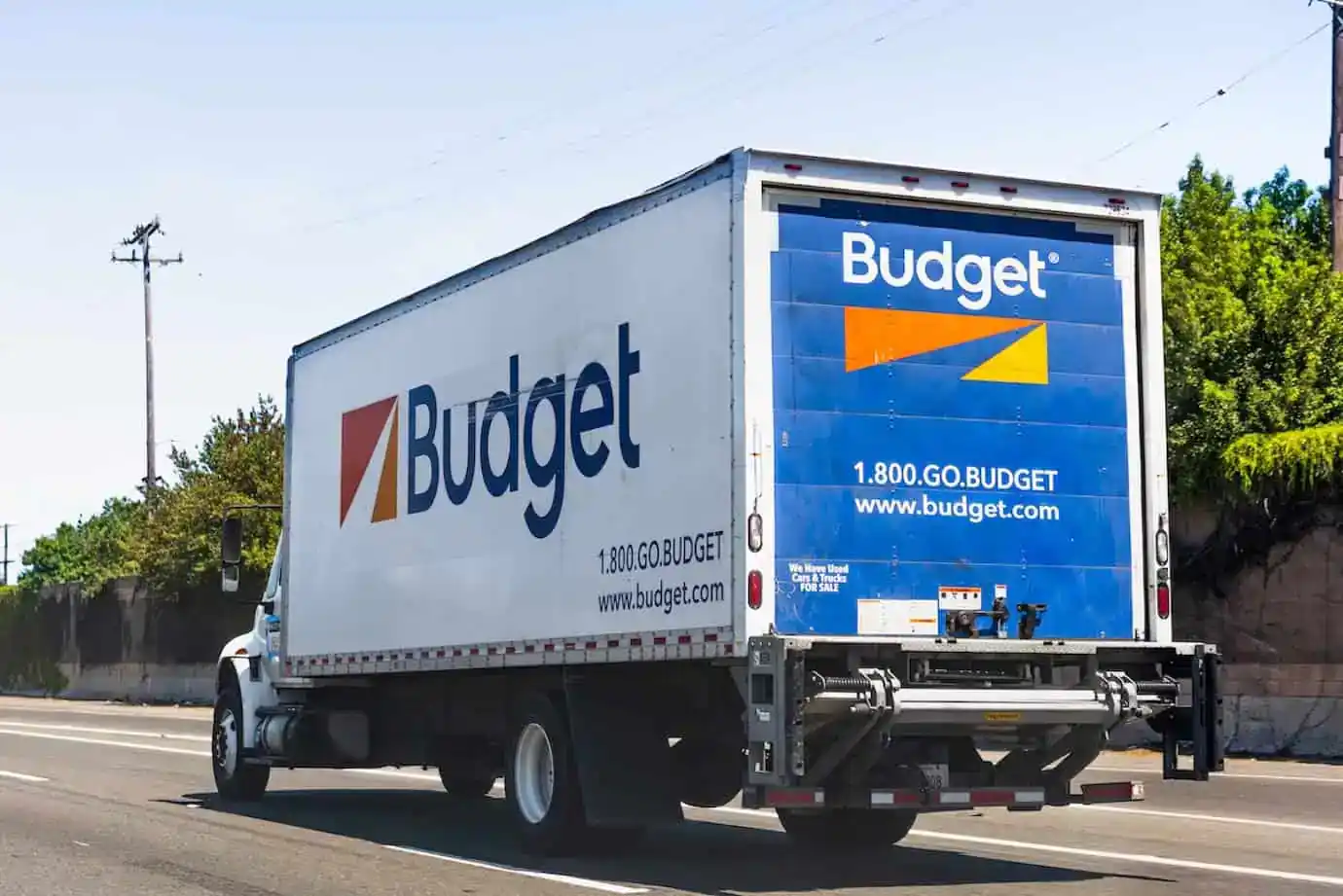
Reservation process
Budget’s checkout is faster. Our tester reached a final quote in about six screens, and some quotes auto-applied a discount online. However, we did see some quirks: a mid-size city quote forced a two-day rental, and one long-distance search threw an error that required a restart.
Truck quality and reliability
Fleet options are simpler, but trucks in our tests were newer and well-maintained. Availability is also strongest in metro areas. One one-way booking in a mid-size market did not complete, which might be due to Budget’s smaller footprint, and they simply didn’t have a return center in our scenario.
Customer service quality
Counters are usually at Budget or Avis car rental locations. We liked the straightforward pricing display, but the taxes and fees line item did not always add up cleanly to its subtotal, which can confuse renters.
Refueling and return
Budget has the same fuel-to-fuel policy as U-Haul. Keep in mind that returns at airport-area sites can involve a short shuttle or shared counter lines, so you should plan a little buffer time if you are returning during peak hours. To learn more about booking Budget for your move, check out our full guide.
Budget vs U-Haul: Which Is Better for Your Move?
If you are still on the fence, here is how to decide based on your specific situation.
Budget Is Usually Better If:
- You want lower base pricing: Especially for long-distance moves, Budget is often the wallet-friendly choice.
- You’re flexible on pickup location: Since they have fewer branches, you might need to drive a bit farther to get your truck.
- You’re moving long-distance: The savings on one-way trips can be significant.
U-Haul Is Usually Better If:
- You need local availability: If you want to pick up a truck just down the street, U-Haul is your best bet.
- You want more truck size options: From cargo vans for studio apartments to 26′ trucks for big homes, they have it all.
- You’re booking last-minute: Their massive fleet means they are more likely to have a truck ready today.
Are There Alternatives to Budget and U-Haul?
Absolutely. If neither of these fits your needs, consider:
- Penske: A premium option known for newer trucks and reliable reservations. You can read our full Penske review to learn more, or see how they stack up head-to-head in our Penske vs. U-Haul comparison.
- PODS: If you don’t want to drive, portable containers are a flexible alternative.
Final Verdict: Budget vs U-Haul
There is no single best rental company. U-Haul is the king of convenience, making it perfect for local moves and odd jobs. Budget lives up to its name, often providing the most affordable option for long hauls.
But no matter which truck you choose, you don’t have to do the heavy lifting yourself. A labor-only move—where you rent the truck and hire pros to load it—is a smart way to save money without breaking your back. You can compare rated and reviewed movers on HireAHelper to find the perfect crew for your moving day.
Frequently Asked Questions
Can you hire movers with Budget or U-Haul?
Yes! You can rent the truck from them and hire independent movers from a marketplace like HireAHelper to load and unload your belongings. This is often much cheaper than a full-service moving company.
Is Budget cheaper than U-Haul?
For long-distance moves, Budget is often cheaper. For local moves, U-Haul typically has lower daily rates, but mileage fees can even things out.
Does U-Haul or Budget charge per mile?
Both charge per mile for local moves. For one-way long-distance moves, both companies typically include a set mileage allowance in the flat rate.
Which has better truck availability?
U-Haul has significantly better availability due to its massive network of over 24,000 locations.
Are Budget trucks reliable?
Generally, yes. While they may not always be the newest fleet on the road (Penske usually wins that category), Budget trucks are maintained for safety and reliability.