

Figuring out how to move a piano is much more of a challenge than a loveseat or couch. They’re awkward, back-breaking, and definitely not something you want to muscle through without a plan. Even a small upright piano can weigh up to 800 pounds!
For something so heavy, it might surprise you to learn that they’re also delicate. Whether it’s a grand piano or an upright, move it without the right protection and it can crack, warp, or go out of tune.
That might sound intimidating, but there’s no need to worry — moving a piano is completely doable. We’ll explain exactly how to move a piano yourself or with the help of movers, and you’ll learn what equipment you’ll need, how to prepare the instrument, and how to handle it safely.
What to Consider Before Moving a Piano
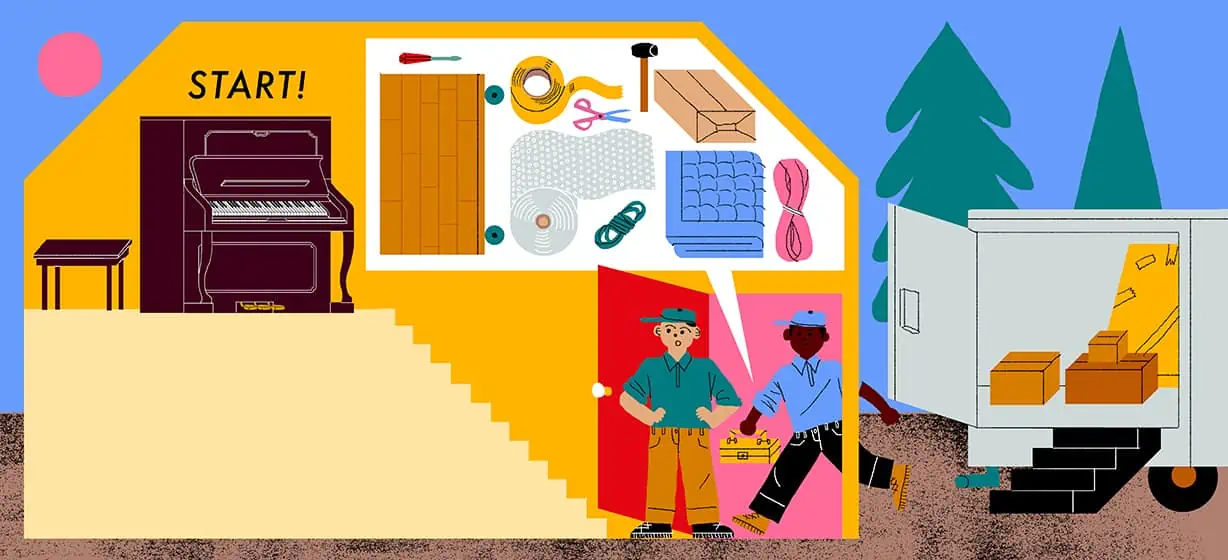
A little bit of planning can make moving a piano as smooth as your favorite jazz solo. From measuring doorways to making sure you have the right equipment, a little preparation can prevent big headaches on moving day. Start by making sure you can answer these key questions.
- Do you need to move the piano? If you don’t play the piano often, it might not be worth moving. You should look into donating or selling it in this instance.
- Do you have space for the piano? Baby grand and concert grand pianos are very large, so it’s important to make sure you have room in your new home.
- Does your new home have safe conditions for a piano? Pianos need a room with carefully regulated temperature and humidity.
- Can you physically move the piano? Measure the hallways, corners, and doors in your current and new home to ensure that the piano will fit.
- Should you hire a professional mover? Because pianos are so finely built, they can be challenging to move safely. Consider working with a professional piano moving service.
What Makes Moving a Piano So Challenging?
Pianos are challenging to move because of their weight and size. How much does a piano weigh? Some models top out at 1,200 pounds.
Although they’re heavy, pianos are very fragile. Inside are thousands of tiny parts, including strings and hammers. Many of the wood and felt components are sensitive to changes in temperature or humidity, swelling and shrinking as the environment changes, which can damage your piano or throw it off-tune.
That’s not all — you’ll need to select the correct moving process for the piano type. Moving a grand piano is much different than moving an upright piano.
Equipment You’ll Need to Move a Piano
The right equipment is essential for moving a piano safely. To start, you’ll need a moving truck with a lift gate and a ramp to roll the piano. You’ll also need to stock up on moving blankets and straps to secure and protect the piano in transit. In addition, it’s a good idea to have gloves to protect your hands and improve your grip.
“Don’t wait until your piano is on the dolly to think about the path to the truck. Scout it out in advance to avoid getting stuck, and make sure there’s nothing you can trip over or knock into.”
The equipment you need depends on whether you’re figuring out how to move a baby grand piano or an upright piano. For a grand piano, you’ll need a piano skid board and a dolly with heavy-duty wheels. The padded board supports the long side of the piano, providing a more secure way to rest it on the dolly.
If you’re learning how to move an upright piano, the equipment selection is a little more flexible. You can typically use a 4-wheeled dolly or hand truck. Either way, with the right equipment at hand, moving a piano doesn’t need to be risky for you or your musical instrument.
How to Move a Piano
How you move a piano varies based on the type of instrument. Moving a concert grand piano is a lot different than moving a compact upright. One is shaped like a box and ships as-is, while the other is oddly shaped, very large, and needs disassembly just to get it out the door. Here are the major differences, and how to tackle them so your piano is safe during the move, no matter the type.
Shape and size
An upright piano is basically a box. It’s tall and very heavy at the back, but it will fit through most doorways and hallways, even if they’re narrow.
Grand pianos, on the other hand, are wide. They have large legs that can get in the way and a lid, which means they’re wide from every angle. Taking off the legs and removing the pedal assembly makes a much more compact package, but you’ll need to be cautious about narrow spaces, since these instruments don’t turn corners well.
Weight distribution

Pay attention to where the weight is in your piano. You want to pack it heavy side down when moving. So, with an upright, you lean the back of the instrument against the dolly or hand truck.
Grand pianos are heavier toward the keyboard, so that’s where you want most of your crew when maneuvering it onto the piano board.
Disassembly
When moving a piano, some disassembly is usually required. Sometimes, if you have enough helping hands and your hallways and doorways are wide enough, you can leave an upright piano in one piece for transport.
A grand piano of any size is different. You’ll usually need to take off the legs, lyre, and pedals, at a minimum. You may also need to pop the lid off and take out the music rack.
Moving equipment
Some models weigh in at 500 pounds or less, so with a dolly and straps, 4 people can usually handle the load, even if they don’t spend a lot of time at the gym.
Most people have a baby grand, not a full-size grand piano, at home. These are often lighter than uprights, so you might only need 3 people to maneuver it, along with a special piano skid board, a sturdy dolly, blankets, and heavy-duty straps.
Stairs and tight turns
You must keep an upright piano upright while moving it, which can add a level of difficulty when navigating turns and stairs, but it’s usually doable with enough elbow grease.
Stairs and turns are much harder with a grand piano, because the long case doesn’t fit easily around narrow corners. You may have to settle for a first-floor installation if there isn’t enough clearance.
Upright vs. Grand piano moving differences:
| Upright piano | Grand piano | |
| Shape and size | Tall and vertical with a compact frame | Wide and horizontal with protruding legs and a lid |
| Weight distribution | Weight is located toward the back | Distributed weight, but the keyboard side is heavier |
| Disassembly | Little to no disassembly | Remove legs, lyre, and pedals |
| Moving equipment | Dolly or hand truck, blankets, straps, and 2-4 movers | Piano skid board, dolly, blankets, straps, and 3 or more movers |
| Stairs and tight turns | Challenging but possible | Very difficult due to the piano’s size |
How to Move an Upright Piano
Follow these steps to move an upright piano:
- Use plastic stretch wrap to close the lid and protect the pedals, and secure the wrap with tape.
- Wrap the piano in moving blankets, and hold them in place with straps or tape.
- Tip the piano carefully (heaviest part down) onto a dolly or hand truck.
- Roll the piano out of the house and up the ramp of your moving truck.
- Lift the piano up and down stairs with multiple people, if necessary.
- Tie down the piano inside the truck using ratchet straps.
- Slip moving pads or blankets around the piano to prevent damage.
Even with careful handling, you risk cracks and tuning issues due to impacts or environmental changes. If your instrument is valuable, think about hiring professional single-item movers. They can provide a safe, controlled process and get your piano to your new home in one piece easily.
How to Move a Baby Grand or Grand Piano
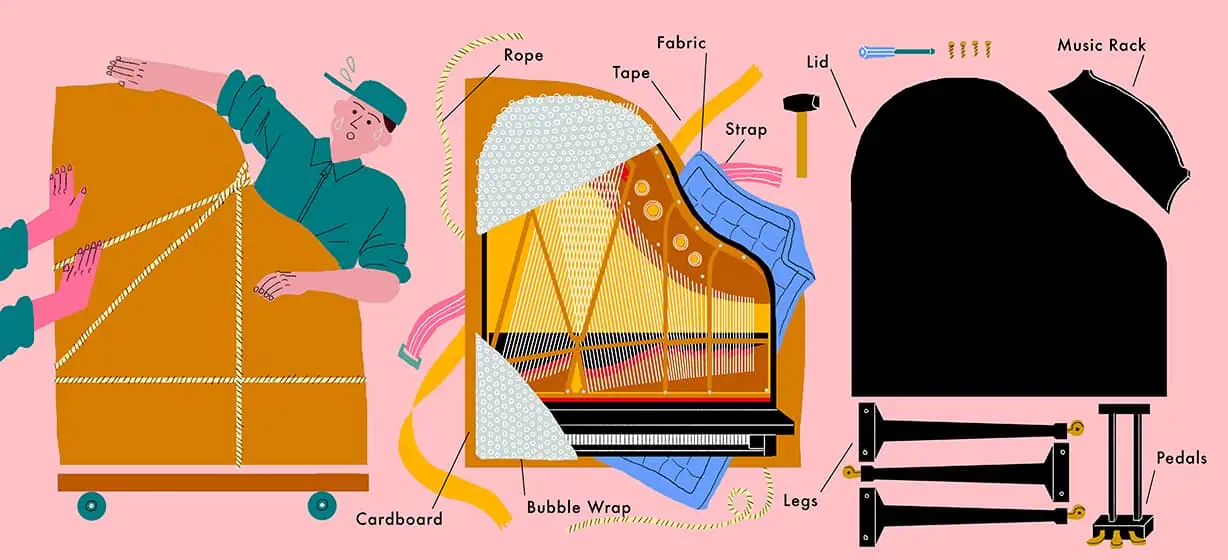
Follow these steps to move a baby grand or grand piano:
- Wrap a thin moving blanket around the keyboard lid, and close it.
- Cover the top of the piano with a moving pad, and secure the pad and lid with straps or large rubber bands.
- Remove the front piano leg that’s next to the hinge of the piano lid.
- With the help of multiple people, tilt the case onto the piano board.
- Remove the remaining 2 legs, the lyre, and the pedals.
- Wrap the piano case in moving pads, and secure gently with straps.
- Fasten the case to the piano board with the manufacturer’s recommended straps.
- Lift the piano board onto a dolly, and ensure that the weight is evenly distributed.
- Roll the case into your moving truck, and anchor it with straps.
Moving a baby grand or grand piano is challenging — the instruments are extremely heavy and famously fragile. With replacement costs anywhere from $3,000 to more than $80,000, a misstep can be very expensive. For these pianos, a professional mover is often the safest way to protect your investment.
DIY Piano Moving vs. Professional Movers
Picking between a DIY and a professional move isn’t easy. You want to keep costs down, but you also want your instrument to arrive in one piece.
Moving a piano yourself means you only need to pay for equipment and a moving truck, and maybe a few beers and pizza for your friends. But relying on friends means you need to work around their schedules, and the buck stops with you if something goes wrong.
“Pay attention to where the weight is in your piano. You want to pack it heavy side down when moving.”
If a person loses their grip, 800 pounds of falling wood and metal could injure someone or damage the building. For many people, the safety and liability issues alone make an insured moving service the better choice.
Whichever option you choose, there’s a safe way to get the job done. If you DIY the process, get a solid crew and equipment to make things smooth on moving day. If you opt for the pros, make it as easy as possible on yourself and use HireAHelper to compare quotes from experienced, vetted local providers, read reviews, book online — all in one place.
How Much Does It Cost to Move a Piano?
The cost of moving a piano depends on the distance, the type of piano, and the details of the move.
| Upright piano | Baby grand piano | Grand piano | |
| Local moves | $150-$300 | $150-$600 | $350-$650 |
| Long-distance transport | $500-$800 | $1,000-$2,000+ | $1,000-$2,500+ |
How much you pay to move a piano also depends on the starting and ending locations. Movers will charge more if they have to lift the piano up or down stairs, for example. The same goes for challenging hallways or tight elevators.
How to Get Rid of a Piano
Sometimes, the challenge and cost of moving a piano just isn’t worth it. If your piano is old, or if you simply don’t have space for it, find another home for it instead.
Try these strategies for getting rid of your piano:
- Selling: If you can still tune and play your piano, consider selling it on Facebook Marketplace or Craigslist. You can also ask local music stores if they’re interested.
- Donation: Donating your piano is a great way to ensure that it has a long life. Organizations like the Beethoven Foundation and Pianos for Education accept donated pianos. You can also check with local churches, schools, or community theater groups to see if they need a new instrument.
- Recycling or repurposing: If you have a damaged piano, you might be able to find another use for it. Some people convert old pianos into desks or turn the inner harp into wall art.
- Junk removal service: When all else fails, these services can haul away your old piano and dispose of it safely. Don’t just leave it on the curb — schedule a pickup through a program like 1-800-GOT-JUNK? Or Loadup.
- Professional piano movers: Some piano movers offer specialized disposal services. They may recycle or repurpose components, which helps reduce your environmental impact.
Getting rid of a piano takes time. Don’t scramble at the last minute or the night before you move. Start looking for solutions early.
Tips for Safe Piano Moving
Planning to move a piano yourself? A little prep goes a long way. Protect yourself and your helpers with these tips for safe piano moving:
- Plan your route: Don’t wait until your piano is on the dolly to think about the path to the truck. Scout it out in advance to avoid getting stuck, and make sure there’s nothing you can trip over or knock into.
- Designate a leader: Assign 1 person to call out instructions when you’re moving the piano to prevent confusion.
- Pad your truck bed: The vibrations of a moving truck can be dangerous for the piano. Create a soft, absorbent surface using moving pads.
- Pause before tackling stairs: Lifting pianos up or down stairs can be dangerous. Before you start, stop to discuss the plan with all of your helpers, so everyone’s on the same page.
- Break out your hygrometer: Use a hygrometer to make sure the humidity level in your moving truck is safe for your piano.
Pianos are heavy, which means the moving process can be dangerous. When in doubt, use extreme caution or consider opting for a professional service instead.
Frequently asked questions
Can I move a piano myself?
You can move a piano yourself with help and the right equipment, and provided it’s on the smaller side. For difficult moves or expensive instruments, however, it’s safer to hire professionals.
How many people does it take to move a piano?
You’ll need about 2 to 4 strong friends to move an upright piano and at least 3 to move a grand piano. If you need to navigate stairs, plan for even more helpers.
Will movers move pianos upstairs?
Movers will move pianos upstairs, but it will probably cost more. The higher price tag covers extra moving labor or compensates workers for the heavy lifting.
Do pianos need tuning after moving?
Yes, pianos almost always need a tuning after a move. The physical jarring and environmental changes often knock the piano out of tune.
Can regular movers handle pianos?
Regular movers can often handle pianos. However, if the piano is very large or valuable, think about hiring a piano moving service. These professionals have the specialized knowledge and experience to protect your piano, and your insurance may require professional movers.