Penske Vs. U-Haul Comparison 2026

Author:

Publish Date:

Last Modified Date:

Category: Costs & Money Saving, Moving Trucks

Tags: Tags: , , , , , , , , , , , , , , , , , , , , , , , , , , , ,

Overall, we recommend U-Haul for most DIY movers because it offers significantly more locations, better local move availability, and lower overall prices. However, Penske tends to have a newer fleet and better long-distance prices, which may ultimately make it the better choice for your move.

Penske and U-Haul are two of the most well-known names in moving truck rentals, and while they may seem very similar at first glance, their differences can affect both your final bill and your moving experience. Since renting a moving truck is one of the easiest ways to save money on your move, making the right choice means a lot for your budget.

In this updated 2026 comparison, we look at U-Haul vs. Penske and how they stack up in the areas that matter most: truck size, availability, pricing, coverage, and discounts.

Here is the quick, at-a-glance breakdown of who should choose which truck:

  • Who should choose U-Haul: if you are moving locally, moving a small apartment, on a strict budget, or need a pickup truck or cargo van.
  • Who should choose Penske: if you are moving long-distance and want a newer truck, you are worried about breakdowns, or you have a strict schedule and cannot risk a reservation cancellation.

Table of Contents


Penske vs. U-Haul at a Glance

Both Penske and U-Haul are solid choices for DIY movers, but they shine in different ways. Use this table to quickly see which company comes out ahead depending on the move type and situation.

Factor Winner Details
Which is better overall U-Haul U-Haul is the better all-around option for most people because it has more locations and availability, plus lower overall prices.
Which is cheaper U-Haul U-Haul’s base rates are usually lower, especially for short, local moves.
Cost per mile Both Typically $0.59 – $0.99 per mile on top of a base rental rate.
Top 3 Pros N/A U-Haul:

  • Widest availability nationwide
  • Lower base prices
  • Flexible short-term rentals

Penske:

  • Newer, well-maintained fleet
  • Unlimited mileage on many one-way rentals
  • Strong customer service reputation
Top 3 Cons N/A U-Haul:

  • Older trucks
  • Per-mile fees can add up fast
  • Prices vary widely by location

Penske:

  • Higher base rates
  • Fewer pickup and drop-off locations
  • Limited availability for smaller moves

Best Choice by Move Type

Depending on where you are going and what you are moving, the “best” truck rental company actually changes. Here is a quick breakdown to help you select the right company for your unique move.

Move Type Best Choice Why?
Local move U-Haul Their lower base rates and dense network of locations usually make them the cheapest and most convenient option for in-town moves.
Long-distance move Penske While U-Haul is cheaper, Penske’s newer fleet reduces the risk of breakdowns on the highway, and they often include unlimited mileage.
One-way move U-Haul U-Haul has far more drop-off locations, making it easier to return the truck near your new home without driving miles out of your way.
Multi-stop moves U-Haul With so many locations, U-Haul is generally more flexible if you need to stop at a storage unit or a friend’s house in a different town along the way.
Small apartment moves U-Haul U-Haul offers pickup trucks and cargo vans, which Penske does not offer for residential moves. These are perfect for studios and small apartments.
Schedule-sensitive moves Penske Penske is known for higher reservation reliability. If you absolutely need a truck at 8 am on Saturday, Penske is the safer bet.

Penske vs. U-Haul: Rental Truck Sizes

When it comes to flexibility, U-Haul offers a wider variety of vehicle sizes, especially at the smaller end for studio apartments or dorm moves. However, Penske wins points for reliability here. If you really need a particular truck size, Penske is more likely to have it in stock for you on moving day, despite not having the same range of sizes as U-Haul.

We reviewed each company’s website and made calls to local rental centers to confirm loading space, mileage, and towing capabilities.

Truck Sizes and Availability

Rental Sizes Penske Truck Sizes U-Haul Truck Sizes
Pickup Truck ✅ Pickup Truck, 19 mpg
Cargo Van (Small studio apt) ✅ Cargo Van, 18 mpg
Smallest Box Truck (Studio or 1 BR apt) ✅ 12-ft Truck, 10–12 mpg ✅ 10-ft Truck, 12 mpg
Mid-range Box Truck (1–2 BR home) ✅ 16-ft Truck, 10–12 mpg ✅ 15-ft Truck, 10 mpg
Large Box Truck (2–3 BR home) ✅ 22-ft Truck, 12 mpg (Diesel) ✅ 20-ft Truck, 10 mpg
Largest Box Truck (3–5 BR home) ✅ 26-ft Truck, 12 mpg (Diesel) ✅ 26-ft Truck, 10 mpg

Who Wins: U-Haul

U-Haul has long offered pickup trucks (not an option at Penske). Now that Penske has phased out cargo vans from their residential lineup, U-Haul is the clear winner in the rental truck size contest. If you need a small vehicle for a quick move, U-Haul is your only real option here.

Penske vs. U-Haul: Services and Add-Ons

When choosing a moving truck, it helps to look beyond just the size or price. The extra stuff, like whether you can rent a dolly, get packing supplies, or add storage, can make your moving day a lot easier.

Penske and U-Haul both cover the basics, including truck rentals, coverage options, and roadside assistance. The main difference is how much each one includes from the start. U-Haul has more services built in, while Penske works with partners to fill in those gaps.

Services and Add-Ons Comparison

Service Penske U-Haul
Rental Trucks
Coverage and Roadside Assistance
Trailer Hitches
Tow Dollies & Car Carriers
International Moving ✅ (with U-Box®)
Self Storage ✅ (through partners)
Portable Storage Containers ✅ (U-Box®)
Moving Labor ✅ (Simple Moving Labor) ✅ (Moving Help®)
Moving Supplies
Propane Sales

Who Wins: U-Haul

U-Haul tends to be easier for people who just want to rent a truck and get going without hunting for extra services. You can usually find what you need in one place, from boxes to storage. Penske does many of the same things, but you will sometimes have to go through partners or make separate arrangements. That is not a dealbreaker for most people, but keep in mind it adds a few extra steps to the process.

Penske vs. U-Haul: Coverage Options

When you rent a moving truck, coverage protects you if something goes wrong, such as damage to the truck or your belongings due to an accident. Both Penske and U-Haul offer different levels of protection, from basic equipment coverage to more complete plans that include personal injury and cargo damage.


“Keep in mind that customer satisfaction can be wildly different depending on which location you rent from. A Penske or U-Haul in one city might be great, while the same company two states over could have issues.”


If you are only driving across town, the minimum coverage might be fine. For a long trip or a one-way move, though, it is worth paying a little more for broader protection. Accidents, weather, or damage during loading can quickly get expensive.

Coverage Reality Check: Does My Auto Insurance Cover Me?

Before you decline coverage at the counter, you need to know this: most personal auto insurance policies do NOT cover rental trucks.

Moving trucks often exceed the weight limits of standard passenger vehicle policies. Before you rent, call your insurance provider and ask two specific questions:

  1. Does my policy cover a commercial rental truck over 10,000 lbs Gross Vehicle Weight (GVW?)
  2. Does my policy cover damage to the cargo inside the truck? (Please note that it almost never does.)

Penske Coverage Options

Plan What It Covers
Basic Damage to Penske equipment only
Standard Equipment damage, third-party damage, and injury claims
Value All Standard coverage plus cargo accident damage
Plus Everything above, plus personal accident and injury protection

U-Haul Coverage Options

Plan What It Covers
Safemove® Damage waiver, cargo protection, and basic medical/life coverage
Safemove Plus® All Safemove protection plus supplemental liability coverage, and no deductible for accidental damage
Safetow® Protection for towed vehicles and cargo
Safetrip® Supplemental roadside protection
Safestor® Coverage for storage with U-Haul or U-Box®
Safehaul® Coverage for shipped items via U-Box®

Who Wins: U-Haul

U-Haul wins here because it offers more types of protection and more flexibility to tailor coverage to your move. Penske’s plans are simple, but U-Haul gives customers more control over what they pay for and how much they are protected.


Penske vs. U-Haul: Cost

Pricing is one of the biggest deciding factors when you are choosing between Penske and U-Haul. Both companies have updated their fees and mileage rates for 2026, so we pulled new data from our most recent truck rental cost analysis to see how they compare for local, regional, and long-distance moves.

For this comparison, we looked at the median prices for a mid-size truck (around 15–16 feet) across large, mid-size, and small U.S. cities. These quotes include base rental costs and standard fees, but not optional insurance or add-ons.

Median 2026 Truck Rental Costs

Move Distance U-Haul Penske
<50 miles (Local) $139 $215
50-250 miles (Regional) $168 $256
Long-distance (Cross-country) $3,249 $3,718

Source: HireAHelper Rental Truck Cost Database, 2026

At a glance: U-Haul remains the more affordable choice across all move types, especially for short and regional trips. Penske’s prices are higher, but some one-way rentals include unlimited mileage, which can make them more predictable for longer trips.

How We Calculate Median Cost

We want to make sure you are seeing real numbers, not guesses. To get this data, we utilized our proprietary Rental Truck Cost Calculator. We analyzed thousands of quotes under the assumption of a standard 2-bedroom move booked 2 weeks in advance.

By comparing apples-to-apples quotes for the same dates and distances, we can show you exactly which company offers the better value on average. You can replicate this for your own move by getting quotes for the same size truck on the same day from both providers.

How Mileage and Fees Work

Both companies charge differently depending on the move type.

  • Local moves: U-Haul pricing includes a daily base rate plus a per-mile fee (usually around $0.99 to $1.39 per mile, depending on the location). Penske’s local rates include unlimited mileage in some markets but often come with higher daily rates.
  • Long-distance moves: U-Haul prices are quoted as flat one-way rates that include mileage and travel days. Penske follows a similar structure, often bundling unlimited mileage into its long-distance pricing.

Hidden Costs to Watch For

The price on the side of the truck is just the baseline, and rarely the actual price you pay. There are typically extra costs baked in, and here are the ones you should budget for:

  • Environmental fees: A small mandatory tax added to almost every rental contract.
  • Mileage overages: If you exceed the allowed miles on a one-way trip, the per-mile fee can be steep.
  • Extra days: Keeping the truck beyond the booked time will result in daily penalty fees.
  • Equipment rentals: Dollies, blankets, and straps all cost extra.
  • Fuel: You must return the truck with the same fuel level as when you left, or pay a premium refueling fee.
  • Coverage add-ons: As mentioned above, these are optional but highly recommended.

Real-World Price Comparison
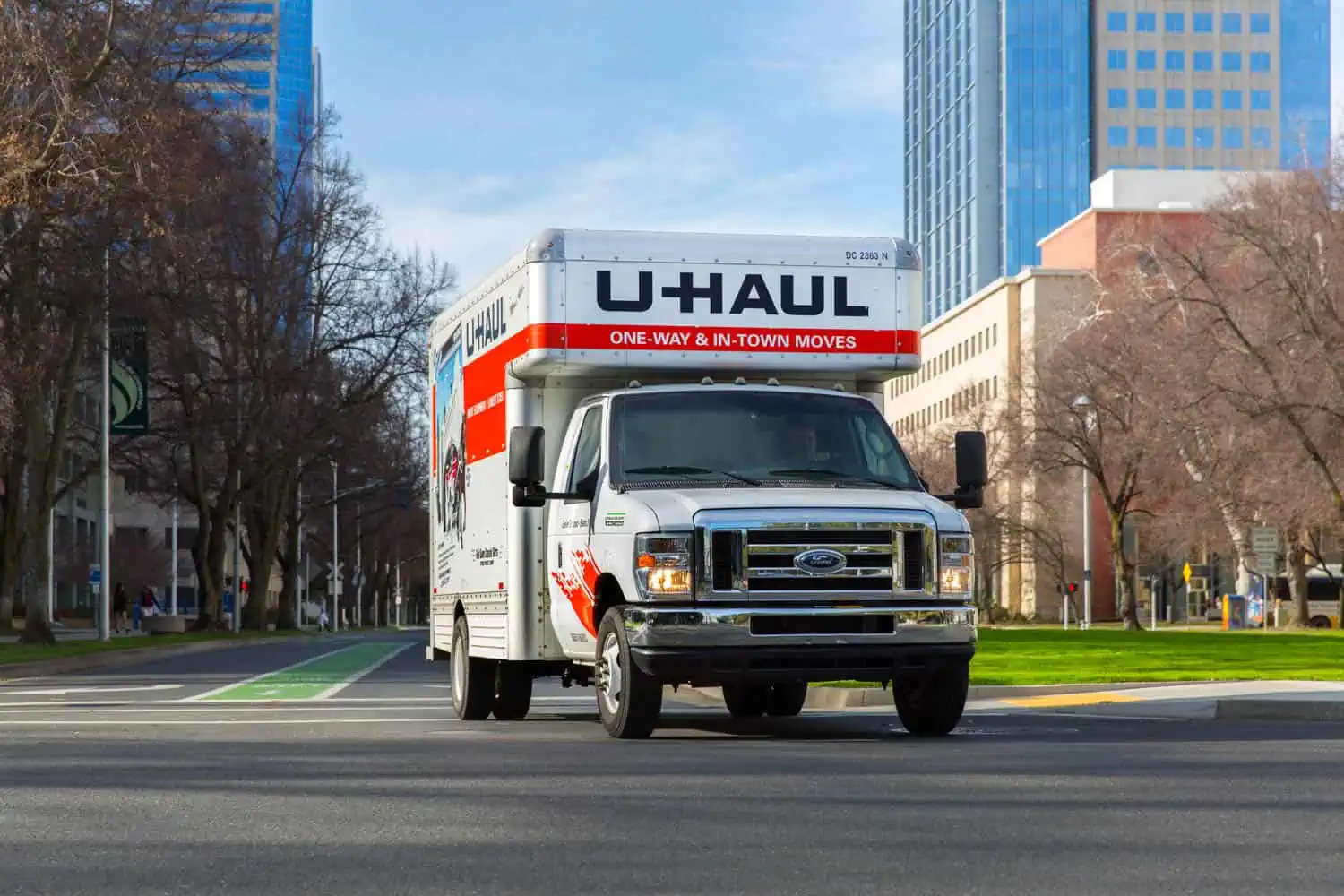
To see how this looks in practice, our team ran specific scenarios to compare the final receipts. We set out to answer two specific questions with our research:

1. Is Penske Cheaper Than U-Haul for a Local Move?

No, Penske is generally not cheaper than U-Haul for local moves. Even before you hit the road, renting from U-Haul costs roughly half as much as renting from Penske for a local move of similar size. Both charge similar mileage rates, but U-Haul’s lower base and insurance costs make it the more affordable option for short trips.

2. Is Penske Cheaper Than U-Haul for Long Distance Moves?

No, Penske is typically not cheaper than U-Haul for most long-distance moves either. While Penske trucks get slightly better gas mileage (thanks to those diesel engines) and often include unlimited miles, the higher base rates usually cancel out those advantages. In our example route from Tampa to Los Angeles, Penske’s total price came in about $1,000 higher than U-Haul’s.

Who Wins: It Depends

For most moves, U-Haul comes out ahead on pure dollar value. Its base prices are consistently lower, and even though you will pay per mile on local trips, the total tends to be cheaper.

However, Penske can win in specific scenarios. If you are planning a very long drive where fuel efficiency is critical, or if you simply need the peace of mind that comes with unlimited mileage and a guaranteed reservation, the extra cost might be worth it.


Penske vs. U-Haul: Discounts and Promotions

Everyone loves saving money, but these two companies approach discounts very differently. Penske typically offers percentage-off discounts that lower your direct rental price. U-Haul generally avoids standard discounts in favor of “value-add” perks, like free storage or box exchange programs.

Does Penske offer better discounts than U-Haul?

Generally, yes. Penske offers clear, upfront price reductions for specific groups. Here are a few of their common discounts:

  • AAA Members: You can usually save 12% or more on your rental. (Note: You cannot use AAA discounts at U-Haul.)
  • Military & Veterans: Active duty and veterans can get up to 15% off.
  • Students: College students often qualify for 10% off on local or one-way moves.

Does U-Haul offer military or student discounts?

Technically, no. U-Haul does not offer a standard percentage off for military members or students on truck rentals. However, they occasionally run specific promotions or bundle deals, so it never hurts to ask the local manager.

Important Note: Why didn’t my discount apply?

If you entered a code but did not see the price drop, it is usually because you need to verify your status at the counter. For example, you will likely need to show your AAA card, military ID, or student ID at pickup to honor the rate. Also, discounts rarely stack; if you use a seasonal promo code, it might cancel out your AAA discount.

Who Wins: Penske

Penske wins this category easily. Their discounts go straight toward lowering what you pay for the truck, so you see the savings right away. U-Haul’s deals (like a free month of storage with a one-way rental) are nice perks, but they do not help your bottom line if you just need to move from A to B.


Penske vs. U-Haul: Ease of Booking

Both U-Haul and Penske let you reserve a truck from your phone or laptop, but the process itself is not quite the same. And while booking a truck online sounds simple, not every company’s website makes it feel that way. Here is how U-Haul and Penske’s processes measure up.

Booking Online with U-Haul

U-Haul’s site is easy to navigate, and the quote tool gives you plenty of options right away. You can enter your dates, choose your truck size, and see availability in your area in a minute or two. The site does try to upsell you (boxes, pads, towing gear), but at least you can see everything in one place before you check out.

Booking Online with Penske

Penske’s site feels cleaner and faster in general. You can get a clear quote in fewer steps and with less upselling. However, Penske’s availability tool is not quite as flexible as U-Haul’s; sometimes specific pickup locations are not confirmed until you speak to a representative.

Reservation Reliability (What Guarantees Really Mean)

One big question a lot of people who are moving with a truck have is: What happens if U-Haul doesn’t have my truck?

It is a nightmare scenario, but it happens. U-Haul operates on a high-volume model, meaning they book trucks tight back-to-back. If the person before you returns the truck late, your reservation might get bumped.

  • The U-Haul $50 Guarantee: If U-Haul cannot fill your reservation (meaning they don’t have the size, location, or time you agreed to), they will give you $50. While this is a nice gesture, $50 won’t help you move a houseful of furniture when your truck isn’t available.

But does Penske guarantee truck availability? The answer is no. However, Penske is generally much more conservative with their bookings. They are less likely to overbook their fleet, which means cancellations are rare. While no company is perfect, Penske has a reputation for holding your specific truck at the specific location you chose.


“Penske wins [in the discount] category easily. Their discounts go straight toward lowering what you pay for the truck, so you see the savings right away.”


Bottom line: If your schedule is flexible, U-Haul is fine. If you have a strict deadline (like a closing date, parking permits, or an elevator reservation), Penske is the safer bet.

Rental Requirements

Before you head to the counter, make sure you actually qualify to drive the truck. Here is everything you need in place before you can rent a moving truck.

How old do you have to be to rent a moving truck?

  • U-Haul: You must be 18 years old to rent a truck and 16 years old to rent a trailer.
  • Penske: You must be at least 18 years old to rent a truck.

Do I need a credit card?

  • Penske: Generally requires a credit card. If you use a debit card, they may place a significant authorization hold on your funds (sometimes hundreds of dollars) until you return the truck.
  • U-Haul: Usually more flexible. You can often reserve with a card but pay cash at the end, though a deposit will be required for cash payments.

Can I return the truck after hours?

Both companies usually allow after-hours drop-offs via a key drop box and mobile check-in. Just be careful: if you drop it off late or don’t check in properly, you could be liable for any damage found the next morning or charged for an extra day.

Who Wins: It’s a Tie!

Penske offers a smoother, more reliable reservation process. U-Haul offers lower age requirements for trailers and more flexible payment options. The winner here depends entirely on what you need.


Penske vs. U-Haul: Customer Satisfaction

We went to Consumer Affairs to find out more about the customer experience at Penske and U-Haul. While reviews are subjective, they paint a clear picture of how each company handles stress on moving day.

Recent Customer Reviews

U-Haul 5-Star Review: “It was a 1,700 mile move and the truck and equipment performed very well. We were able to return the equipment to the Cottonwood office where the person in charge was very knowledgeable and helpful. It was a positive experience.” – Robert C., Cottonwood, AZ (September 2025)

U-Haul 1-Star Review: “Rented a 15 foot truck for 3 hours. Vehicle had damage all around it including the safety equipment. Used mobile app to check in. That backfired because they ended up charging me for damage that had been previously done to this truck as well as the insurance. The team there was unwilling to resolve.” – Javier, U-Haul customer (October 2024)

Penske 5-Star Review: “Overall, loved working with Penske. Terrific customer service! Vehicle was fine. Tough to see out of passenger side mirror; had my son drive instead. Easy pick up, easy drop off!” – Jill M., San Marcos, CA (July 2025)

Penske 1-Star Review: “I rented from them in July and returned the truck on time. A week later, I was told the vehicle hadn’t been returned and was charged over $500. When I called, they changed their story and said it was for a missing key. Very frustrating experience.” – Twila H., Jacksonville, FL (October 2025)

Consumer Ratings

Criteria Penske U-Haul
Consumer Affairs Rating 3.8 / 5 2.6 / 5
Trustpilot Rating 3.4 / 5 2.1 / 5
5-Star Review Percentage 18% 10%
1-Star Review Percentage 56% 73%
Total Reviews (approx.) ~400 ~1,400

Who Wins: Penske

From what people are saying this year, Penske just feels more reliable. The trucks show up clean and ready to go, and most folks finish their move without a hassle. U-Haul is everywhere and cheaper, but too many people report problems getting the truck they booked or unexpected charges. Penske costs more, but you often get a higher level of service in return.

Your Experience May Vary by Location

Keep in mind that customer satisfaction can be wildly different depending on which location you rent from. A Penske or U-Haul in one city might be great, while the same company two states over could have issues. Before you book, take a few minutes to look up reviews for the specific pickup and drop-off locations you will be using.


Penske vs. U-Haul: Availability
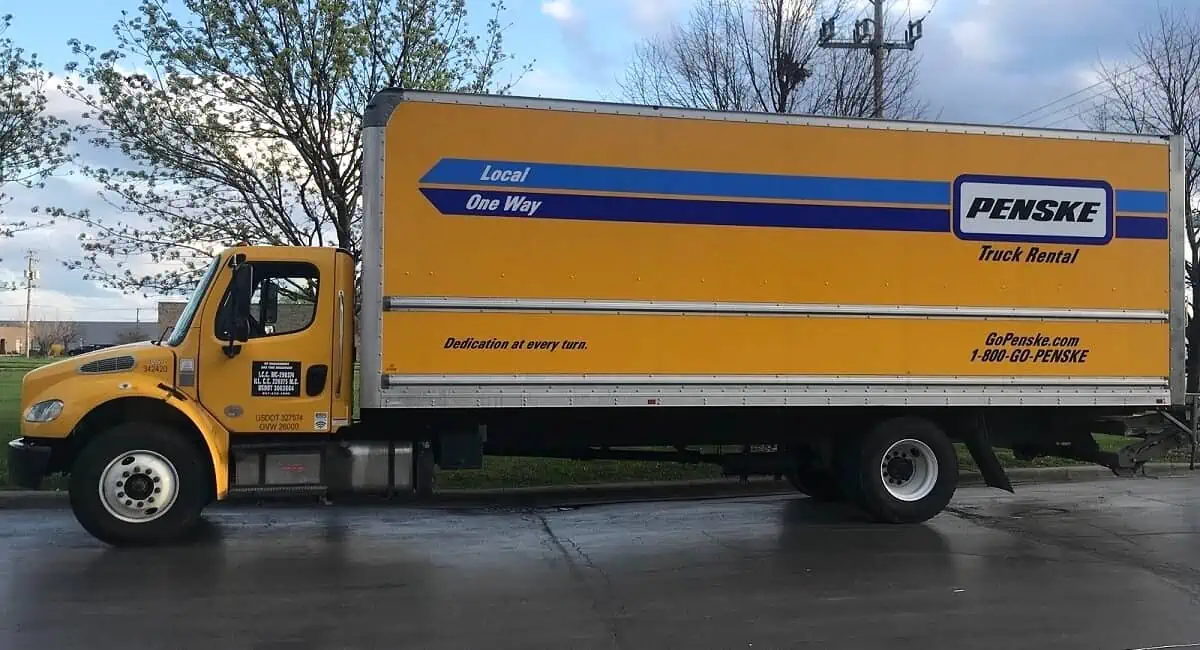
penske truck

Availability can make or break a move, especially if your schedule is tight. This is one area where U-Haul’s size really shines. With thousands of locations across the country, it is usually not hard to find a truck nearby. Many of their vehicles are stationed at small local businesses and gas stations, as well as at U-Haul centers, making same-day or last-minute rentals possible in most areas.

The one thing to keep in mind is that U-Haul’s massive inventory moves quickly. Because they are constantly “rebalancing” their fleet to meet demand, customers sometimes report being reassigned to a different pickup site or truck size when demand is high.

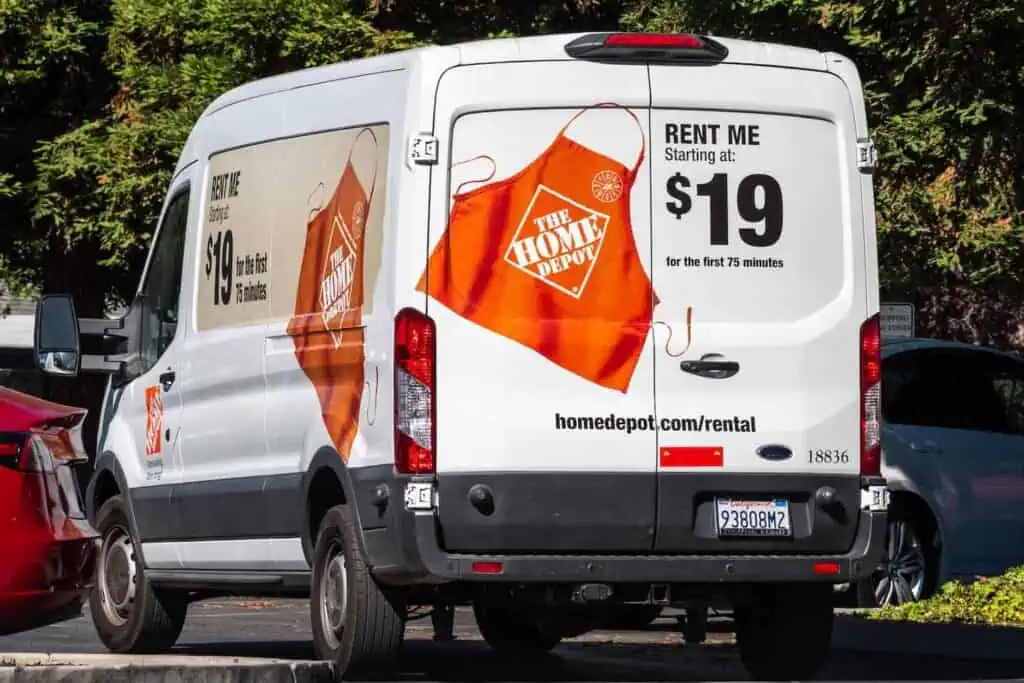
Penske’s network is smaller but often more predictable. You will find most of their trucks at Home Depot stores or official Penske branches. There may not be as many locations to choose from, but reservations are typically more reliable. When you book a truck with Penske, it is far more likely to be waiting for you at the exact time and place you scheduled.

Who Wins: U-Haul

U-Haul offers broader access, making it easier to find something close and available right away. Penske’s biggest advantage is dependability because they have a smoother process overall. If convenience is your top concern, U-Haul will do the job. If reliability is what matters most, Penske is the safer choice.


So, Is Penske a Good U-Haul Alternative?

Renting a truck remains one of the most affordable ways to move, and both U-Haul and Penske make that possible. The key difference comes down to what kind of value you are looking for.

  • Choose U-Haul if: You are moving locally, have a smaller apartment, or need the lowest possible price. It is the better all-around option for most people because of its unmatched availability and lower base rates.
  • Choose Penske if: You are moving long-distance, need a guaranteed reservation for a tight schedule, or simply want a newer, more comfortable truck.

U-Haul wins on price. Penske wins on reliability. The right choice depends on what matters more for your move: saving the most money or knowing you will have a well-maintained truck waiting when you arrive.


A Look at Other U-Haul Alternatives

U-Haul may be one of the better-known options out there, but it isn’t the only one. If you can’t find what you want at U-Haul (or Penske), check out some of these other U-Haul alternatives.

Budget Truck Rental

  • Unlimited mileage for one-way rentals
  • Affordable rates
  • Discounts available
  • Limited services

Enterprise Truck Rental

  • 12+ different truck/van sizes
  • Moving supplies add-ons
  • One-way rentals aren’t always available

Home Depot Truck Rental

  • Unlimited mileage options
  • Low-cost hourly rentals
  • Convenient locations
  • Packing/moving supplies available in stores
  • One-way rentals aren’t always available

Why You Can Trust HireAHelper

Everything we write is based on real data and research we do ourselves. We do not just guess or estimate prices. Instead, we built a proprietary Rental Truck Cost Calculator to analyze thousands of real-time quotes.

Our methodology assumes a standard 2-bedroom move booked two weeks in advance to ensure apples-to-apples comparisons. By stripping away the marketing fluff and looking at the final receipts, we can give you a clear, neutral look at which company actually offers the better value.

HireAHelper has helped more than a million people move. We have seen what works and what doesn’t, and we use that experience to make moving easier for everyone who reads our guides.


Penske vs. U-Haul: Frequently Asked Questions

Why is Penske better than U-Haul?

Penske is often considered “better” in terms of vehicle quality and reliability. Their fleet is newer, meaning you are less likely to encounter a breakdown, and their reservation system is less prone to last-minute cancellations.

Which trucks are easier to drive?

Penske trucks are generally cited as smoother rides. Because they are newer and well-maintained, the steering, brakes, and suspension often feel tighter than older U-Haul models. However, both companies offer trucks with automatic transmissions and power steering.

Why is Penske so expensive?

Penske’s higher rates reflect the cost of maintaining a premium fleet. You are paying for a newer truck, better maintenance, and a higher likelihood of reservation guarantees.

Does Penske really offer unlimited mileage?

Yes, most of the time, Penske gives you unlimited miles on one-way trips. U-Haul usually sets a specific mileage limit you have to stick to, so Penske is a great choice if you want to take the scenic route without stressing about extra fees.

Does my car insurance cover a rental truck?

Almost never. Most personal auto policies specifically exclude vehicles over a certain weight (usually 9,000–10,000 lbs). Always check with your provider, but expect to need the rental company’s coverage.

Why did my U-Haul quote change after booking?

U-Haul reservations are sometimes “preferences” rather than guarantees. If inventory shifts, your pickup location, equipment size, or even the rate could be adjusted based on what is actually available on moving day.

Why is my final U-Haul bill higher than the estimate?

The most common reasons usually come down to the gas and the miles. If you drove a little further than you planned or forgot to top off the tank before returning the truck, those fees can pile up fast. You will also see a small environmental fee on the receipt, which is standard for most rentals.

Is Penske’s higher base price actually cheaper in the end?

It can be, but usually only for very specific long-distance trips. If you plan to drive significantly more miles than U-Haul’s allowance, Penske’s unlimited mileage could save you money. For most standard moves, however, U-Haul’s lower base rate still wins out.
Home Depot vs. U-Haul Truck Rental: Which Is Better?

Author:

Publish Date:

Last Modified Date:

Category: Money Saving, Moving Advice

Tags: Tags: , , , , , , , , , , , , , , , , ,

About 26 million Americans move each year, so it makes sense that a lot of people end up asking the same thing: Is it cheaper to rent a truck from Home Depot or from U-Haul? The quick answer is that U-Haul usually wins for short moves with low mileage, and Home Depot can come out ahead when you expect to drive a lot in one day.

For this comparison, we did what most people do. We booked the trucks, used them for the same simple local move, and paid the real prices. Plus, HireAHelper works with moving crews across the country and sees what rental trucks actually cost people every week. That gives us a solid base of experience to explain how these two brands compare. If you want more details on U-Haul’s lineup, you can check out our U-Haul truck review.

Table of Contents


At a Glance: U-Haul vs. Home Depot Truck Rentals

Before we go deeper into pricing and truck features, here is a quick side-by-side look at how the two brands compare. The biggest difference is simple: Home Depot only offers one true moving truck, while U-Haul has 4 sizes that cover everything from a studio to a four-bedroom home. That alone shapes who each brand works best for.

Category Home Depot 12 ft Box Truck U Haul (10 ft, 15 ft, 20 ft, 26 ft)
Truck Sizes 1 moving truck size (12 ft, 515 cu ft) 4 moving truck sizes (402 to 1,682 cu ft)
Best For Studio or small 1-bedroom, short local hauling Studio to 4 bedroom homes, small to large local or long distance
Pricing Structure Time-based (75 min, hourly, day rate) Daily base rate plus mileage
Mileage Charges Unlimited miles included About $1.19 per mile, varies by location
Daily Price $149 per day $19.95 to $49.95 per day
Coverage No liability coverage offered Multiple coverage options
One Way Rentals No Yes
Ramp Ramp included Ramp included on 15 ft, 20 ft, 26 ft
Dolly Dolly included Dolly rented separately
Return Rules Must return to the same store Return to the same or a different location, depending on rental type
Overall Value Better for short, time-sensitive, high-mileage local moves Better for most moves, especially longer or one-way trips

Truck Sizes: Home Depot vs. U-Haul Truck Rental

Home Depot offers only one true moving truck size, while U-Haul has four. That difference alone shapes most of the pros and cons for each brand.

If you only need a single small truck for a quick local move, both brands can work. But if you need more space or want to finish your move in one trip, U-Haul is the only option that offers enough room. Since we are only looking at Home Depot-branded trucks (not Penske, which is also offered at Home Depot stores), here is a clear look at how each company compares on size options:

Truck Type Home Depot U-Haul
Flatbed/Pickup Trucks (small items or store purchases) ✅  ✅ 
Cargo Van Moving Truck (small furniture and boxes) ✅  ✅ 
12 ft box truck (studio or small 1 bedroom) ✅ 10 ft box truck
15’ Moving Truck (1 bedroom home or 2 bedroom apartment) ✅ 
20’ Moving Truck (2 to 3 bedroom home) ✅ 
26’ Moving Truck (3 to 4 bedroom home) ✅ 

Home Depot Truck Sizes

Home Depot rents several types of vehicles, but only the 12 ft box truck and, in some cases, the cargo van have the enclosed space you would need for moving a home. Here is a simple breakdown of everything in their local fleet:

Flatbeds and Pickups

These include the 8 ft pickup and two flatbed sizes (8 ft and 10 ft). They work best for store runs, materials, or oversized items that are fine staying uncovered.

  • 8 ft pickup: carries up to 2,200 to 3,000 lbs and is good for small purchases
  • 8 ft flatbed: open bed, sides that fold, about 77 cu ft of space
  • 10 ft flatbed: larger open bed with 121 cu ft of space, also has folding sides.

These vehicles are helpful for projects but are not designed for moving furniture or boxed household items.

Cargo Van

This van has a low entry height and an enclosed space large enough for small furniture and boxes. It can work for a studio or a very small one-bedroom apartment.

  • About 142.9 cu ft of usable cargo space
  • Interior depth around 126 inches, width about 70 inches, height around 4 feet
  • Max load about 3,000 lbs

The cargo van is a practical option for small apartment moves where you do not need a full box truck.

12 ft Box Truck

This is Home Depot’s only true moving truck and the one most people use when relocating household items.

  • 515 cu ft of enclosed cargo space
  • Fits a studio or a small one-bedroom
  • Max load about 3,850 lbs
  • Comes with a loading ramp, rear view camera, tie rails, and a dolly
  • Unlimited mileage included 

This truck has enough height and room for furniture, mattresses, and stacked boxes, but larger homes will require multiple trips.

U-Haul Truck Sizes

U-Haul has a wider range of moving vehicles than Home Depot, including a pickup, a cargo van, and four box truck sizes. The box trucks are the most useful for moving a home, since they offer the enclosed space and height needed for furniture and stacked boxes.

Pickup Truck

U-Haul’s 8 ft pickup is best for small jobs or hauling a few larger items. It also has real towing capacity, which can help with personal vehicles or equipment.

  • Inside bed: 8 ft long by 5 ft 1 in wide, 1 ft 10.5 in tall
  • Max load: 2,280 lbs
  • Towing capacity: up to 6,000 lbs
  • Seats 3 adults

This pickup is not ideal for moving a home, but it can help with small loads or towing something during your move.

Cargo Van

U-Haul’s 9 ft cargo van works for furniture, boxes, and small apartment moves, where you want a fully enclosed space.

  • Enclosed cargo area, similar in size to Home Depot’s van
  • Good for a studio or a small one-bedroom apartment

This van is a reasonable option if you do not need the height or ramp of a box truck.

10 ft Box Truck

This is U-Haul’s smallest box truck and a common pick for studio moves.

  • 402 cu ft of cargo space
  • Best for a studio or a small 1-bedroom apartment
  • No loading ramp
  • Towing capable

This size is close to Home Depot’s 12 ft truck, but slightly smaller. It’s good for studio moves or if you need to move a few big furniture items.

15 ft Box Truck

This is the step up for slightly larger households or those who have a lot of belongings in their studio or storage.

  • 764 cu ft of cargo space
  • Best for a 1-bedroom home or a 2-bedroom apartment
  • Comes with a loading ram
  • Towing capable

Works well when you want a single trip and have more furniture than a studio.

20 ft Box Truck

A good match for medium-sized moves, and one of the most common sizes for moving trucks.

  • 1,016 cu ft of cargo space
  • Best for a 2 to 3-bedroom home
  • Loading ramp included
  • Towing capable

This is a strong all-around option for most family-sized moves.

26 ft Box Truck

U-Haul’s largest rental truck and the one that fits the most in one trip.

  • 1,682 cu ft of cargo space
  • Best for a 3 to 4 bedroom home
  • Loading ramp included
  • Towing capable

This is the choice for bigger households or anyone who wants to avoid repeat trips.If you have a very large home, or a home with storage space like an attic and garage, this is probably the truck to pick


Pricing: Home Depot vs. U-Haul Truck Rentals

a parked home depot moving truck

Home Depot is often cheaper for longer local moves because mileage is unlimited, while U-Haul is usually the better value for quick, low-mileage trips.

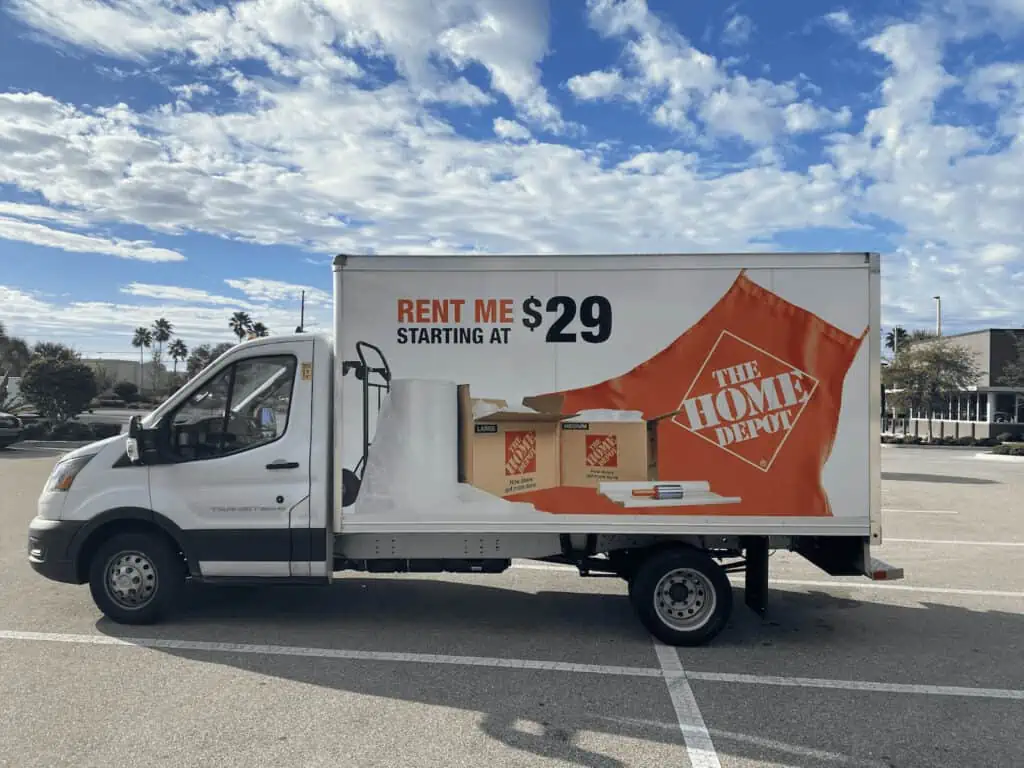
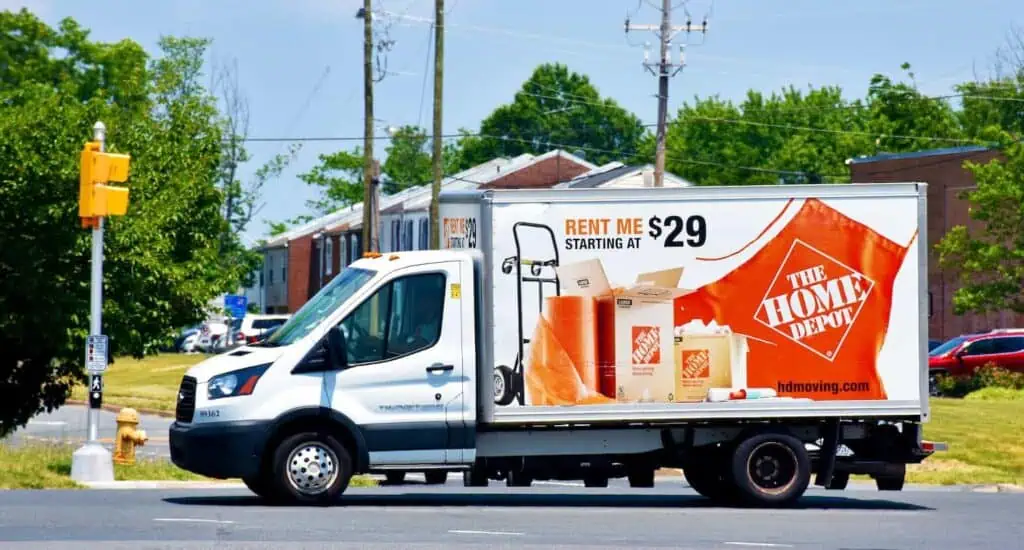
Home Depot keeps its pricing simple. You pay $29 for the first 75 minutes or $149 for a full day, with unlimited miles included. Optional damage protection is 15% of the rental price, and an environmental fee may be added at checkout. There is no hourly rate listed beyond the initial 75-minute window.

U-Haul uses a different model. All local rentals include a daily rate plus a per-mile charge. Mileage prices change based on your location and date, so the numbers you see online are just a starting point. 

For example, in Phoenix, where we pulled our sample quotes, the pickup and cargo van were listed at $19.95 per day plus $1.09 per mile. The box trucks ranged from $19.95 to $49.95 per day, plus $1.29 per mile. Additional small fees apply, and renters can add damage protection or equipment like dollies if needed. 

To make the comparison easy, here is a look at what both companies would charge for a six-hour, 30-mile local move before taxes and optional add-ons.

Important U-Haul Mileage Rates Change a Lot by City: U-Haul mileage rates are not the same everywhere. On the same date, Phoenix listed $1.29 per mile for box trucks, Tampa listed $1.39 per mile, and New York City listed up to $2.49 per mile. That difference can double your final cost on a longer local move, so it’s worth checking your local mileage rate before you book.

Cost Example: 6 Hour, 30 Mile Local Move

Truck Estimated Cost Before Taxes How It’s Calculated
Home Depot Cargo Van $149 Full day rate, unlimited miles. Does not include optional damage protection or environmental fees.
Home Depot 12 ft Box Truck $149 Full day rate, unlimited miles. Does not include optional damage protection or environmental fees.
U-Haul Pickup (8 ft) $52.65 $19.95 day rate plus 30 miles at $1.09 per mile, plus standard local fees. Does not include optional coverage or dolly.
U-Haul Cargo Van (9 ft) $52.65 $19.95 day rate plus 30 miles at $1.09 per mile, plus standard local fees. Does not include optional coverage or dolly.
U-Haul 10 ft Truck $58.65 $19.95 day rate plus 30 miles at $1.29 per mile, plus standard local fees. Does not include optional coverage or dolly.
U-Haul 15 ft Truck $68.65 $29.95 day rate plus 30 miles at $1.29 per mile, plus standard local fees. Does not include optional coverage or dolly.
U-Haul 20 ft Truck $78.65 $39.95 day rate plus 30 miles at $1.29 per mile, plus standard local fees. Does not include optional coverage or dolly.
U-Haul 26 ft Truck $88.65 $49.95 day rate plus 30 miles at $1.29 per mile, plus standard local fees. Does not include optional coverage or dolly.

What This Example Shows

For short local trips, U-Haul usually comes out ahead because the mileage fees stay low and the base rates are inexpensive. Once your mileage climbs, Home Depot becomes more cost-effective because the price does not increase with distance

However, if you need the room to move a larger home, U-Haul is the only brand with truck sizes big enough to finish in one trip. Home Depot works best for small homes or simple hauls where unlimited miles save the most money.

Home Depot Truck Rental Pricing

Home Depot’s pricing is time-based, with a $29 rate for the first 75 minutes and a flat $149 daily rate, plus an option to rent by the week. Exact pricing is determined at the store, but the advertised pricing online is as follows:

  • $29.00 for 75 minutes
  • $149.00 per day (regardless of number of hours)
  • $1,043.00 per week

Your rental may be subject to additional fees, such as:

  • Environmental fee (may apply)
  • Damage protection (15% of the cost of your rental) — Optional

After all that, you still have to cover tax and gas, but at least there are no mileage fees!

U-Haul Truck Rental Pricing

U-Haul uses a mileage-based pricing model. You pay a daily rate based on the truck size plus a per-mile charge, which can make short local moves very affordable. For a deeper look at how these costs add up, you can read our full breakdown in How Much Does a U-Haul Really Cost?

Long-distance and one-way rentals follow a flat rate structure with additional fees, but most local renters will pay the daily rate, mileage, and any optional coverage they choose. Mileage rates vary by location. In Phoenix, box trucks currently run $1.29 per mile, while pickups and vans run $1.09 per mile.

U-Haul Local Truck Pricing (Phoenix Example)

Truck Size Base Daily Rate Additional Mileage Fee*
10-Foot Truck $19.95 $1.29 per mile
15-Foot Truck $29.95 $1.29 per mile
20-Foot Truck $39.95 $1.29 per mile
26-Foot Truck $49.95 $1.29 per mile

Mileage fees may change based on demand, season, and pickup location. U-Haul also adds standard small fees, including a vehicle license recovery fee, an environmental fee, and optional damage protection. These charges can bring your final price up before tax and fuel.

Which Moving Truck Rental Is Cheaper?

U-Haul is usually cheaper for short, low-mileage moves, while Home Depot becomes the better value once your trip gets longer. That difference comes down to how each brand sets prices.

Home Depot charges a flat $29 for the first 75 minutes or $149 for a full day, and mileage is unlimited. You do not pay more for driving farther.

U-Haul’s daily rates seem low, but the price goes up with every mile. In many cities, the mileage fee is more than a dollar per mile, which adds up quickly once you pass local, in-town distances.

The result is simple:

  • If your move is close by, U-Haul usually wins.
  • If your move covers more ground, Home Depot often ends up cheaper.

Price Breakpoint: When Does Home Depot Become Cheaper?

Home Depot becomes cheaper when your mileage climbs high enough that U-Haul’s per-mile charges push the final cost above the $149 daily rate. Since Home Depot’s price does not change once you hit the day rate, the gap can widen quickly. U-Haul stays ahead for small, close moves. Once you hit a moderate distance, the math flips.

Embed code:

The graph above shows how U-Haul’s price climbs mile by mile, while Home Depot stays flat. Each U-Haul truck reaches that $149 point at a different distance, but most hit it sooner than people expect.


Real World Use Cases

Below are examples using current pricing out of Phoenix, AZ. Mileage fees, base rates, and small add-on charges can shift by region, so think of these as helpful benchmarks rather than exact totals for your area. Each scenario shows how the cost changes when time or mileage increases.

Cost Example: 1-Hour 15-Minute Move / 8 Miles

This distance is an example of moving to the next neighborhood over, maybe just a few blocks from your old place.

Winner: Home Depot

Truck Estimated Total Before Taxes and Fees How It Is Calculated
Home Depot 12 ft $29.00 $29 for the first 75 minutes, unlimited miles
U-Haul 15 ft $29.95 + ($1.29 × 8 miles) = $40.27 Daily rate plus mileage

For short moves with a handful of miles, Home Depot’s 75-minute rate is hard to beat. But what about higher-mileage and more time-intensive moves?

Cost Example: 4-Hour 15-Minute Move / 22 Miles

Picture a typical across-town move here, the kind where you make two short trips to get everything settled.

Winner: U-Haul

Truck Estimated Total Before Taxes and Fees How It Is Calculated
Home Depot 12 ft $149.00 Full day rate, unlimited miles
U-Haul 15 ft $29.95 + ($1.29 × 22 miles) = $58.33 Daily rate plus mileage

When your move goes past the 75-minute mark but is still within a small radius, U-Haul usually costs much less. Keep in mind that Home Depot doesn’t offer one-way moves. You have to return the truck to the same location where it was rented.

Cost Example: 1 Day Move / 120 Miles

This reflects a full-day move where you’re driving between nearby cities and getting everything loaded and unloaded in one stretch.

Winner: Home Depot

Truck Estimated Total Before Taxes and Fees How It Is Calculated
Home Depot 12 ft $149.00 Flat daily rate, unlimited miles
U-Haul 15 ft $29.95 + ($1.29 × 120 miles) = $184.75 Daily rate plus mileage

Once mileage climbs, Home Depot’s flat daily rate pulls ahead quickly. At 120 miles, the savings become significant.


Availability: Home Depot vs. U-Haul

U-Haul has far more availability, offers more pickup and drop-off flexibility, and has a larger fleet. Home Depot works well if you live near a store that has trucks in stock, but its single moving truck size and same location return rules limit how widely you can use it.

Home Depot Availability

A home depot box truck driving along a residential road

Home Depot has more than 2,000 stores in the United States, but only some locations carry branded moving trucks. Availability can vary a lot by store and by region, and truck inventory is not guaranteed. Since Home Depot only offers one true moving truck size, you may not have the option to scale up if you need more space.

Hours of operation for truck rental generally follow store hours. Many locations open early, which can help with early morning moves, but you must return your rental to the same store where you picked it up. No one-way rentals are available for Home Depot-branded trucks.

Home Depot is a good fit when you live close to a store that has trucks in stock, and you only need a small moving truck for a short local job.

U-Haul Availability

U-Haul has more than 21,000 rental locations nationwide, including stores, neighborhood dealers, and partner sites. This network is far larger than Home Depot’s, which makes it easier to find a truck nearby. It also means you have a higher chance of finding the exact truck size you want.


“Each truck is rented out with a full tank of gas, and you’re expected to top it off before returning it. If you don’t, Home Depot may automatically charge a refueling fee, which is typically higher than the average price at a gas station.”


Hours vary by location, but U-Haul also offers 24/7 pickup and drop off through its mobile app at many sites. This makes it easier to schedule moves outside of standard business hours. U-Haul also supports one-way rentals, which is important for anyone moving between cities.

With more truck sizes, more locations, and more pickup and drop-off flexibility, U-Haul is usually the easier option for most people, especially if you need a larger truck or do not live near a Home Depot with moving trucks in stock.


Fuel Efficiency: Home Depot vs. U-Haul Truck Rentals

Home Depot’s trucks tend to get slightly better gas mileage because they are newer, but real-world MPG varies depending on load, driving speed, and the specific truck you receive.

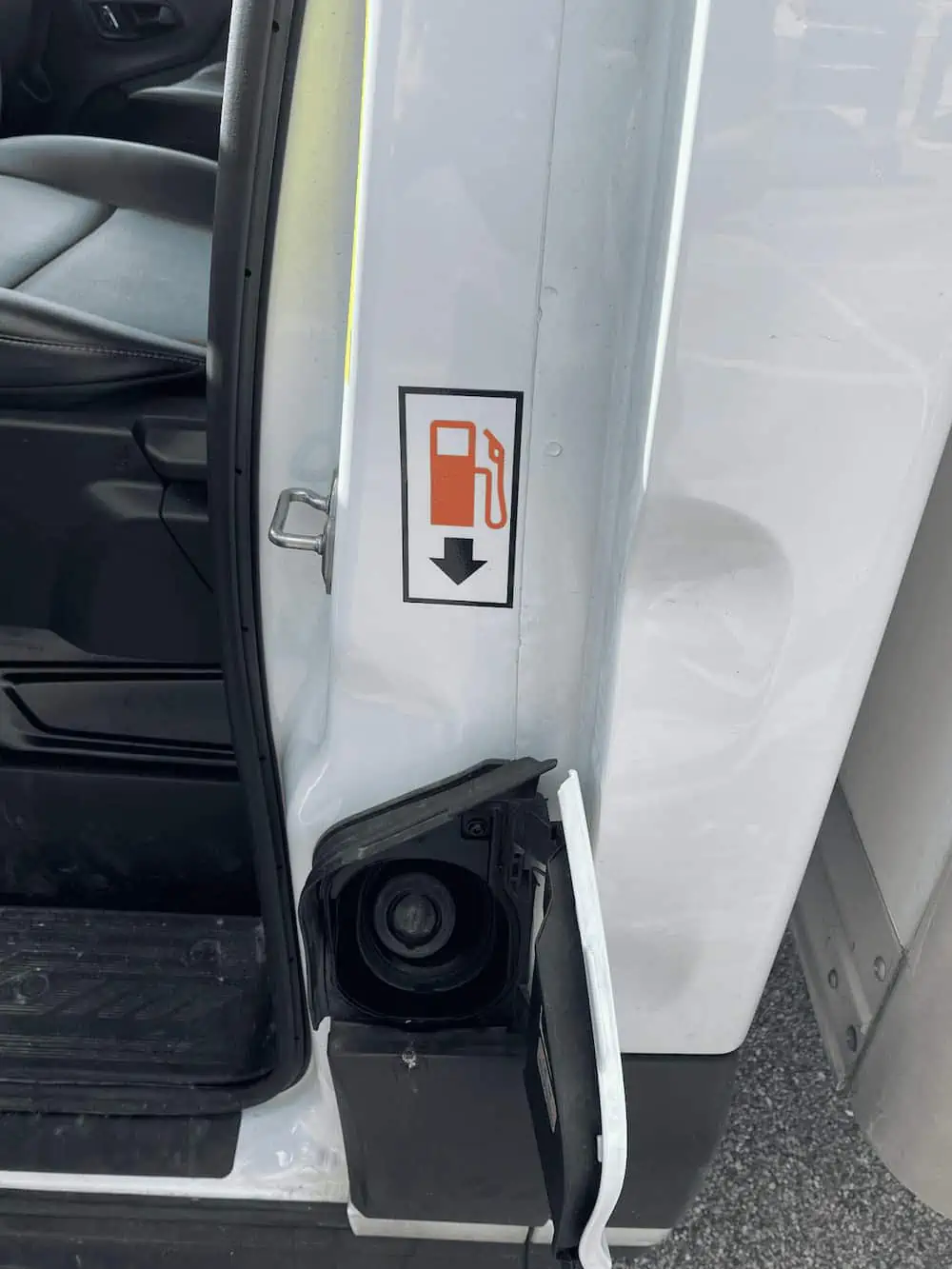
a photo of the location of the gas tank fuel inlet on a Home Depot moving truck

With Home Depot, vehicle make, model, and year may vary by location, which means that not all Home Depot box trucks are created equal. But since U-Hauls aren’t exactly jaw-droppingly efficient, chances are the fuel efficiency of a Home Depot truck will be better than a U-Haul. This is because, as Home Depot trucks are a newer thing, the trucks themselves are likely to be fairly new.

The truck we rented was a new Ford Transit 350 HD, and it was quite fuel-efficient. It even had a little MPG indicator on the dash that tells you how you’re doing. Ours got 12 miles to the gallon. We drove 8 miles and only spent $1.39 to top it off when we were done.

U-Haul Rental Truck Fuel Efficiency

U-Haul’s 10-foot rental truck gets up to 12 miles to the gallon under ideal driving circumstances. Once you’ve loaded the truck with all your belongings, expect that number to drop. MPG estimates for the larger trucks cap out at 10 miles per gallon, under ideal circumstances.


Ease of Driving: Home Depot vs. U-Haul Truck Rentals

Home Depot’s smaller, newer trucks are often easier and more comfortable to drive, while U-Haul’s driving experience depends more on the age and condition of the specific truck you are given.

Driving a Home Depot Rental Truck

Home Depot’s box truck is smaller than most U-Haul trucks, plus the fleet is relatively newer. As a result, driving a Home Depot truck might be more comfortable and feel more like driving a pick-up truck than a boxy moving truck. The cab is lower and easier to get into, parking is less of an issue, and the wide mirrors mean visibility is generally good.

Driving a U-Haul Rental Truck

U-Haul’s fleet has been around longer, and some rentals simply aren’t as new as others. The 10-foot trucks should be relatively easy to drive (like Home Depot’s 12-foot rental), but the larger models can be more challenging to maneuver and ride a little rougher.


Coverage Options: Home Depot vs. U-Haul Truck Rentals

Home Depot offers very limited coverage, while U-Haul provides several protection plans that cover more situations and give renters more peace of mind.

Home Depot Coverage Options

Home Depot only offers a damage protection plan for 15% of the cost of a rental. It covers up to $500 of repair costs for non-collision physical damage and also covers replacement charges of non-collision damage (not including theft). However, the coverage doesn’t include damage protection for your cargo, personal liability, or injury protection.

Instead, they take your insurance information, and your own car insurance provider is placed on the hook. So definitely be sure to take pictures of your truck before and after the rental!

U-Haul Coverage Options

U-Haul has several coverage options at various price points, from simple roadside assistance to supplemental liability coverage, cargo protection, and more. Between Home Depot and U-Haul, U-Haul definitely has more and better coverage options.


Reservation Process: Home Depot vs. U-Haul Truck Rentals

U-Haul’s reservation system is easier and more flexible, while Home Depot requires an account, a higher deposit, and offers fewer pickup and return options.

Reserving a Home Depot Rental Truck

Home Depot allows you to search for stores with available trucks in your area — which is convenient — but then you have to sign in or create an account and pay a deposit to reserve a truck. Reservations are done through the same system used to reserve tool rentals, so the wording can seem a bit funny at times.


“Home Depot keeps its pricing simple. You pay $29 for the first 75 minutes or $149 for a full day, with unlimited miles included.”


A two-hour rental reservation required a $150 deposit or credit card hold, which is almost triple the rental price. Of course, it’s just a deposit and will be refunded when the truck is returned as long as everything is in order.

Reserving a U-Haul Rental Truck

U-Haul’s online reservation system is streamlined and easy to use. After specifying when and where you want to rent a truck, you compare rates, select pickup and drop-off locations, choose coverage, and any other add-ons you might need. The only downside might be all the “upsell” pages that you have to click through to get to your quote. But if you need the add-ons, then it’s actually super helpful.


Returning the Truck: Home Depot vs. U-Haul Truck Rentals

Home Depot requires same-location returns and proof of refueling, while U-Haul offers more flexible return options but still expects the truck to be refueled and cleaned.

Returning a Home Depot Rental Truck

a home depot moving van parked on the side of the street

Home Depot trucks must be returned to the same location they were picked up. Each truck is rented out with a full tank of gas, and you’re expected to top it off before returning it. If you don’t, Home Depot may automatically charge a refueling fee, which is typically higher than the average price at a gas station. So be sure to top it off, snap a pic, and keep your gas receipt! The Tool Rental associate will ask to see the receipt, which covers you for any fuel used on the way back from the gas station to Home Depot.

Returning a U-Haul Rental Truck

When you pick up your U-Haul truck, your paperwork should indicate the current fuel level, but it’s always a good idea to double-check before taking off. You’re responsible for returning the truck with the same amount of fuel as when you picked it up. Otherwise (you guessed it) you’ll be charged a fuel replacement fee. Remember to remove any garbage and give the truck a quick sweep, or you may be charged a cleaning fee as well.


Pros and Cons: Home Depot vs. U-Haul Truck Rentals

So, with all this in mind, how does Home Depot stack up against U-Haul when it comes to moving truck rentals?

Pros and Cons: Home Depot Truck Rentals

Pros Cons
  • No mileage fee
  • Hourly rental option
  • Moving dolly included
  • Loading ramp
  • Cheaper per day for high miles
  • High daily rate
  • Only one truck size available
  • Same location drop-off only
  • Pricier per day for low miles

Pros and Cons: U-Haul Truck Rentals

Pros Cons
  • Low initial daily rate
  • Four different truck sizes
  • EZ-Load ramp (15-ft, 20-ft, 26-ft)
  • One-way rental available
  • Cheaper per day for low miles
  • Mileage fee
  • No loading ramp on 10-ft truck
  • Dolly not included
  • Pricier per day for high miles

Home Depot keeps pricing simple with unlimited miles and a single 12-foot moving truck. This can save money on longer local days, but the fleet is limited, and the lack of liability coverage means your own auto insurance must apply.

U-Haul offers more truck sizes, one-way rentals, and stronger protection plans. The tradeoff is the mileage fee, which can get expensive in some cities. For short trips, U-Haul is usually cheaper. For longer local days, Home Depot often catches up.

Home Depot stores also tend to open early, which can be helpful for timing your move, while U-Haul’s 24/7 mobile pickup offers more flexible start times.


Which Is Better? Home Depot vs. U-Haul Truck Rentals

We’ve said this before, and we’ll say it again: U-Haul wins the short-distance race against virtually all of its competitors. So, if you need a truck for a quick in-town move, U-Haul’s pricing is really hard to beat — unless you can load, drive, and unload a small apartment and drop off your truck in under 75 minutes.

But if you’re only moving a few pieces of large furniture and that’s it, or if you have lots of miles to drive and don’t mind dropping off the truck where you picked it up, then Home Depot becomes a very nice alternative.

Scorecard summary

Below is a quick look at how Home Depot and U-Haul performed across each category.

Category Winner Why
Price for short local moves U-Haul Lower daily rates and low mileage make quick, in-town trips cheaper.
Price for longer local days Home Depot Flat daily rate with unlimited miles beats U-Haul once mileage climbs.
Truck size selection U-Haul Four box truck sizes, plus pickup and cargo vans, allows one-trip moves.
One-way rentals U-Haul Home Depot offers none on branded trucks. U-Haul supports regional and cross-country trips.
Ease of driving Home Depot Newer trucks and smaller size make them simpler to park and handle.
Availability U-Haul More locations, more inventory, and 24/7 mobile pickup options.
Coverage options U-Haul Multiple protection plans vs. Home Depot’s minimal coverage.
Fuel cost predictability Home Depot Newer trucks often get slightly better actual MPG.
Best for beginners Home Depot Small, easy to drive, and straightforward pricing.

Making the Most of Your Moving Truck Rental

Hiring professional movers on an hourly basis can make a huge difference when using a time-sensitive moving solution. Since Home Depot is all about the hourly rate, having movers expedite the move can shave some time off that final bill. But not only that, they can use their Tetris skills to pack the truck way more efficiently than most of us ever could. This means secure belongings that don’t shift in transit (aka less damage) and fewer trips back and forth.

If you are not sure how much help you really need, you can start with our guide on how many movers you should hire. Once you have a sense of the right crew size, HireAHelper makes it easy to compare local moving pros, see real customer reviews, and book the help that fits your timeline and budget.


Why Trust HireAHelper

This guide is built on real data and real testing. We gathered current prices straight from each company, checked truck availability across multiple cities, and ran the same move scenarios using the published rates. Every cost example reflects the numbers renters actually see, not rough guesses.

HireAHelper has helped millions of people move since 2007, and we spend a lot of time studying how truck rentals work in the real world. Because we track pricing trends and hear from customers every day, we have a clear view of what each brand does well and where the trade-offs are. Our goal is to give you reliable information so you can choose the truck that fits your move with confidence.

Other Helpful Articles:

×

I'm Moving

Moving? Thinking about moving? Whether your move is off in the distance or you already have one foot out the door, you'll learn about everything you should expect through our useful how-to's, cool articles and much more. It's all specially curated for you in our "I'm Moving" section.
Explore
×

I'm a Mover

For rookies or veterans alike, our "I'm a Mover" section is filled with extensive industry news, crucial protips and in-depth guides written by industry professionals. Sharing our decade of moving knowledge is just one way we help keep our professional movers at the top of their game.
Explore