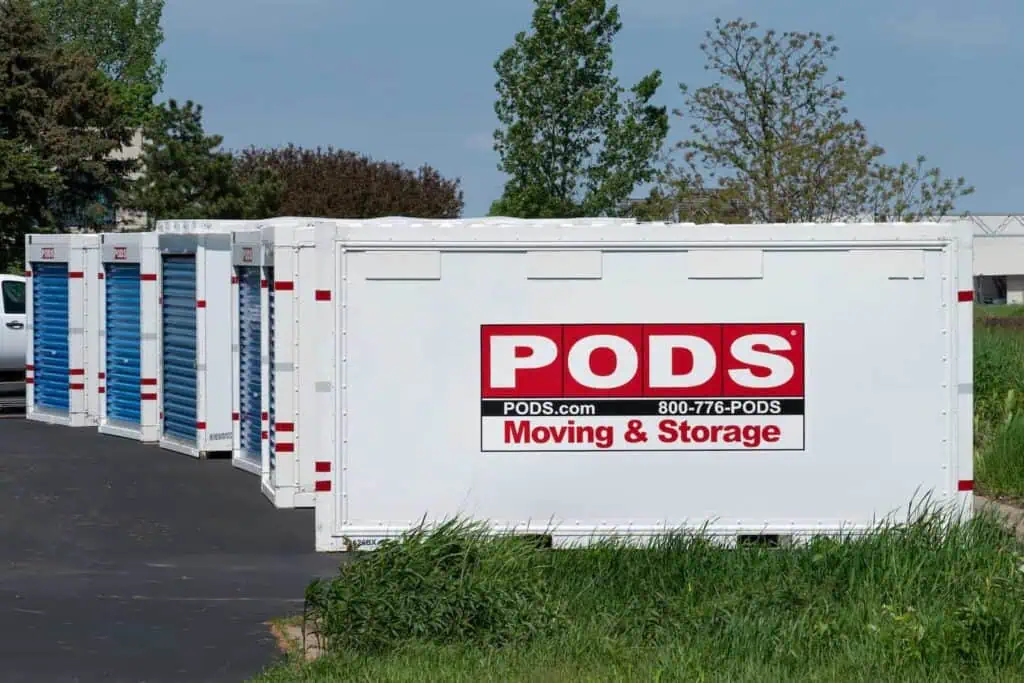
PODS Container Sizing Explained: What Fits in Each Option

Author:

Publish Date:

Last Modified Date:

Category: Moving Advice

Tags: Tags: , , , , , , , , ,

Most people moving a standard 2-bedroom home or larger will need a 16-foot PODS container. For a studio or small apartment (under 500 sq. ft.), the 8-foot container is the best choice, while the 12-foot option typically fits 1- to 2-bedroom apartments.

Portable, on-demand storage (PODS) makes moving easy: they drop off a clean container, you fill it (or hire movers to help), and they move it to your new home. But picking the right size is one of the most important steps. If you’re unsure which size fits your needs, this guide breaks down exactly what each container holds so you don’t overpay or leave items behind because they don’t fit.

Table of Contents


Overview of PODS Container Sizes

PODS offers three main container sizes to handle everything from dorm room cleanouts to full-scale family moves: the 8-foot, 12-foot, and 16-foot containers.

Choosing the right size is the most important step in your rental process. If you go too small, you might have to leave furniture behind. If you go too big, you are paying for empty air.

Here is the quick overview to help you decide which size matches your move:

  • 8-foot container: Best for studio apartments, dorms, or moving a single room (approx. 500 sq. ft.).
  • 12-foot container: Ideal for 1-bedroom apartments or smaller 2-bedroom homes (approx. 500–800 sq. ft.).
  • 16-foot container: The go-to choice for 2-bedroom homes or larger (approx. 1,200 sq. ft.).

Keep in mind that while the 12-foot and 16-foot containers are both roughly the size of a parking spot, they hold drastically different amounts of furniture. If you are on the fence, we usually recommend sizing up or consulting a professional to ensure your move goes smoothly.


Dimensions and Size Comparison for PODS Containers

PODS moving container sizes range in length from 8 to 16 feet. You can fit most common household items inside a PODS unit, including couches, beds, dressers, and home decor.

However, you need to be sure you select the right container rental size for your specific needs. Smaller container rentals are typically fine for people who live alone or don’t have much furniture, while the large containers are best for a large home or rooms filled with furniture.

Here is a quick breakdown to help you compare your options.

Details on PODS Container Sizes

Dimensions Cubic Footage Weight Limits What It Can Hold
8′ x 7′ x 8′ Fits up to 500 sq. ft. 4,200 lbs. Bed, dresser, bookshelf, TV, several boxes
12′ x 8′ x 8′ Fits 500-800 sq. ft. 4,700 lbs. Furniture, decor, and appliances from a 1- or 2-bedroom apartment, including beds, dressers, couches, and electronics
16′ x 8′ x 8′ Fits 1,200 sq. ft. 5,200 lbs. Large furniture, such as sectional couches, and appliances from a 3- or 4-bedroom home

Important Note on Weight: Weight doesn’t affect pricing for PODS temporary storage options. However, you should still consider getting multiple PODS units if you’re near the weight limit, as excess weight can make transportation harder or incur fees.


What Fits in PODS Containers?
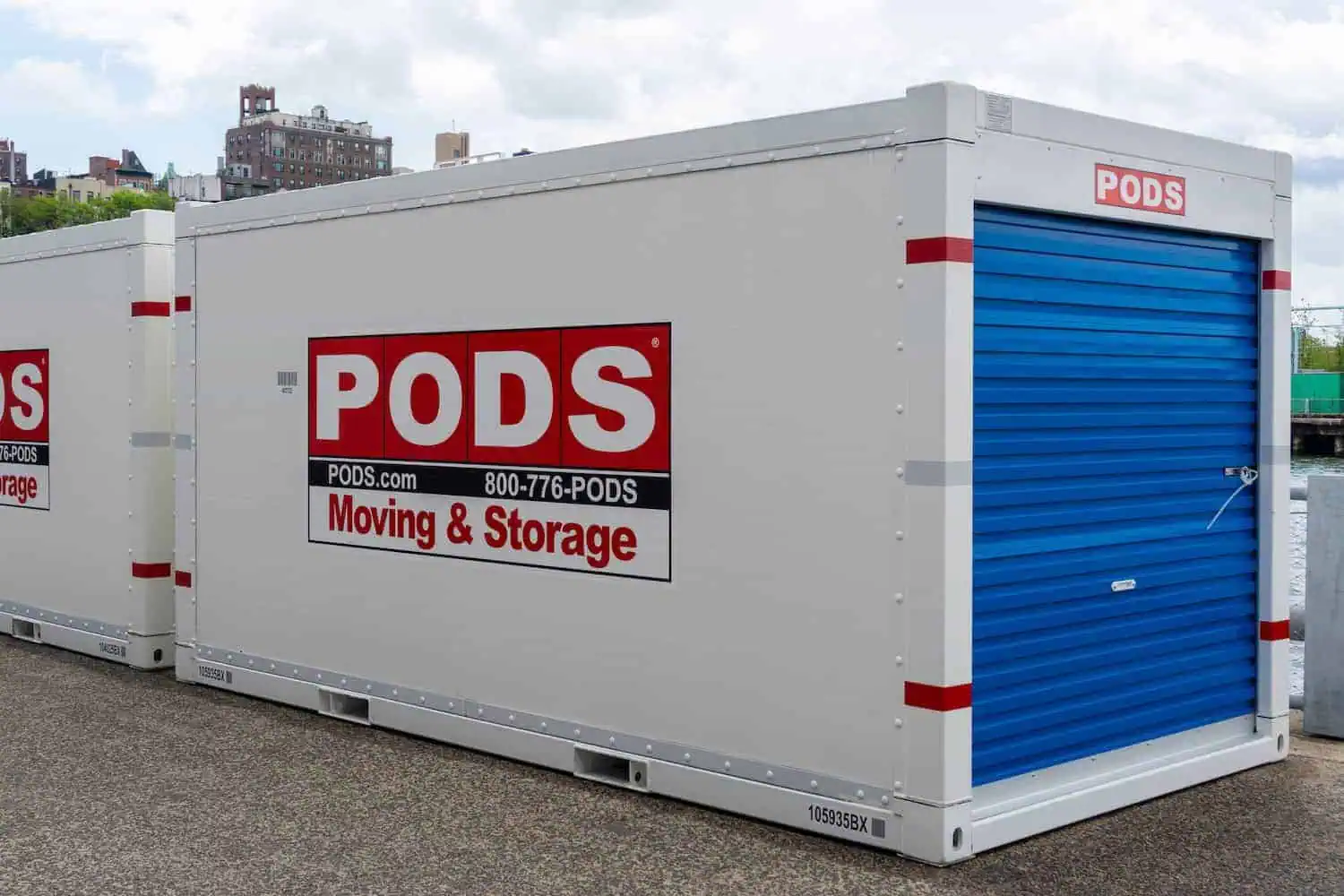
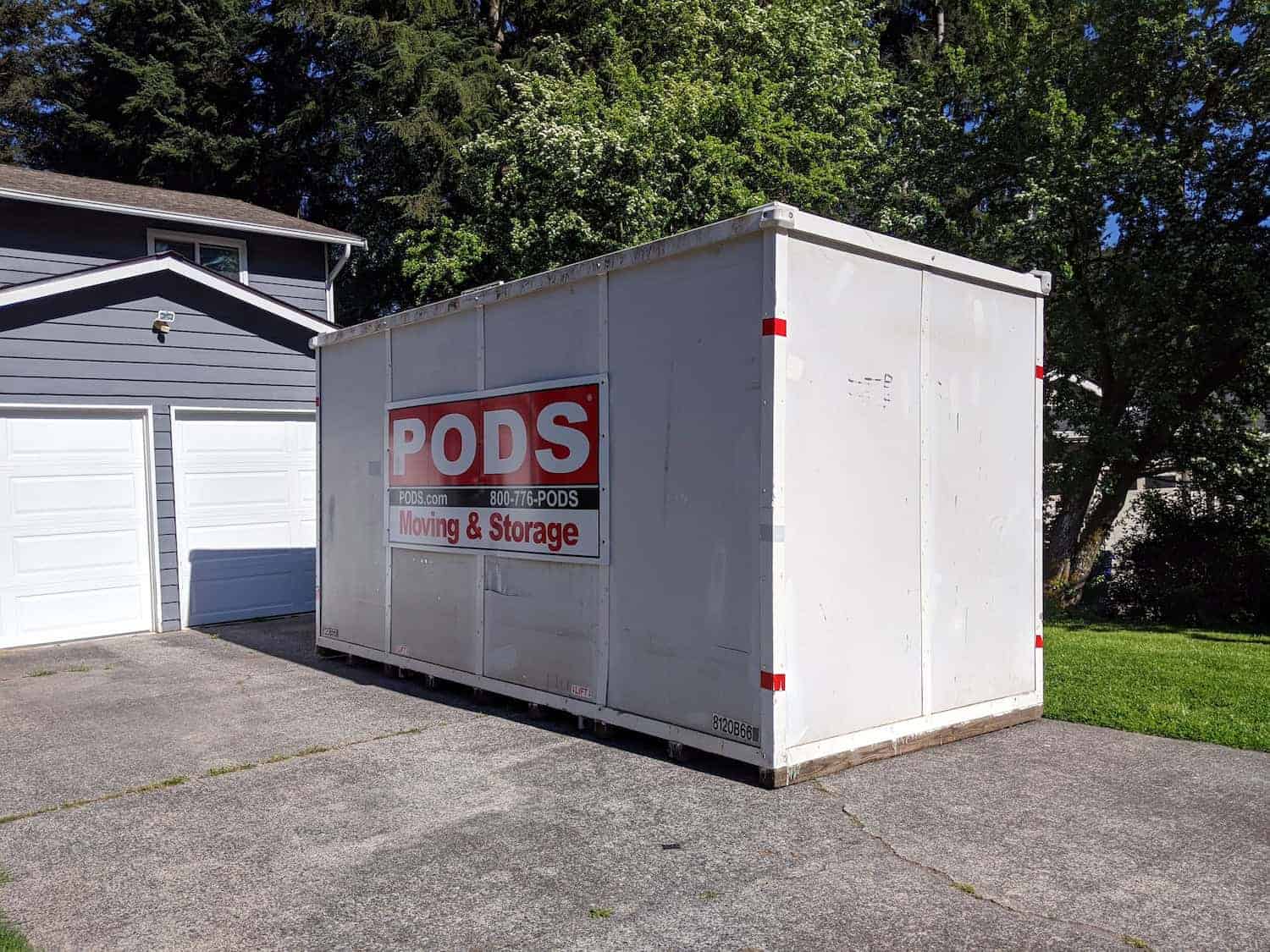
A PODS container sits in a parking lot

While the charts give you the raw numbers, it is often hard to visualize exactly how much furniture fits inside a steel box. To help you plan, here is a realistic look at the inventory you can fit into each size option.

8-Foot PODS Container

Think of this unit as roughly comparable to a 10-foot rental truck. It is the perfect size for a college student moving out of a dorm or a single person leaving a studio apartment. It is also ideal if you are remodeling a single room and just need to temporarily clear out the furniture.

  • Best for: Studio apartments, dorms, or partial moves.
  • What actually fits: A mattress set (up to Queen), a loveseat, a dresser, a small dining set, and approximately 80 boxes.
  • When to size up: Don’t underestimate bulky furniture. While a studio apartment fits easily, an overstuffed sofa or an oversized entertainment center might eat up too much floor space for this small unit.

12-Foot PODS Container

The 12-foot container is the “middle child” of the lineup — bigger than a studio hauler but smaller than a full-family mover. It is generally the right choice for a spacious 1-bedroom apartment or a minimalist 2-bedroom home.

  • Best for: 1-bedroom apartments or small 2-bedroom homes.
  • What actually fits: A King or Queen bed, a standard sofa, a dining room set, a TV console, and boxes for kitchen and wardrobe items.
  • When to size up: If you have a 2-bedroom home with large appliances (washer/dryer) or a sectional couch, you will likely need to upgrade to the 16-footer.

16-Foot PODS Container

This is the largest and most flexible option PODS offers. If you are moving a standard 3-bedroom home or long-distance, this is the container you will likely need. It is roughly the size of a standard parking spot.

  • Best for: 3- to 4-bedroom homes or long-distance moves requiring maximum space.
  • What actually fits: A King bed, a large sectional sofa, a dining table with chairs, a washer and dryer, bookcases, and roughly 150+ boxes.
  • When to size up: If you have a 4-bedroom home or a garage full of tools, one 16-foot container might not be enough. Many homeowners in this bracket rent one 16-foot unit and add a second 8-foot unit to handle the overflow.

How to Choose the Right PODS Container Size
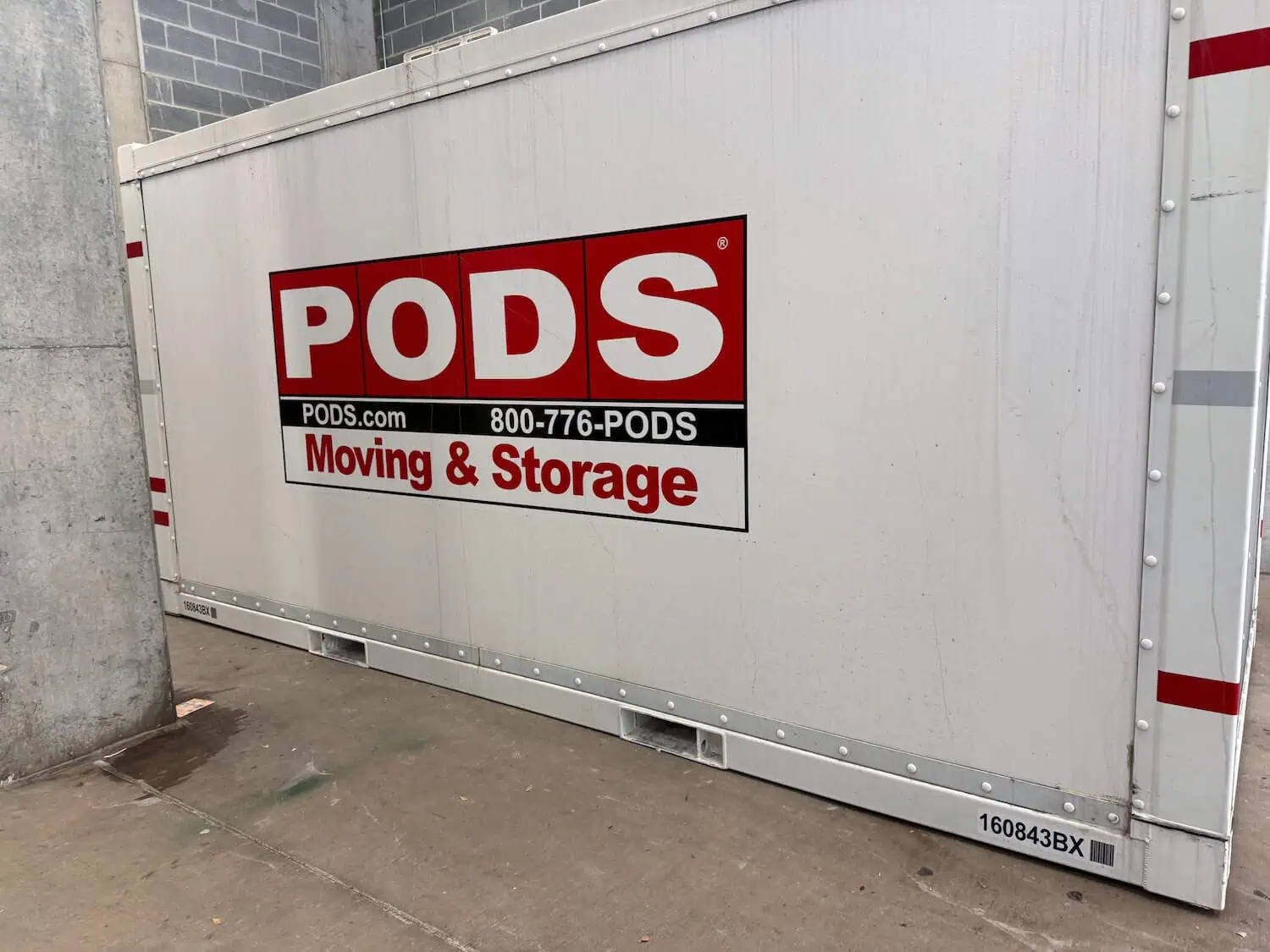
A PODS container is set in an area with a concrete floor

While your home size is a big factor, it’s not the only one. When comparing container size options, it’s also important to consider your home’s type and how many items you have.

Assess Your Home Size and Type

Are you a minimalist or a maximalist? Consider a large PODS rental if you have a lot of stuff or live in a 3- or 4-bedroom home. College students, people with few belongings, or folks who live alone can often get by with a smaller container rental.


“Be mindful of fragile or lightweight items when you load your PODS container. Don’t place heavier items on top of them. Otherwise, delicate belongings may get crushed under the weight.”


A medium-sized PODS container can be perfect for people with 1- or 2-bedroom homes, but keep in mind that if you have a basement or attic, the actual amount of stuff you have might be closer to a 3-bedroom home in the end.

Create a Detailed Inventory

Determine what you’re taking during the move, then create a detailed inventory of your possessions. Consider breaking your inventory list into categories, such as by room, or keeping similar items together. Not only does this help with determining what type of PODS rental you need, but it also makes it easy to ensure everything you want to keep makes it inside the PODS container.

When in Doubt, Go Slightly Larger

If you’re on the fence about PODS container sizes, go with the larger option, so you have plenty of space. It’s much better to have a little too much space than realize you can’t fit your favorite recliner inside the container.

Factor in Your Storage Needs

Think about your storage needs when you request a PODS container rental. Do you only have items in your house, or are there outdoor toys or tools in your shed that require storage? Consider a large unit if you want to store outdoor furniture, kids’ play equipment, and gardening tools along with your indoor essentials.

General Size Guidelines

To help you make the final call, here is a quick summary of when to choose each size.

  • Choose the 8 ft container if you live in a studio apartment (under 500 sq. ft.), are moving out of a dorm room, or only need to move a specific room or partial load.
  • Choose the 12 ft container if you are moving a 1-bedroom apartment or a smaller 2-bedroom home (500–800 sq. ft.). This is also a smart pick if you are a minimalist who has already decluttered heavily.
  • Choose the 16 ft container if you have a standard 2- or 3-bedroom home (up to 1,200 sq. ft.). This is your safest bet for long-distance moves or homes with bulky furniture like sectional sofas.

Common PODS Sizing Mistakes to Avoid

Even if your inventory list looks right on paper, real-world variables can throw off your math. Watch out for these common pitfalls that often force people to order a second container at the last minute.

  • Counting rooms instead of stuff: Saying you have a “2-bedroom home” is really just a starting point! The actual amount of belongings you need to move depends heavily on your lifestyle and how many people share your space. For instance, a single person who loves the minimalist look will have a lot less to pack up than a family of three who loves collecting things.
  • Packing flat instead of tall: The biggest waste of space comes from packing like you are loading a car trunk. If you don’t stack boxes floor-to-ceiling, you could waste up to 25% of your container’s volume. You are paying for the height, so make good use of it!
  • Ignoring dead air from odd shapes: Cubic-footage calculators assume everything fits together perfectly, like blocks. In reality, round tables, bicycles, and curved sofas create “dead air” gaps that boxes can’t fill. Always buffer your estimate for these awkward shapes.
  • Overlooking weight limits: While rare, it is possible to hit the weight limit before the container is full if you are moving dense items like a massive book collection, tools, or gym weights.

Pro tip: Professional packing creates space. If you are on the borderline between sizes, the difference often comes down to how you pack. Consider hiring Labor-only movers to load your container. Experienced movers can maximize vertical space and fill tight gaps, often fitting a 3-bedroom home into a container that an amateur packer would overflow.


How to Effectively Pack a PODS Container
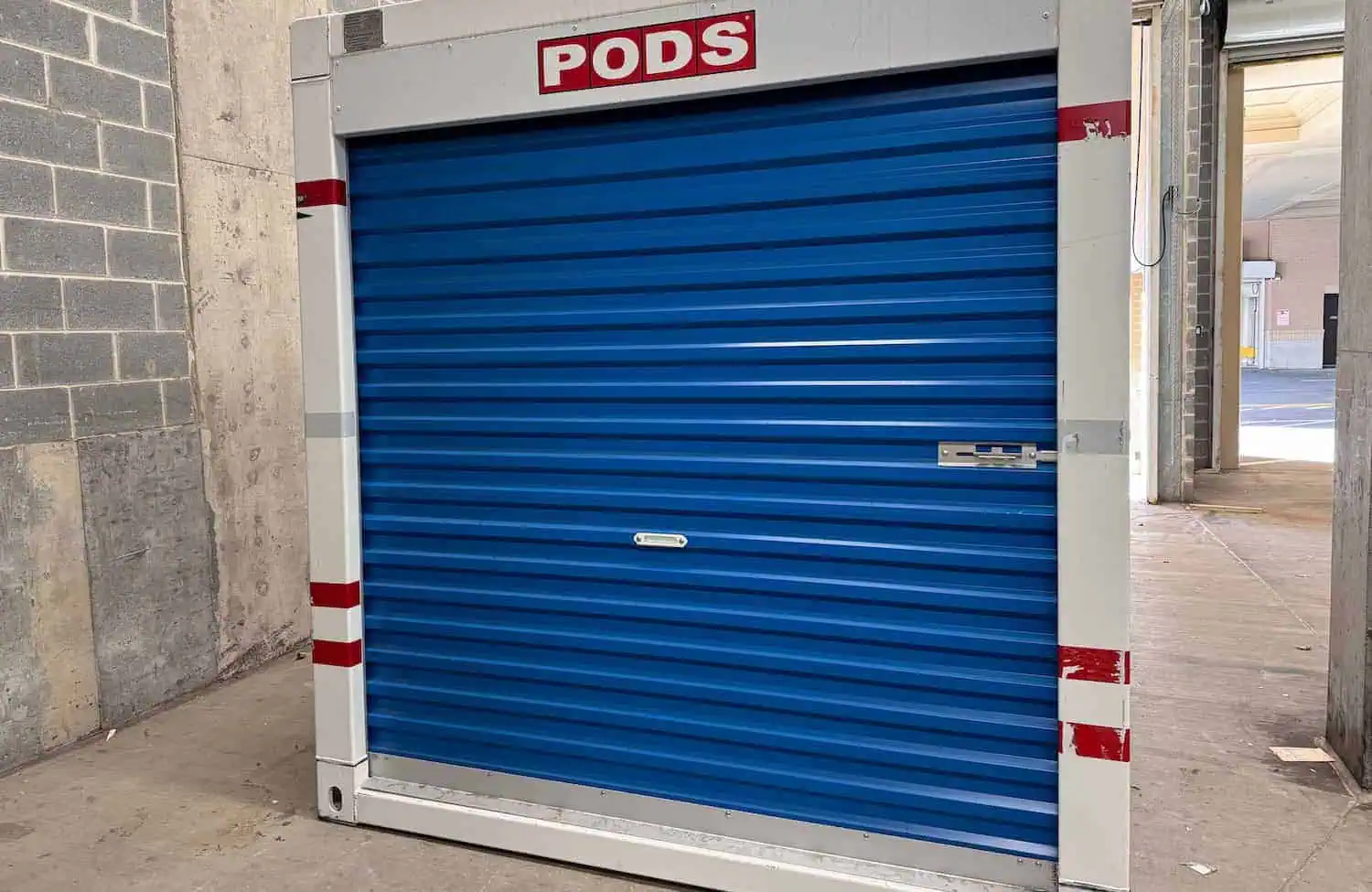
A closed and shut PODS door faces the camera

Loading your PODS unit correctly can maximize space and prevent items from getting damaged during transit. Whether you’re cutting it close on space or just want a smooth move, follow these helpful packing tips.

  1. Choose uniform boxes. As much as possible, ensure your packing boxes are all the same size before you load them into your portable storage containers. This helps prevent boxes from sliding or falling and saves space because you can more easily stack boxes on top of each other.
  2. Pack vertically. Maximize space by packing items vertically rather than horizontally as you load your PODS unit. Stacking boxes or furniture vertically helps prevent items from sliding around and utilizes the greatest amount of space from the floor to the ceiling.
  3. Utilize wall space with tie-downs. Using tie-downs helps prevent items from falling while in transit. Tie-downs are also important because they help distribute weight evenly in your PODS rental and improve stability.
  4. Keep essentials easily accessible. You should keep important documents and other essential items you might need during your move on your person. But if you have to put them in your container, put them near the front of your PODS container so you can grab them quickly.
  5. Disassemble large furniture. Make the most of every square foot in your PODS unit by taking apart large pieces of furniture. Disassembly also helps reduce the risk of damage during transit.
  6. Put heavy boxes on the bottom. Be mindful of fragile or lightweight items when you load your PODS container. Don’t place heavier items on top of them. Otherwise, delicate belongings may get crushed under the weight. In other words, don’t put that box full of books on top of your framed family photos!
  7. Avoid packing prohibited or unsafe items. Your PODS unit shouldn’t contain flammable items, including paint, nail polish, aerosol hair spray, or gasoline. You should also avoid packing live animals, fertilizer, very sentimental items like family heirlooms, plants, and perishable food.

PODS Sizing vs Other Moving Containers

PODS is often used as a catch-all term for portable storage, but size options vary significantly between companies. The biggest differentiator is the 16-foot container, which is a massive size unique to PODS. Most other major competitors rely on smaller, modular containers that you rent in multiples.

Here is how PODS sizes generally stack up against the competition:

  • PODS vs. U-Pack ReloCube: A U-Pack ReloCube is roughly 6’ x 7’ x 8’. In terms of volume, it is slightly smaller than the 8-foot PODS container. If you need the capacity of a 16-foot PODS unit, you would likely need about three ReloCubes to match it.
  • PODS vs. U-Haul U-Box: U-Boxes are smaller plywood containers (approx. 8’ x 5’ x 7’). Because they are more compact, you will typically need four to five U-Boxes to equal the space of a single 16-foot PODS container.
  • PODS vs. rental trucks: A 16-foot PODS container is roughly comparable to a 15-foot rental truck. While a 20-foot or 26-foot truck definitely holds more, the PODS container offers the advantage of ground-level loading, meaning you don’t have to navigate a steep loading ramp.

Frequently Asked Questions

Is PODS a good way to move across the country?

Renting a PODS container helps make your cross-country move hassle-free. You can load the container at your own pace — no need to rush! You may find this is also a safer option, as you’re the only one handling your belongings. Traditional moving services may shuffle your prized possessions between trucks, but PODS storage conveniently keeps everything in one container. Plus, PODS rentals are often more cost-effective than hiring a traditional van line for a long-distance haul.

What can’t I load into a PODS moving container?

Live animals should not be loaded into your PODS moving container. You should also avoid packing flammable materials, cleaning supplies, radioactive materials, very sentimental items like family heirlooms, items that can’t be replaced easily, and perishable food into your temporary storage container. You can’t put a car, motorcycle, or riding lawnmower in your PODS, either.

How much time do I need to move with a PODS moving container?

PODS offers 30-day rentals, so you can take your time planning your move. If you need more time when your 30 days are up, you’re able to continue renewing your rental in 30-day increments.

Are PODS containers weatherproof and secure?

PODS containers are weatherproof and made from resilient materials, such as steel and wood. These storage containers have steel-locking mechanisms, and you provide your own lock for extra security.

What areas does PODS service, and are there any limitations?

PODS rentals are available in 46 states. The PODZILLA level-lift system service requires a flat, level surface for dropping off and picking up PODS. Some rental communities and HOAs have guidelines that limit or prohibit on-site PODS for residents. You should also check local laws regarding on-site temporary storage.

How do I know what PODS size I need?

Assess your home size and inventory. Use an 8 ft container for studios (under 500 sq. ft.), a 12 ft container for 1-bedroom apartments, and a 16 ft container for homes with 2–3 bedrooms or up to 1,200 sq. ft.

What fits in a 16 ft PODS container?

A 16 ft container fits the contents of a 1,200 sq. ft. home. This typically includes a King bed, sectional sofa, appliances, dining set, and roughly 150 boxes.

Is one PODS container enough for a 2-bedroom apartment?

Usually, yes. A 12 ft container fits a modest 2-bedroom apartment (500–800 sq. ft.). However, if you have large furniture, appliances, or a basement full of items, you should size up to a 16 ft unit.

Can movers help load a PODS container?

Yes. You can hire labor-only movers to load your container. They maximize space, potentially saving you money by fitting your belongings into a smaller container size.

Is it better to get one large PODS or two small ones?

One large 16 ft container is generally more convenient and cost-effective than two smaller ones. However, two containers offer flexibility if you need to separate storage loads or stagger your delivery dates.

What happens if my PODS container is too small?

If your container is too small, you will need to rent an additional container or leave items behind. It is always safer and more cost-effective to size up if you are on the fence.

Are PODS containers bigger than moving trucks?

Not usually. A 16 ft PODS container is roughly comparable to a 15 ft rental truck. A 26 ft moving truck holds significantly more volume than the largest PODS container.

How efficiently do PODS containers need to be packed?

Very efficiently. Poor packing reduces usable space and increases the risk of damage. Stack vertically, disassemble furniture, and fill gaps to get the most out of your rental.
How Much Does PODS Cost for Moving in 2026?

Author:

Publish Date:

Last Modified Date:

Category: Costs & Money Saving, Moving Advice

Tags: Tags: , , , , , , , , , , , , ,

PODS costs around $500 for a single-container local move, to around $4600 for a long-distance move with two containers. This means PODS sits right between the DIY moving day with a rental truck and the high price tag of full-service movers.

Moving is categorized as one of the most stressful life events. It’s complicated, expensive, and there are a lot of decisions, so in 2026, understanding your options is the first step toward a stress-free move.

PODS is one such option, and is a great bet if you need storage with your move. With PODS, you load at your own pace, they handle transporting the container, and you only pay for the space you use.

In this guide, we break down the real costs for PODS in 2026, from local to cross-country moves. We’ll cover container sizes, hidden fees, and how PODS stacks up against the competition so you can create your ideal moving scenario.

Table of Contents


What Is PODS and How Does It Work?

A PODS container sitting in a driveway

PODS (Portable On Demand Storage) is a moving and storage container company that popularized the concept of “containerized moving” back in the 1990s. Today, they are still one of the biggest names in the game with more than 240 storage centers across North America.

So, how does it actually work? It’s pretty simple:

  • Drop-off: PODS brings a weather-resistant container to your home and places it right in your driveway or on the curb.
  • Loading: You load your belongings into the container. Unlike a rental truck, you can take your time because your quote typically includes a full month of rental use.
  • Transport: When you are ready, PODS picks up the container and drives it to your new home or one of their storage facilities.
  • Unloading: You unload your stuff at your new place, and they haul the empty container away.

But how is this different from other moves? Think of PODS as the middle ground between renting a truck and hiring a full-service moving company.

  • Unlike a rental truck, you don’t have to drive a massive vehicle on the highway.
  • Unlike full-service movers, you handle the packing and loading yourself (or hire hourly help), which usually saves you money.
  • As a bonus, pricing is based on the container size and distance, not the weight of your items. That means you pay a flat rate for the box, regardless of how heavy your furniture is.

What is the Cost of Moving Using PODS?

The price of a PODS move fluctuates based on your specific needs and the current market demand. However, unlike full-service movers who charge by weight, PODS pricing is generally more predictable.

PODS Pricing Factors

Your final quote is shaped by a handful of key variables:

  • Distance: Are you moving across town or across the country? Mileage is the biggest cost driver, and the longer the distance your move is, the more it will cost.
  • Container Size & Quantity: A studio apartment might need one 8-foot container, while a 4-bedroom house might need two 16-footers.
  • Rental Length: Your quote typically includes one month of use. If you need it longer for storage, you pay a monthly rental fee.
  • Seasonality: Moving in the summer (peak season) or on a weekend costs more than a mid-week move in November.
  • Location: Rates vary by city and availability at your local storage center.

Average PODS Costs by Move Type (2026)

The final bill for your PODS relies on several factors, but we crunched the numbers for 2026 for you. Here are the average costs you can expect for different types of moves.

Move Type Average Moving Cost What’s Included
Local Move (1 container, short-term) $524 – $640 1-month rental + delivery + transport
Long-Distance Move (1 container) $2,450 – $2,994 1-month rental + delivery + transport
Long-Distance Move (2 containers) $3,811 – $4,658 1-month rental + delivery + transport
Storage Only (Monthly) Prices start at $149/month Container rental only (does not include pick up/delivery)
Long-Distance + Storage Combo $4,258 – $5,105 Move + 3 months storage fees

Note: Prices are estimates based on standard 2026 rates. Final costs depend on your specific zip codes and timing.

The “Predictability” Bonus: One major perk of using PODS is predictability. Unlike some van lines that might hike the price on moving day because your boxes are heavier than expected, PODS pricing is generally a flat rate for the container and mileage. You pay for the space you reserve, not the weight you pack.


PODS Container Sizes and What Fits

PODS prices depend heavily on which container you choose. You don’t want to pay for space you don’t need, but you definitely don’t want to leave your mattress on the curb because it won’t fit in the smaller container size you chose.

Here is a quick breakdown of your options:

  • 8-Foot Container: This is the “studio” size. It fits a dorm room or a studio apartment (approx. 500 sq. ft.) and is comparable to a 10-foot rental truck.
  • 12-Foot Container: This size is great for a 1-bedroom apartment or 2–3 rooms (approx. 500–800 sq. ft.). Note that this size is generally available for local moves only.
  • 16-Foot Container: The biggest one. This fits a typical 2-bedroom home or up to 3–4 rooms (approx. 1,200 sq. ft.). It compares to a 20-foot rental truck.

PODS Size Prices (Recent Quotes)

To give you a better idea of what an actual move with PODS and its cost looks like, we gathered real quotes for three different scenarios. This also shows how the price shifts based on the container size.

Move Type 8′ (Small) 12′ (Medium) 16′ (Large)
Local (San Diego to Chula Vista, 12 miles) $596 $652 $652
Regional (Tampa to Atlanta, 460 miles) $1,613 N/A $1,841
Cross-Country (NY to LA, 2,790 miles) $3,646 N/A $4,710

These quotes include one month of rental, delivery, and transport. Note that the 12-foot container is not included in the long-distance quotes because it is typically restricted to local moves.


Monthly PODS Storage Costs

If your new home isn’t ready yet, or if you are staging your current home to sell, storage is where PODS really shines.

In 2026, monthly rental rates for storage start at $149 per month. However, the price scales up with the size of the container. While that starting price covers the smaller 8-foot unit, a 16-foot container typically runs between $324 and $344 per month, depending on your location.

How the Pricing Works

  • Pay-as-you-go: PODS rentals are month-to-month. You aren’t locked into a long-term contract.
  • No “Double Move”: This is the biggest value add. With a traditional storage unit (approx. $107–$133/month), you have to load a truck, drive to the facility, unload into the unit, and then do it all again when you move out. With PODS, you load once, and the container stays stored until you are ready.
  • Delivery Fees: Keep in mind that “storage only” prices usually cover just the rent. Delivery and pick-up fees average around $74.99 per trip.

Additional PODS Fees to Budget For

The biggest number on your quote that involves container and transportation cost is important, but it’s rarely the only fee. To keep your budget on track, you’ll want to account for these other potential line items during your planning phase:

  • Delivery and Pickup Fees: PODS typically charges for each trip the driver makes. This includes the initial drop-off, the move to your new location, and the final pick-up of the empty container. These fees generally average around $74.99 per trip, though they can vary by location.
  • Extended Rental: This is the most common surprise or extra charge. PODS operates on a monthly billing cycle, which means if you hang onto the container for even one day past your due date, you are typically responsible for a full extra month of rent.
  • Street Permits: If you have a private driveway, you’re golden. But if you need to place the container on a city street, you’ll likely need a permit. This is your responsibility to secure and pay for through your local municipality, not PODS.
  • Rescheduling: PODS is generally flexible, so you can typically cancel or reschedule up to 24 hours before your service without penalty. However, changes made last-minute (on the day of service) may incur a fee.

PODS Moving Insurance

Accidents are rare, but they happen. You’ll need to decide how much protection you want for your belongings.

Every rental includes Container-Only Protection for a small fee (usually $10), which covers damage to the box itself, but not your stuff inside.

For your actual furniture and boxes, you can add Contents Protection. This covers your items while they are at your home, in storage, or on the road.

Sample Monthly Costs for Contents Protection:

  • $5,000 coverage: ~$38.95/month
  • $20,000 coverage: ~$76.95/month
  • $25,000 coverage: ~$87.95/month
  • $50,000 coverage: ~$131.95/month
  • $100,000 coverage: ~$197.95/month

For long-distance moves, there is also typically a one-time administrative fee of $54.95 and a $100 deductible per claim.

Pro Tip: Most customers find that coverage should be around $20,000–$25,000. This balances affordability with enough coverage to replace major furniture and electronics if the worst happens.


PODS vs Other Moving Options

Is PODS actually the best deal for you? HireAHelper has been in the moving industry for years, so while we’re a marketplace for moving services, we see all sides of the industry. Here is how PODS compares to the alternatives in 2026.

PODS vs. Moving Alternatives: Local Moves

For a local move (under 50 miles), the process is straightforward: PODS drops off the container, you fill it up, and they zip it across town to your new driveway. Based on our 2026 data, the average cost for a local PODS move is between $524 and $640.

On the other hand, if you choose a DIY move, you’ll rent your own truck, do all the heavy lifting, and drive it yourself to your new place. Another option is full-service moving, where a professional crew handles the labor, transport, and unloading for you — you just meet them at the finish line.

Move Type Average Cost What’s Included Pros Cons
PODS $582.19 Container delivery + transport No driving; flexible loading timeline. More expensive than a truck rental.
Rental Truck (DIY) $130.50 Truck rental only Cheapest option, immediate transport. You do all the driving and heavy lifting.
Full-Service Movers $1,480.00 Truck + Crew + Labor They handle everything. Highest overall cost.

The Winner: Rental Truck (DIY) takes the gold for pure savings. However, PODS wins if you need temporary storage during a renovation or a gap between leases.

PODS vs. Moving Alternatives: Long-Distance Moves

Driving a rental truck 400+ miles is exhausting, and gas prices add up quickly. In other words, time and effort are also money. A long-distance PODS move typically costs between $1,566 – $1,914, but it keeps you out of the driver’s seat, and that’s something to consider.

Move Type Average Cost What’s Included Pros Cons
PODS $1,739.77 Container + mileage + transport You don’t drive; predictable pricing. Slower delivery window than driving yourself.
Rental Truck (DIY) $654.62 Truck rental only You control the schedule. Gas, hotels, and highway stress add up.
Full-Service Movers $3,655.00 Truck + Crew + Labor Total convenience. High cost; delivery windows can be vague and narrow.

The Winner: PODS often wins here. It strikes the perfect balance between the high cost of a full-service move and the hassle of driving a massive truck yourself.

PODS vs. Moving Alternatives: Cross-Country Moves

For moves spanning 2,000+ miles, the logistics get heavier and more complex. While rental trucks seem cheaper upfront, fuel and lodging costs for a cross-country trek can skyrocket, narrowing the price gap.

Move Type Average Cost What’s Included Pros Cons
PODS $3,884.82 Container + transport Safe transport; storage included. Delivery can take 10+ days.
Rental Truck (DIY) $2,457.13 Truck rental Immediate arrival. Extremely fatiguing; expensive fuel; you need to put in a lot of planning.
Full-Service Movers $7,955.00 Truck + Crew + Labor Hands-off and convenient experience. Very expensive; higher risk of damage/loss.

The Winner: PODS. For a cross-country trek, the safety and convenience of shipping your items and flying to your new destination usually outweigh the savings of driving a truck yourself.

The Cost of PODS Storage

If you need storage, PODS is generally more convenient than traditional self-storage because you skip the “double move.” Instead of loading a truck, driving to a storage unit, unloading, and then reloading weeks later, you load your PODS container once, and it stays stored until you are ready for redelivery.

2026 Monthly Storage Rates:

  • Starting Price: ~$149 per month (typically for smaller units).
  • 16-Foot Container: ~$324 – $344 per month (depending on location).

Plus Protection:

  • Contents Protection: +$38.95 – $197.95 per month (depending on coverage value).

While a standard self-storage unit might be slightly cheaper (national averages hover around $107–$133/month for non-climate-controlled units), the convenience of portable storage often outweighs the price difference. You save money on truck rentals, gas, and — most importantly — your own time and labor.


PODS vs. Other Moving Containers

PODS might be the biggest name in the game, but they aren’t the only option. Here is how they stack up against major competitors like U-Pack, U-Haul U-Box, and 1-800-Pack-Rat in 2026.

Feature PODS U-Pack (ReloCube) U-Haul (U-Box) 1-800-Pack-Rat
Container Quality Steel-frame, weather-resistant Metal, durable, weather-proof Plywood with vinyl cover All-steel, barn-style doors
Availability High (46 states) High (50 states) Very High (International) Medium (37 states)
Local Move Cost $524 – $640 N/A (Long-distance only) $506 – $618 $556 – $680
Long-Distance Cost $1,566 – $1,914 $1,512 – $1,848 $1,511 – $1,847 $1,662 – $2,032
Cross-Country Cost $3,496 – $4,273 $3,376 – $4,127 $3,374 – $4,124 $3,712 – $4,537

Note: These cost estimates are based on a 1,500 sq. ft. home.

The Verdict:

  • U-Haul U-Box is usually the cheapest option, but the containers are smaller and made of plywood, which offers less protection than steel.
  • U-Pack ReloCube is a strong budget-friendly alternative for long-distance moves, known for durable metal containers and pay-for-what-you-use trailer options.
  • PODS and 1-800-Pack-Rat offer the sturdiest steel containers, making them the best choice for on-site storage or moves where weather protection is a priority.

Can You Hire Movers With PODS?

Absolutely. In fact, pairing a container with professional movers (often called a “hybrid move” or “labor-only moving”) is one of the smartest ways to handle a relocation.

Here is how it works: You rent the PODS container to handle the transportation and storage, but you hire professional movers to do the heavy lifting of loading and unloading it for you. You get the back-saving benefits of a full-service move without the eye-watering price tag.


“With a traditional storage unit, you have to load a truck, drive to the facility, unload into the unit, and then do it all again when you move out. With PODS, you load once, and the container stays stored until you are ready.”


Even better, you can use a marketplace like HireAHelper. Why? We aren’t a moving company, but we are a marketplace that connects you with top-rated local movers. You enter your zip code and move date, and instantly see a list of available crews, their upfront prices, and real customer reviews. This saves you the effort and legwork of calling around and digging up reviews yourself.

The Benefits of Labor-Only Moving:

  • Safety: Professional movers are like Tetris masters. They know exactly how to pack a container tight to distribute weight evenly and prevent your stuff from shifting (and breaking) on the road.
  • Speed: What might take you and a few friends all weekend, a two-person crew can often finish in just a few hours.
  • Flexibility: You are in control. You can hire them just for the big stuff (like the couch and fridge) or for the entire house. Plus, with HireAHelper, you have customer support available 7 days a week to help if your schedule shifts.

By combining PODS with labor-only movers, you avoid the hours spent and physical toll of doing it alone, while keeping your budget significantly lower than a full-service van line.


Is PODS Worth the Cost?

A picture of a trailer containing a PODS container

Ultimately, moving with PODS is a lifestyle choice as much as a financial one. It sits squarely in the middle ground of moves: costs more than a DIY rental truck but far less than a full-service mover. But the real value isn’t just in moving your boxes, it’s in the flexibility and time it buys you during a chaotic transition.

PODS Is Usually Worth It If:

  • You want flexible timing: You can take a week (or a month) to load. There is no rushing to get the truck back by 5:00 PM to avoid a late fee.
  • You need short- or mid-term storage: This is the biggest benefit. If you are staging your home to sell, have a gap between leases, or are renovating part of your home, you can avoid the nightmare of moving into a storage unit and then moving out again later.
  • You prefer not driving a truck: If the thought of piloting a 16-foot box truck through highway traffic makes you sweat, the price premium is worth the peace of mind.

PODS May Not Be Ideal If:

  • You’re on a very tight budget: A standard rental truck will almost always be cheaper if you are willing to do the driving and heavy lifting yourself.
  • You don’t need storage: If you are moving straight from Point A to Point B on a tight schedule, you might be paying for flexibility you don’t actually use.
  • Your move is extremely small: For a small studio apartment or just a few pieces of furniture, a cargo van or a smaller shipping crate (like a U-Box) might save you money.

Frequently Asked Questions

Does PODS offer discounts?

Yes. PODS frequently runs seasonal promotions (especially during slower months like winter) and offers specific discounts for military members (active duty, retired, and veterans) of typically around 10%. It’s always worth checking their website or asking a representative about current promo codes before you book.

How much does PODS cost per month?

In 2026, monthly rental rates typically start around $149 per month for smaller containers. For the popular 16-foot container, prices generally range between $324 and $359 per month, depending on your location and whether you store it at your home or at a PODS facility.

Is PODS cheaper than hiring movers?

Generally, yes, PODS is significantly cheaper than a full-service van line, often saving you thousands on a long-distance move. However, if you hire a full packing and loading crew to help you with your PODS container, the price gap narrows.

Is PODS cheaper than U-Pack?

It depends on the move. U-Pack is often cheaper for long-distance moves because you can pay for just the linear feet you use in a freight trailer or rent smaller ReloCubes. However, PODS is often the better value for local moves (which U-Pack doesn’t always service) and offers more flexibility if you need on-site storage for a long period.

Is PODS cheaper than U-Haul?

If you mean a U-Haul rental truck, no. Driving the truck yourself is almost always the cheapest option. If you mean U-Box (U-Haul’s container service), PODS is typically more expensive, but you get a larger, sturdier steel-frame container compared to U-Box’s smaller plywood ones.

How many PODS do I need?

It depends on the volume of belongings you have, but here is a reliable rule of thumb based on home size:

  • Studio / Dorm (up to 500 sq. ft.): One 8-foot container.
  • 1-Bedroom Apt (500–800 sq. ft.): One 8-foot container (if light on furniture) or one 12-foot container (for local moves only).
  • 2-Bedroom Home (800–1,200 sq. ft.): One 16-foot container.
  • 3-4 Bedroom Home (1,200+ sq. ft.): Two 16-foot containers.

Pro Tip: If you are on the fence, reserve an extra container. You can usually cancel it up to 24 hours before delivery without a penalty, which is much better than running out of space on loading day.

Can I move long-distance with PODS?

Yes, this is their specialty. Just be aware that, unlike a rental truck you drive yourself, delivery isn’t instant. Cross-country transport can take anywhere from 8 to 14 days, so pack a “first week” bag to keep with you.

What are the pros and cons of moving from one state to another using a POD?

Pros: You avoid the stress and fatigue of driving a massive truck thousands of miles. You also get built-in storage if your new home isn’t ready immediately.

Cons: It is more expensive than a DIY truck rental. You also have to wait for your belongings to arrive, meaning you might be camping out on an air mattress for the first few nights.

How Do PODS Work for Moving?

Author:

Publish Date:

Last Modified Date:

Category: Moving Advice

Tags: Tags: , , , , , , ,

Thinking about using a PODS container for your move? Great call — but you’ll want to make the most of it. There are a lot of advantages when getting a moving container like PODS, but they don’t fit every situation. And, because they’re a finite space, if you don’t pack it well, you might have to get more than one (of course, hiring pros who know how to pack safely and efficiently helps eliminate this problem).

Not sure where to start? You can read on to learn about how PODS work, how much they cost, what moving scenarios they benefit most, and how you can make sure your move with PODS goes as smoothly as possible.


What Are PODS?

PODS storage containers are stacked inside and outside a covered warehouse unit

Think of a PODS (Portable On Demand Storage) container as a moving truck and storage unit rolled into one. You gather your boxes, load your belongings at your own pace, lock up the container, and then PODS transports it wherever you need. You do the packing, but you don’t have to drive a giant truck or squeeze everything into one hectic day.

How do PODS work for moving?

Here’s the process in a nutshell:

  1. Book a container: Reserve a PODS container (7-foot, 12-foot, or 16-foot size) and pick a delivery date. Make sure there’s a flat, clear space — often a driveway — and check if you need a permit for street placement.
  2. Container drop-off: On the scheduled day, a PODS truck delivers the empty container. The driver uses a nifty hydraulic lift (called PODZILLA) to gently set it down without scraping your property.
  3. Pack at your pace: Fill the container with your stuff on your own schedule. Take a day, a week, or a little longer if needed — just pack wisely so items stay secure.
  4. Pickup and delivery: Once you’re ready, PODS returns to pick up the loaded container and transports it to your destination or a PODS storage facility. When it arrives at your new home, they drop it off for you to unload, and then they haul the empty container away.

PODS also has a few rules and prerequisites you should follow to make sure your move goes smoothly. Here’s what you should keep in mind:

  • PODS location requirements: You need a suitable surface for the container, which means something level, off the grass, and free of obstructions. A typical driveway or firm parking spot works well. If you need to place the container on the street, check local rules or HOA guidelines. Also, ensure there’s enough overhead clearance (about 15 feet) for the hydraulic lift.
  • Prohibited items: PODS will not allow dangerous or living things inside the container. These include gasoline, chemicals, propane tanks, and fireworks. Perishable foods, household plants, live animals, and motor vehicles are also prohibited. Basically, stick to normal household goods and furniture.

How Are PODS Transported Long Distance?

You’ve finished loading your PODS container for a cross-country move. Now, you might be wondering: How does the PODS moving system work for a long-distance move? It works by truck, train, cargo ship, or occasionally ferry. PODS uses its own trucking fleet and logistics network to move containers long distances.


“[With PODS] you put your own lock on the container, so only you have the key. Plus, your stuff stays in the same container the entire time, which means no unloading and reloading along the way and less of a chance for damage or mix-ups.”


Your sealed container might share a truck with other PODS containers heading in the same direction. For very long routes, containers sometimes hop on freight trains. And if you’re off to Hawaii or Alaska, they’ll take a cargo ship.

The good news is that you don’t have to coordinate any of this. Once your container is locked, it remains sealed until it arrives. When it reaches your new area, a local PODS driver will bring it right to your door. You skip the stress of driving a big rig or worrying about multiple transfers—PODS handles the entire handoff behind the scenes.


What PODS Sizes Are Offered?

PODS offers 3 container sizes to fit different move types, from studio apartments to multi-room homes. Knowing what each size holds can help you avoid ordering too much space — or not enough. Let’s take a look at the container sizes available, and how you can choose the perfect PODS option to match your move. 

8-Foot PODS Container

This is the smallest PODS option and is ideal for tight spaces and light moves.

  • Dimensions: 8’ x 7’ x 8’
  • Cubic Feet: 448
  • Best For: Studio apartments, dorm rooms, or a single large room

If you’re moving out of a college dorm or need to store just a few big items (like a couch and some boxes), this size does the trick. It also works great for decluttering or seasonal storage.

12-Foot PODS Container

Middle-of-the-road in size, the 12-footer works well for modest household moves.

  • Dimensions: 12’ x 8’ x 8’
  • Cubic Feet: 768
  • Best For: 2–3 rooms or a small apartment

This container has enough space to hold the contents of a one-bedroom home or apartment. It’s especially useful if you’re downsizing or moving locally and want more wiggle room than the 8-footer provides.

16-Foot PODS Container

This is the largest size most people use for residential moves.

  • Dimensions: 16’ x 8’ x 8’
  • Cubic Feet: 1,024
  • Best For: 3–4 rooms or a medium-sized home

The 16-foot container is ideal for the average family move. It’s the most commonly selected PODS size, especially for long-distance moves. With careful packing, you can fit an entire small home into one of these.

Here’s a quick reference chart to help visualize the difference:

Dimensions Cubic Feet What Fits
8 ft. PODS 8’ x 7’ x 8’ 448 Dorm or small apartment
12 ft. PODS 12’ x 8’ x 8’ 768 1 – 2 rooms
16 ft. PODS 16’ x 8’ x 8’ 1,024 3 – 4 rooms

What Size PODS Do I Need?

Choosing the right PODS size depends on how many rooms you’re moving, how efficiently you pack, and whether you’re moving a short or long distance. If you’re unsure, estimate on the higher side. It’s often better to have a little extra space than to run out halfway through.

Here’s a basic guide:

Home Size Recommended PODS Size(s)
Studio or Dorm 1 x 8 ft.
1-Bedroom Apartment 1 x 12 ft. or 2 x 8 ft.
2-Bedroom Apartment/House 1 x 16 ft. or 1 x 12 ft. + 1 x 8 ft.
3–4 Bedroom House 1 x 16 ft. + 1 x 12 ft. or more

How Much Do PODS Cost for Moving?

A woman sits on a covered couch holding a credit card in front of a laptop. She's surrounded by moving boxes.

The cost of a PODS container depends on a few key factors: distance, number of containers, rental length, season, and your final destination. There’s no universal flat fee, but here are some ballpark figures:

  • Local moves (under ~50 miles): Expect anywhere from $300 to $800. That usually covers a single container, about one month of use, and the container drop-off plus pickup.
  • Long-distance moves (100+ miles): Anywhere between $1,000 and $5,000 (or higher), depending on how many containers you need and how far they’ll travel.

These estimates generally include the initial month of container rental and transport. If you keep the container longer, you’ll pay more. And this doesn’t account for extra costs such as tipping your PODS driver for doing a stellar job.

To be sure of your total costs, get a personalized quote on the PODS site. You’ll plug in your move details (dates, container size, origin, and destination) and get a quick estimate. For a deeper dive into real-world numbers, check out our PODS cost review.

How Much Do Moving PODS Cost per Month?

When you rent a PODS container, you typically get the first 30 days included in your quote. After that point, you’ll owe a monthly rental fee, which ranges from $150 to $300 per month — sometimes more, depending on moving container size, location, and seasonal demand. For example, a smaller container might cost between $150 and $200 per month, while a larger one could range from $250 to $300.

Keep in mind: if you stretch even a few days past your initial 30 days, PODS charges for the entire second month. They don’t prorate partial months. In other words, day 31 means you’re on the hook for another month’s rent.

That said, a little extra time can be worth it if you need the container for staging, renovation work, or a tricky gap between move-out and move-in. Just watch your calendar to avoid extra and unplanned charges.


Advantages of PODS

A PODS container sits in a residential driveway

Wonder why some people swear by moving containers? Here are five benefits of PODS:

  1. Flexible timing: You can pack and load at your own pace instead of being forced to finish in a single day. This flexibility makes moving a lot less stressful.
  2. No driving required: You won’t have to drive a massive moving truck. PODS handles the transportation, so you avoid the hassle (and anxiety) of navigating a big vehicle.
  3. Storage when needed: If your new place isn’t ready right away or you have a gap between homes, PODS doubles as storage. You can keep the loaded container on your driveway or have PODS store it at their facility until you’re ready for your belongings.
  4. Secure handling: You put your own lock on the container, so only you have the key. Plus, your stuff stays in the same container the entire time, which means no unloading and reloading along the way and less of a chance for damage or mix-ups.
  5. Cost-effective middle ground: Using PODS can be cheaper than hiring a full-service moving company. You’re doing some work (packing and loading) to save money, but you still get conveniences like door-to-door transport and flexible scheduling. It’s a nice balance between cost and effort.

See prices for local moving labor. Read real customer reviews. Easily book your help online.

Disadvantages of PODS

Despite the many benefits, there are some disadvantages of PODS:

  1. Costs vs. DIY: While cheaper than full-service movers, PODS can be more expensive than renting a moving truck and doing everything yourself. And remember, if you keep a container for extra time, those fees will stack up fast.
  2. Space and permits needed: This can be a problem if you don’t have a driveway or private parking area. Putting a PODS on a public street usually requires a permit, and some neighborhoods might not allow it.
  3. No labor included: PODS is basically a drop-off and pick-up service. You’re responsible for all the packing and loading (and unloading later). If you can’t or don’t want to lift and carry your stuff, you’ll need to arrange help or hire movers for the labor.
  4. Scheduling and transit time: During peak moving season, PODS availability can be limited if you don’t book early. Also, long-distance moves with PODS may take longer to arrive than driving a U-Haul yourself — your container might be in transit for up to a week or more, depending on the distance.

More on How the PODS Moving System Works

A row of PODS sits in a parking lot

Now that you know the basics, you might have some other questions about how PODS operates. Take a look at some of the FAQs:

Do PODS Need a Foundation?

No, PODS containers don’t require any kind of foundation. They’re designed to sit flat on a relatively level surface, like a driveway or parking lot, with no extra construction work. When the PODZILLA lift drops off your container, it stays steady on its built-in support rails. As long as you’re not placing it on super-soft ground or an extreme slope, you don’t need a concrete slab or anything fancy.

Some people lay plywood or boards under the container if they’re worried about a delicate surface. But for most standard driveways, you can place a PODS container down without any special gear or prep.

Do PODS Containers Damage Your Driveway?

Usually not. A fully loaded PODS is heavy, but the weight is distributed across the container’s steel frame, which helps prevent direct strain. PODS drivers use the PODZILLA lift to gently position the container rather than drag or drop it. Think of it like parking a large truck—most driveways can handle that weight just fine.


“You need a suitable surface for the container, which means something level, off the grass, and free of obstructions. A typical driveway or firm parking spot works well.”


If your driveway is brand-new (or freshly poured concrete that hasn’t fully cured), you might want to wait before placing a heavy load. Also, if your driveway is already damaged or riddled with cracks, be cautious: a PODS container could make them worse.

Laying plywood boards under the support rails can help if you’re worried about it. Typically, though, you’ll just see mild impressions or nothing at all.

How Long Can You Keep a PODS Container in Your Driveway?

You can keep a PODS container in your driveway as long as you’d like. PODS won’t force you to give it back, but they will keep billing you monthly until you schedule a pickup.

However, your local rules might not be so flexible. Some cities or HOAs restrict how long a portable container can stay visible, especially if it’s on the street. If it’s fully on your private driveway, you might be fine, but it’s smart to confirm any local regulations or HOA guidelines before your PODS shows up. And remember, every extra month adds to your bill, so plan ahead.

×

I'm Moving

Moving? Thinking about moving? Whether your move is off in the distance or you already have one foot out the door, you'll learn about everything you should expect through our useful how-to's, cool articles and much more. It's all specially curated for you in our "I'm Moving" section.
Explore
×

I'm a Mover

For rookies or veterans alike, our "I'm a Mover" section is filled with extensive industry news, crucial protips and in-depth guides written by industry professionals. Sharing our decade of moving knowledge is just one way we help keep our professional movers at the top of their game.
Explore