The Most Important Questions to Ask Movers (and Yourself) Before Moving

Author:

Publish Date:

Last Modified Date:

Category: Moving Advice

Tags: Tags: , , , , , , , , , , , , , , , ,

There are a ton of options for moving companies, but you need the right questions to ask movers to make sure you pick the best option. After all, these are the people you’re going to trust with your furniture and valuables. It doesn’t matter if you want a full-service experience or just labor-only pros to load your rental truck; you always have to vet your moving team carefully before booking.

But what are the right questions to ask? We put together a clear guide to help you figure it out. This covers the most important things to ask moving companies and yourself. When you compare reviews and prices on our platform, these answers will help you make the best choice. Here’s what you need to know.

Questions To Ask Movers When Vetting Their Credentials and Legitimacy

Before you trust anyone with your belongings, you must confirm they’re a real, legitimate company. This means checking their local address, license numbers, and insurance status to avoid scams. Here are some more common questions to ask and things to know about any moving company.

Where Are You Located and How Can I Verify Your Address?

Always ask the company for its physical business address. A real moving company usually has an office or a yard for its trucks. Once you have the address, look it up on Google Maps. You want to see a real building with a sign. If the map shows a house or a rental apartment, take that as a red flag. Reliable movers are easy to find in person.

Are You Licensed, Insured, and Registered With the DOT?

Any company moving goods across state lines must have a USDOT number. You can check this number on the FMCSA website to see their safety record. Ask if they offer basic released value protection or full-value protection for your items. Basic coverage is free but pays very little if an item breaks. For extra peace of mind, make sure they have additional insurance that covers their team and your home.

Are You a Broker or a Carrier?

A carrier is a company that owns trucks and employs the people who actually move your stuff. A broker is a middleman who sells your move to another company and takes a fee. While it’s convenient to have someone else handle getting movers for you, brokers can be risky because you never know who’ll actually show up.


“For long trips, you want to know where your stuff is. Ask the company if they use GPS tracking or send text updates. Some modern providers have an online portal where you can watch the truck move in real time.”


It’s usually safer to hire a carrier directly so you can check their specific reviews and ratings. Check the FMCSA’s movers vs. brokers page for more on the subject.

Do You Conduct Employee Background Checks?

You should feel safe with the people entering your home, so it’s important to ask the company if they run background checks on every person they hire. You should also figure out if the crew acts as full-time staff or temporary help. Full-time staff usually get better training. Finally, verify they have workers’ compensation coverage. This protects you if a mover gets hurt on your property.

Questions About Pricing, Estimates, and Payment

A couple talks to movers and looks over a clipboard with cost and term agreements

Budgeting for a move is easier when you know exactly what you’re paying for. Clear pricing helps you avoid hidden fees and stay within your limit. This section explains how companies set their rates and what kind of quotes you might receive. It also covers how to pay safely and what to expect with deposits.

How Do You Calculate My Final Cost?

Local movers usually charge by the hour, and the rate depends on how many people you need and how long the job takes. For example, a two-person team might cost $100 per hour. If the move takes 5 hours, your total labor cost would be $500.

Long-distance moves work differently. These costs often depend on the weight or volume of your items and the distance to your new home. A company will estimate how much your furniture weighs or how much space it takes up to give you a price. Regardless if you’re moving locally or long-distance, always ask if fuel, stairs, or heavy items like pianos add extra fees to the bill.

Is This a Binding Estimate or a Not-to-Exceed Quote?

A binding estimate is a set price. Even if your items weigh more than expected, you pay the amount on the paper. This is great for staying on budget because the price is firm and you know exactly how much you’ll pay. However, if you end up moving fewer items, you’re essentially paying for space and labor you don’t actually need or use.

With a not-to-exceed quote, if the move is lighter or faster than planned, you pay less than the estimate. But if the job is bigger, you never pay more than the original cap. This gives you a “ceiling” price while still allowing for potential savings.

What Payment Types and Deposit Requirements Do You Accept?

Only use safe payment methods to protect your money and create a paper trail. Most legitimate companies offer several ways to pay for their services. Ask the mover which of the following options they accept before you book:

  • Credit and debit cards: These are the safest ways to pay. They offer fraud protection if something goes wrong with your service. Most professional companies accept major cards for both deposits and final payments. While some movers charge a small processing fee for using a card, the peace of mind is worth the extra cost.
  • ACH and bank transfers: These are direct payments from your bank account to the business. They’re also secure and often used for large, long-distance moves. Just keep in mind that these transfers can take a few days to clear.
  • Digital wallets: Some companies take Apple Pay, Venmo, or Zelle. However, be careful if a mover only accepts those payment methods. While these apps are handy for friends, a lack of other options is a major red flag.
  • Cash: Be wary of any company that asks for the full payment in cash before they start. It’s practically impossible to get your money back, even if something goes wrong, if you pay this way. You should only use cash for tipping your moving team to show your appreciation for their hard work.

Most companies ask for a small deposit to hold your date on their calendar and for assurance that you’re a serious customer. This is normal, especially during the busy summer season. A fair deposit is usually a small percentage of the total cost or a flat fee. If a company asks for a very large deposit up front (or even worse, the whole payment), you may want to look elsewhere.


Questions About Coverage, Claims, and Liability

Even with a professional company, accidents can sometimes happen during a move. It’s important to know how your items are protected before the truck arrives. This section explains the difference between basic and full coverage for your belongings. We’ll also show you how to file a claim if something breaks.

What Coverage Options Are Available for Loss or Damage?

Federal law requires movers to offer basic protection at no extra cost. This is called released-value coverage. It pays a set amount based on weight, not the item’s actual value. If you want better protection, you can pay for supplemental valuation coverage. This option ensures you get more money back if expensive items are lost or damaged.

Comparing Moving Coverage Options

Released Value Protection Basic Full Value Protection Supplemental
Cost This is included in your move for free. You don’t pay extra for this level. You must pay an extra premium. The price depends on the total value of your goods.
How It Pays Payouts are strictly based on weight. You usually get 60 cents for every pound. The company is liable for the full replacement value.
Coverage for Expensive Items You don’t need to list every item. Only the total weight of the shipment matters. You often need to list high-value items worth more than $100 per pound.
Best For People moving clothes, books, or old furniture. People moving electronics, art, or nice furniture.

Choosing the right plan depends on what you’re moving. Basic coverage is fine if your furniture is old, heavy, and hard to break. However, if you have a $2,000 TV that weighs 50 pounds, basic coverage will only pay about $30. In that case, paying for full-value protection is a much smarter choice.

How Do You Handle Damage Claims and Disputes?

If you find damage, stay calm and follow the process outlined in your insurance coverage and the moving company’s policies. Ask the mover for their specific claim form. You legally have 9 months to file a claim for moves between states, but sooner is always better. Local moves often have much shorter deadlines, so check your contract. To make sure your claim is successful, you need to gather proof first. Here are the steps to take:

  • Take photos: Snap clear pictures of the damage right away.
  • Keep the evidence: Don’t throw away broken pieces or the box they came in.
  • Write it down: Note any damage on the inventory sheet before the movers leave.

Submit everything in writing, and avoid doing claims only over the phone so you have a clear record. The company will review your photos and notes to decide on a payout based on the coverage you picked.


Questions About Move Logistics and Special Services

There are also questions to ask about your actual moving day. You need to know how many people will show up and how long the job will take. You’ll also need to know about tracking your truck, who to call if plans change, and how to handle special requests like storage or moving heavy items.

How Many Movers Will Be Assigned and How Long Will My Move Take?

Movers carrying sofa from house to moving truck

Much like the size of your moving truck, this depends on how much stuff you have. You can get a general idea of the number of movers you’ll need by consulting a few guides, and having this information on hand really helps your movers.

If possible, you should have your movers come over to take a look at your home. They’ve done enough moves to be able to tell with a quick walk around how many people you’ll need to have on the crew for your moving day.

Can I Track My Shipment and Who Will Be My Point of Contact?

For long trips, you want to know where your stuff is. Ask the company if they use GPS tracking or send text updates. Some modern providers have an online portal where you can watch the truck move in real time. This helps you plan your arrival at the new house.

Also, ask for the name and number of one specific person to manage your move. You don’t want to call a general hotline when you have a problem. Having a direct line to a manager or supervisor saves you time if the truck runs late. You need someone who knows your case and can get answers fast.

Do You Offer Storage Solutions and Handle Specialty Items?

If your new home isn’t ready when you arrive, ask if the mover offers overnight storage or portable containers. These services are helpful if there’s a gap between moving out and moving in, and they’ll save you from renting a separate storage unit.

You should also mention specialty items like pianos, pool tables, or antiques early on. These pieces often require custom crates or extra tools to move safely. Always confirm that the team has the right experience for these heavy or delicate tasks.

What Are Your Cancellation, Rescheduling, and Price-Matching Policies?

Most companies allow you to cancel or change your date if you give them enough notice, soask how many days in advance you need to call to avoid paying a fee.

On HireAHelper’s platform specifically, we offer a price-matching policy that can get you the best deal under certain conditions. If you find the same move (same date and service) with the same provider but for less money, we’ll match the price for you.

What Happens if My Final Move Takes Longer Than Estimated?

For hourly moves, the final bill depends on the actual time worked. If the move takes longer due to heavy traffic or long walkways, your cost might go up. Make sure you understand the hourly rate for any unexpected extra time.

If you have a not-to-exceed quote, you’re better protected. Even if the crew takes longer than they thought, they can’t charge you more than the agreed cap. Always get this price in writing before the work begins.

Can I Change My Move Date After Booking?

A man looks contemplative as he stares at boxes stacked in a room

Most companies are flexible if you change your date at least a week before the move. However, if you wait until the last minute, you might have to pay a rescheduling fee. This fee helps cover the cost of the crew’s lost time.

If you booked through HireAHelper, first check with the moving company to see if they’re free on the new date. Then simply let our team know so we can update your booking. If the original company is busy on that date, you can cancel and find a new team on our marketplace.


Questions To Ask Yourself Before Booking Help

Before you hire anyone, look at your own situation closely. You need to decide how big a truck to rent and how much work you want to do yourself. It’s also important to set a firm budget and check your calendar for the best dates. Finally, think about where the truck will park and if the crew can reach your front door easily.

What Size Truck or Container Will I Need?

Your answer, of course, depends on how much stuff you have. For the average person without a lot of experience moving, figuring this out can seem like a confusing task. Thankfully, there are some helpful guidelines you can follow to get an idea of the truck size you need.
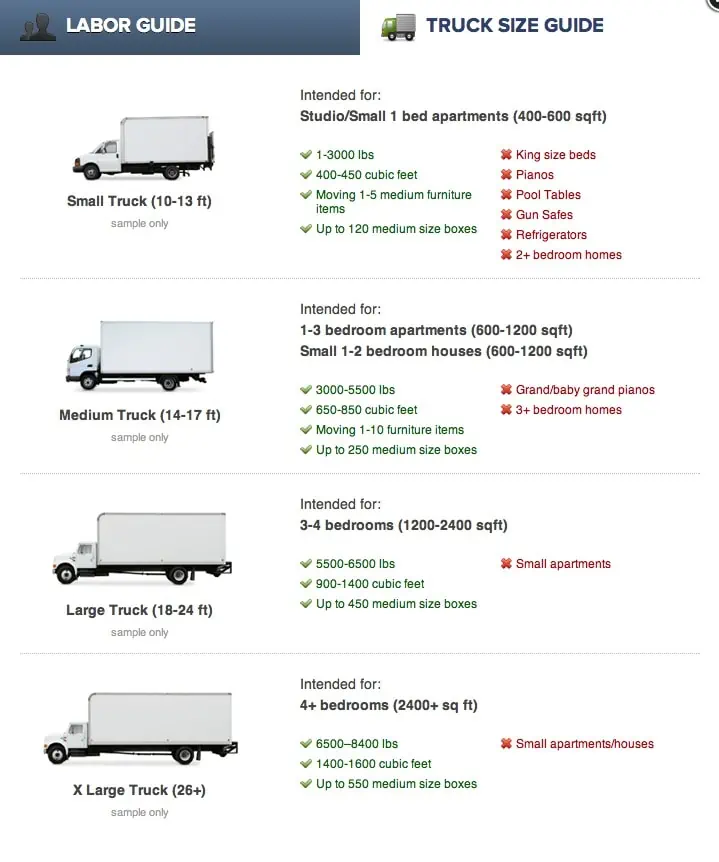
A diagram showing the best moving truck sizes for the size of home you have

However, these are just estimates, and there are some other things to consider besides just the number of bedrooms or square footage. For example, if your home has an attic, a basement, or a large tool shed, you might want to count them as another “half” room, depending on how full they are.

What’s most important is that you now have a rough idea of what you’ll need and can give that information to the movers if they ask.

How Much Help Do I Want Versus Doing It Myself?

Deciding between a DIY move and hiring professionals is a big choice. Think about your physical strength and your schedule before you decide. Here’s how movers can help with different types of moves:

  • Labor-only help: You rent a moving truck or container and handle the transportation yourself. The moving crew just loads and unloads your belongings for you. This is a great budget-friendly choice, especially if you don’t mind a container in your driveway or having to drive a big vehicle.
  • Full-service move: This option is for people who want a hands-off experience. The company brings the truck, loads it, drives it, and unloads it at your new place. They handle everything from start to finish. This is the easiest way to move, but it costs much more than just hiring labor.

Labor-only services save you a lot of money because you’re not paying for a large moving truck. However, full-service moves save you the most time and effort. Pick the one that fits your budget and your energy levels best.

What Is My Budget and Timing Flexibility?

Before you start looking at companies, decide on a firm number you can afford to spend. Moving costs can add up fast with supplies, gas, and service fees. Having a clear budget helps you narrow down your choices on our marketplace. You can also get an estimate quickly with our moving cost calculator.

If you can be flexible with your dates, you might save even more. Prices rise with demand, and most people move on weekends or at the end of the month. If you can move on a weekday in the middle of the month, your costs will be lower. Also, try to avoid the summer rush to keep your expenses as low as possible.

How Close Can the Vehicle Get to My Door?

Walk your property and look at the path from your door to the street. If a large truck can’t park close by, the movers will have to carry items a long distance. This is called a “long carry”, and some companies charge a fee for this extra work. You should also check for low-hanging trees or narrow driveways that might block a big moving van.


“…[A]sk for the name and number of one specific person to manage your move…Having a direct line to a manager or supervisor saves you time if the truck runs late.”


In busy cities, you might need a parking permit to keep a spot open for the truck. Getting a permit ahead of time will prevent costly tickets. Also, if you live in an apartment, check the building rules for moving hours. Keep all these details in mind to help your movers work faster and more efficiently.


Preparing for a Smooth Moving Day

Getting the right answers early makes the actual move feel much more manageable. Planning your move with clear information about pricing, insurance, and timing means you can focus on your new home instead of worrying about hidden fees. Be sure to take the time to vet your moving team with these questions in mind to stay on track and on budget.

Our marketplace is designed to make this process simple and transparent. You can browse local movers, read real customer reviews, and see clear pricing all in one place. Whether you need a full crew or just a few hours of help with heavy lifting, we can help you find the right fit. Once you have your answers ready, you can book with confidence and look forward to a successful moving day.


How To Seriously Lessen Your Carbon Footprint When You Move

Author:

Publish Date:

Last Modified Date:

Category: Green Moving, Moving Checklists & Planning

Tags: Tags: , , , , , , , , , , , , , ,

About 11.8% of Americans moved to a new home in 2024. That’s a lot of relocations — and a lot of extra strain on the environment.

If you’re planning a move in 2026, there are ways to reduce the greenhouse gases generated by your actions, also known as your carbon footprint. Eco-friendly and zero-waste moving requires more time and detailed planning, but it can benefit your budget and the planet. HireAHelper, we’re all about making your move easier, no matter what kind. This guide provides eco-friendly moving tips and helps you plan a green relocation by decluttering, recycling, conserving fuel, and offsetting emissions.


1. Declutter and Donate Before You Move

moving boxes

Moving is a great opportunity to go through everything you’ve collected since you moved into your current place. The less stuff you have to move, the cheaper and quicker it will be.

If you’re trying to lower your environmental impact, give yourself plenty of time for this step. That way, you’ll be less likely to toss stuff in the trash just to be rid of it, and instead, you can sort and dispose of anything you need to in a more eco-friendly way.

To start, create separate piles for items that you want to sell, donate, and throw out. You can label a few boxes or designate specific spots for each category.

Don’t wait until the last minute to deal with donations, either. Many charity organizations offer free pickups for furniture and other large items as long as you schedule in advance. It saves you a trip, and because the driver usually has multiple stops, it reduces overall emissions.

When it comes to things that can’t be donated, sold, or given away, consider recycling. It’s a great way to reduce your contributions to the landfill. You can recycle a variety of home goods, including:

  • Carpeting
  • Old mattresses
  • Scratched CDs, game discs, and DVDs
  • Stained or torn clothing or bedding
  • Large and small appliances (dryer, microwave, etc.)
  • Old electronics (cell phones, TVs, computers, printers, and stereos)
  • Crayons and dry markers
  • Ink cartridges
  • Working and non-working holiday lights

If you have old paint, cleaners, or fertilizer lying around, don’t throw them out; they can cause serious environmental damage if they leach into the ground. Call your local hazmat office and ask where you can drop them off for recycling. You can also recycle hazardous items, including solvents, motor oil, and pesticides.


2. Plan a Carbon-Neutral Move

The average move involves a lot of driving, which generates more emissions than usual. b. That will help reduce your impact, but it’s not possible to cut out emissions entirely.

That’s where carbon offsets come in. These credits help pay for projects that reduce emissions or remove CO2 from the environment. You can buy them by the metric ton to effectively bring your moving emissions to zero. This strategy is called carbon neutrality.

How to offset your carbon emissions for a move

To start, calculate the emissions for your move. Multiply the average emissions per mile by the number of miles. The average moving truck creates 10-20 pounds of carbon dioxide (CO2) per mile, and a passenger vehicle creates about 400 grams of CO2 per mile. Talk to your rental company or check the manufacturer’s website for specifics.

Once you have a rough idea of your extra emissions, add 100-200 extra pounds per person. This helps cover the extra bags of trash you’re sending to the landfill over the course of a move. Or, go the extra mile and buy enough to offset your family’s entire carbon footprint beyond the move by using the EPA’s carbon footprint calendar to estimate it.


“In general, rental crates tend to be the most eco-friendly [packing] option. While plastic bins eliminate your personal cardboard waste, a rental crate can be used for about 500 moves.”


From there, offsetting your emissions is a breeze. All you have to do is buy offsets from organizations such as the United Nations carbon offset platform and Terrapass. The money helps pay for projects including reforestation, renewable energy, and green waste management, just to name a few. Carbon offsets cost as little as $1 per metric ton, and many programs even allow you to pick which projects to fund.

How to Find Eco-Friendly Movers

Working with sustainable movers is an easy way to reduce your emissions and plan an eco-friendly move. Look for companies that use planet-friendly practices. They might have a fleet of hybrid or electric moving trucks, for example, or provide reusable plastic bins for packing. Some movers even offer carbon offsets to make your life a little easier.

As you compare companies, keep an eye out for green credentials. Many eco-friendly movers belong to groups like the Climate Action Business Association. Others have certifications from organizations such as the Green Business Certification Inc. (GBCI).


3. Create an 8-Week Green Move Timeline

Whether you’re planning a carbon-neutral move or simply trying to reduce emissions, it’s important to start early. After all, finding eco-friendly supplies and figuring out what you can recycle and donate takes time. When you give yourself a longer runway, you’re less likely to get overwhelmed by the process.

Here’s a sample 8-week timeline for an eco-friendly move:

  • Week 1: Start decluttering your home, separating items that can be donated, given away, sold, or recycled. Create a moving budget, and schedule your utility and service cancellations.
  • Week 2: Photograph items you want to sell, and create listings. Research local recycling options for electronics, appliances, and other household goods.
  • Week 3: Schedule large-donation pickups. Organize other donations by organization, and try to make all drop-offs in one trip. Pack documents and other important records, plan maintenance, and start changing your address.
  • Week 4: Compare quotes from eco-friendly movers and book your date. Buy or rent reusable packing bins and biodegradable packing materials, and stock up on tape. This is also a good time to start working through the food in your house to reduce waste.
  • Week 5: Start packing things you’re not using, such as holiday decorations, out-of-season clothing, and sporting goods.
  • Week 6: Drop off recyclables at your local recycling center. Bring large waste items to a nearby Waste Management site or set out for curbside pickup. Continue packing clothing, toys, and non-essentials.
  • Week 7: Forward your mail, and pack non-perishable foods. Start deep-cleaning packed rooms with non-toxic, biodegradable products. Pack the remaining rooms.
  • Week 8: Confirm move details with your movers. Dispose of any remaining trash or recycling. Clean remaining spaces. Leave out essential items for moving day.

The key to stress-free green moving is to declutter and pack gradually. Tackle projects slowly, pack as you go, and you won’t need to rush before you hit the road. And for tips on what to do during and after the move, check out our green move checklist.


4. Packing Materials: Life-Cycle and Cost Comparison

Packing materials are the perfect opportunity to create a greener move. Your packing containers make up the bulk of the supplies you need, which means that they offer the biggest potential for reducing emissions and waste.

Here are 3 green options to consider:

  • Cardboard boxes: While they’re affordable and readily available, cardboard boxes have the shortest life cycle of all packing containers. At about $1-$8 each, they also have a relatively high cost per use. Reduce your impact by finding used boxes, and if you must purchase new, look for options made from post-consumer recycled materials. After the move, make sure to give away or recycle the boxes to reduce CO2 emissions.
  • Reusable plastic bins: Basic bins cost about $10-$20 each, but you can use them to store everything from holiday decorations to tools and off-season clothes. These bins can cut your carbon emissions by up to 29% compared to cardboard boxes. Plus, they stack easily in your moving truck, garage, or storage space.
  • Rental crates: For the lowest emissions and cost per use, check out rental crates. These sturdy plastic crates can be used over and over again by multiple people, drastically reducing emissions. And if you rent a multi-bin package, the cost per bin is usually between $3 and $5.

The best option for you depends on your needs. If you have a lot of stuff to store and organize once you get to your new home, it’s simple to find uses for plastic bins. However, if your new place doesn’t have much space, rental crates are probably a better way to reduce waste. And if your top priority is cost-cutting, try to find free, gently used cardboard boxes.

Once you’ve settled on containers, consider the other materials you’ll need. Choose eco-friendly cornstarch peanuts instead of styrofoam peanuts, which don’t biodegrade (at least, not in our lifetime). You can also use recyclable bubble wrap or corrugated cardboard wrap. When it comes to tape, consider biodegradable paper tape made with a water-activated adhesive.

Comparing Eco-Friendly Packing Materials

Packing Option Lifecycle Cost CO2 Savings
Cardboard boxes 1-2 uses, recyclable $1-$8 per box Low
Plastic bins 5-10 years, recyclable $10-$20 per bin Medium
Rental crates 3-5 years, recyclable $3-$5 per crate High

In general, rental crates tend to be the most eco-friendly option. While plastic bins eliminate your personal cardboard waste, a rental crate can be used for about 500 moves. In other words, they prevent a lot of boxes from ending up in the landfill.


5. Zero-Waste Moving-Day Kit Checklist

If you’re serious about going green, a zero-waste move could be the right fit. Planning is key — when you’re prepared with a zero-waste kit, it’s easier to avoid disposable materials. Wait until the last minute, and you’ll be running to the store to stock up on boxes and plastic tape.

Here’s what to include in your moving-day kit:

  • Rent reusable crates: Moving companies often rent reusable, heavy-duty moving crates that come in many shapes and sizes. When you’re done moving, simply return the boxes. Assemble the crates about 2 weeks in advance to make sure they’re ready to go.
  • Sustainable crate labels: Rental crates may come with reusable labels. If not, look for biodegradable or compostable labels.
  • Washable padding: Instead of disposable packing paper, pad your boxes with towels, sheets, or even pillows and clothes. You’ll save space, and you can simply wash the items after the move.
  • Refillable cleaners: Transport the bottles during the move, and refill them at your new home to reduce plastic waste.
  • Multi-use straps: Secure your stuff in the moving truck with ratchet straps. You can reuse the straps for camping, hanging gear, or securing a kayak to the top of your car.

A good money-saving tip is to pack as much as you can in empty drawers, laundry baskets, suitcases, tote bags, and other containers you already have on hand. Then, you can rent fewer crates and reduce the weight in the moving truck.

If crates aren’t an option, source free cardboard boxes from friends and local stores. Close them by interlocking the flaps rather than taping. Instead of plastic sheeting, cover mattresses and other large items with blankets, sheets, or a drop cloth.


6. Energy and Fuel Efficiency During the Move

If you’re hiring a moving company, you don’t have control over the road they take or how much fuel they use. Don’t worry — conserving gas boosts the bottom line, so moving companies plan their loads and routes carefully. When you’re booking through the HireAHelper platform, check out each company’s listing to find out if they use fuel-efficient hybrid or electric moving vehicles.

If you’re moving yourself, here’s what you can do to save on gas:

  • Plan your route. Take a route to your new place that will use the least amount of gas. The best route may be the shortest, or it may be a longer one with less traffic congestion — and therefore, the fewest idling stops. Most traffic apps offer the option to filter by fuel-efficient routes.
  • Make as few trips as possible. The fewer trips you need to take to get your stuff to your new place, the less fuel you’ll use and the more eco-friendly your move will be. The same logic applies when you’re dropping things off for recycling and donation.
  • Optimize your load. When you’re packing, fill your containers as full as possible so you’ll need fewer of them. Pack your things in the vehicle(s) carefully to reduce wasted space. Efficient packing allows you to use a smaller truck with lower emissions.

You can also save on energy by turning off the HVAC during the move. Since your doors will be wide open while you’re loading boxes into the moving truck, turn off the heat or A/C to save energy. Keep the lights off when possible. If it’s extremely hot or cold outside, move everything close to the front door to speed up the process and keep everyone comfortable.


7. Post-Move Reuse and Recycling

eco friendly packing

A move isn’t really eco-friendly until you deal with the leftover boxes and packing materials. As you unpack each box, set the packing materials aside. Give usable boxes to friends, or put them up on a free online marketplace for people to claim. Some moving companies, including U-Haul, allow you to drop off used boxes for other people to take.

If the boxes are too beaten up to be reused, recycle them. Create separate piles for boxes that can be recycled curbside and boxes you’ll need to drop off. Remove tape from the cardboard before you break down the box.

Are you planning to set up a compost system in your new home? Many types of cardboard and packing paper are compostable, so you might be able to avoid recycling completely. Just make sure to shred them into small pieces before adding them to the pile. You’ll eliminate waste and help your new garden or flower beds grow.


A New Start: Sustainable Living in Your New Home

Now that you’re all settled in, take a deep breath, relax, and take a good look around your new place. Now’s the best chance to evaluate what you can do to reduce your carbon footprint and your utility bills as you settle into your routine.

Protect your air quality

Poor air quality in your home is bad for your health and for the environment. Keep your indoor air quality as high as possible by:

  • Using eco-friendly wall paint: Paint is notorious for off-gassing volatile organic compounds, or VOCs, into your home. Plus, the production of conventional paint has serious environmental consequences. When it’s time to decorate, choose low-VOC paint, which is less harmful to the environment and your health.
  • Switching to non-toxic cleaners: Conventional home cleaning products often contain toxic chemicals that can end up in our natural waterways and poison aquatic wildlife. Consider buying non-toxic cleaners or using vinegar and baking soda to get the entire place sparkling clean.
  • Changing the HVAC filter: A dirty filter makes your HVAC system work harder, which uses more energy. Inspect your filter each month, and replace it when it’s dirty.

Conserve energy and lower your utility bills

The less energy you use at home, the better it is for the environment, and the lower your gas and electricity bills will be. Here’s how to conserve energy in your new home:

  • Maintain your furnace and A/C. Your HVAC system is responsible for a large portion of your home’s energy consumption. Keeping it in tip-top shape can reduce your costs and emissions. Each year, schedule professional service for your furnace and AC.
  • Install solar panels. Consider installing solar panels on your home. Solar power generates zero emissions during operation and cuts your electricity costs.
  • Invest in ENERGY STAR appliances. When something breaks, replace it with an ENERGY STAR appliance. These efficient models can help you use up to 30% less energy and avoid 77,000 pounds of emissions over the product’s lifetime.

Conserve water

Less than one percent of the earth’s water is available for human use, so conservation is up to everyone. Here are some ways to do it at home:

  • Install low-flow fixtures. These efficient fixtures can reduce your water usage by up to 30%. They’re easy to install, and they don’t affect the quality of your showers, the cleanliness of your dishes, or the force of your flush.
  • Run the shortest cycles on the dishwasher and washing machine. Unless your clothes or dishes are heavily soiled, the shortest cycle will get them clean and save a lot of water.
  • Re-think your lawn. Lawns are one of the worst offenders when it comes to environmental damage. Use less water and ditch the fertilizers and pesticides by switching to a low-maintenance xeriscape or native garden to help your local wildlife.

Finally get your household waste under control

Every year, the U.S. produces 12% of the world’s trash. With a recycling rate of just 32%, most of that waste goes to the landfill. There, it breaks down into methane, carbon dioxide, and other poisonous gases.

If you don’t already, start recycling. Other ways to reduce waste include:

  • Going paperless: Opt for paperless bill paying, invoicing, and receipts. Then, opt out of junk mail.
  • Composting: A backyard compost pile can dramatically reduce food waste. Food isn’t the only thing you can compost — toss in non-glossy paper, cardboard, natural fabrics, and wine corks.
  • Buying in bulk: Food packaging makes up nearly half of all municipal waste, and it ends up in waterways and inside wildlife as microplastics. To reduce your contribution, buy your food in bulk, and bring your own bags to the store.

Frequently Asked Questions

What is a carbon-neutral move, and how do I plan one?

A carbon-neutral move happens when you reduce and offset the extra emissions created by your moving activities. You can plan one by reducing waste, using reusable plastic crates, renting fuel-efficient moving vehicles, and taking fewer trips. It’s also helpful to book low-emission movers on the HireAHelper platform. To make up for the remaining emissions, consider buying carbon offsets.

Where can I find eco-friendly movers?

Use HireAHelper to research eco-friendly moving companies in your area. You can read mover profiles and reviews on our platform that often mention a company’s commitment to green moving and the services they provide. Other ways to find green movers include:

  • Researching individual moving company websites
  • Calling local movers to ask about their environmentally friendly practices
  • Contacting local sustainability groups for recommendations

As you compare moving companies, look for businesses that offer reusable rental crates, hybrid or biodiesel trucks, and paperless billing. Some movers also use route-optimization software to maximize fuel efficiency and cut emissions.

What moving companies offer eco-friendly moving options?

Moving companies that offer eco-friendly moving services include:

  • Gentle Giant Moving Company (reusable supplies, recycling, biodegradable materials)
  • U-Haul (rental crates, sustainable energy, box reuse)
  • Green Van Lines (crate rentals, tree planting)

You can also find sustainable local movers through HireAHelper. Look at the company description and reviews to find information about green practices and fuel-efficient fleets.

How can I find electric or biodiesel moving trucks?

If you’re booking labor-only movers through HireAHelper, you can plan a green move by renting an electric or biodiesel moving vehicle. Penske and Ryder rent electric cargo vans. For small moves, you might be able to get away with a large electric pickup rental from a regular car-rental company. Biodiesel rentals aren’t as common, so you’ll have to check with local providers in your area.

What are the most sustainable packing materials?

When you’re planning an eco-friendly move, look for packing supplies that can be reused — or, if necessary, recycled. Reusable items are a great way to reduce waste. Recyclables have fewer emissions than disposable items, but they’re not completely green. The most sustainable packing materials are:

  • Plastic packing crates or bins
  • Washable padding
  • Biodegradable or compostable packing paper and packing peanuts
  • Recyclable paper tape

How do I assemble a zero-waste moving-day kit?

As you build a zero-waste moving kit, make sure to include rental moving crates, sustainable labels, and reusable packing materials. Instead of traditional disposable cleaning supplies, look for containers you can refill and reuse. Build the crates at least 2 weeks before the move, and if they’re not in the budget, consider getting free boxes from Facebook Marketplace or local buy-nothing groups.

How do I set up recycling and composting after I move in?

Once you get to your new home, check the city website for details about curbside recycling. If that’s not available, find the nearest recycling and hazardous waste drop-off centers. If you’re planning to compost, build a slatted wooden bin in the yard. Alternatively, invest in a compact indoor composter if your new place doesn’t have outdoor space.

How-To Guide for Getting the Best Rental Truck For You

Author:

Publish Date:

Last Modified Date:

Category: Moving Trucks

Tags: Tags: , , , , , , , , , , , , , , , , , , , , , , , , ,

The easiest way to get the best rental truck is to know a few things ahead of time: what size you need, what your budget is, and which company you want to use. Few people would argue that moving is a huge undertaking, especially if you’re DIY-ing it all. And undoubtedly, the most important part of planning is renting the truck that’s going to transport you and your stuff to your new home.

The process of renting a truck is pretty easy, but finding a good deal on a truck that’s both reliable and big enough to hold all your belongings is the challenge.

Read on to find out how to snag a rental truck that fits your needs, preferences, budget, and — most importantly — your stuff, no matter if you’re hiring labor-only movers or doing a full DIY move.


Figuring Out What Size Truck You Need

Before you book, figure out exactly how much space you need in the truck to haul all of your belongings. Finding out your stuff won’t fit in your U-Haul is a huge hassle and a bigger expense if you end up having to take two trips.

Rental trucks come in certain sizes, and they’re usually tied to how many rooms your home has. For example, studio apartments can fit in a 10-truck, while 4 or 5 bedrooms could require 26. And it’s not just the size of your home that matters. If you live a minimalist lifestyle, you might be able to get away with a smaller truck, but if you have an attic/basement and a ton of furniture, you may need a size up.

Here’s a look at standard moving truck sizes and approximately how many boxes and furniture items they can hold:

Small truck (10-13 feet)

  • Studio apartment
  • 120 boxes
  • 1-5 medium furniture items

Medium truck (14-17 feet)

  • 1-3 bedroom home or apartment
  • 250 boxes
  • 1-10 medium furniture items

Large truck (18-24 feet)

  • 3-4 bedroom home
  • 450 boxes
  • 1-15 medium furniture items

Extra-large truck (26+ feet)

  • 4+ bedroom home
  • 550 boxes
  • 1-20 medium furniture items

For specifics, check out our moving truck rental guide.

If you find yourself waffling between sizes, always go with the bigger one. Thedifference in price is negligible compared to what a second trip would cost, and will more than compensate for the stress of not knowing if all your stuff will fit.

Local vs. Long-Distance Moves

The distance of your move can affect the truck size you choose. If you’re moving locally and you accidentally get a truck that’s too small, you can make another trip (although that gets expensive). That’s not an option for long-distance moves.

Some contracts include unlimited miles, while others charge by the mile. Figure out how far you’ll be driving, and run the price calculations before making a final choice.


“Most providers require you to be at least 18 to rent a moving truck, though some may limit truck rentals to people aged 21+. You’ll also need a valid driver’s license.”


For long-distance moves, it’s also important to book your moving truck in advance. Aim for 2-3 months out, especially if you’re moving in the peak summer season. You’re more likely to get the size you want, and you won’t need to rush to find a last-minute rental.


Comparing Rental Truck Companies

Some of the top truck-rental companies in the U.S. are U-Haul, Penske, Budget, and Enterprise. Each one has a nationwide presence, which means it’s pretty easy to find a branch in most areas. You can also consider Ryder for business moves.

All major rental truck companies offer a variety of truck sizes, and many offer both local and long-distance moves. Enterprise, however, doesn’t allow one-way truck rentals.

As you’re choosing a provider, consider the fleet condition, mileage policy, and additional fees. Mileage is especially important if you’re moving long-distance.

Comparing Major Nationwide Truck Rental Companies

U-Haul Penske Budget Enterprise
Fleet Quality Good Excellent Good Good
Mileage Policy Base mileage allowance plus a fee for extra miles — $1.19 for one-way rentals and variable for local moves (usually $0.50 – $1.50 per mile) Unlimited miles for one-way rentals, $0.99-$1.49 per mile for local miles One-way moves include base mileage plus a fee for additional miles — $0.80 per mile if purchased in advance or $1.00 per mile otherwise. For local moves, fees are usually $0.79 – $0.99 per mile. Local moves incur a per-mile fee ranging from $0.29 to $0.79.
Fees Environmental fee Environmental fee, recovery fee Recovery fee, fleet management fee Security fee, recovery fee
Best Use Cases Local moves, one-way moves Long-distance moves Local and regional moves Local moves

Whose Trucks Are the Most Reliable?

Overall, Penske seems to have the best reputation for clean, reliable trucks. Their fleet is the newest, and their trucks are fuel-efficient and high-quality.

But you can find good and bad reviews on every rental company, so it’s important to do your research. And keep in mind that a lot of reviews are heavily tied to the region. A truck company might have a stellar reputation overall, but the branches near you have poor reviews and customer service.

Reliability matters for the company, too. Forbes recently conducted a comprehensive survey of five nationwide rental companies, and Penske came out on top there, too.

Again, your results may differ! There’s also availability to consider, as well as other company rules or services that could make a specific truck rental less than ideal for your move.


Rental Truck Cost Breakdown

Two white Penske rental cargo trucks parked in a lot, displaying the brand's name and logo

Rental truck prices vary considerably based on the type of move, location, and distance. Every company has its own pricing structure, and things like mileage and base fees can vary by location.

The typical breakdown of a standard rental truck cost goes like this: Total cost = Base rate + mileage + fuel + one-way fees + surcharges.

But if things like base rate and mileage are different between companies, how much does a moving truck really cost? Should you go with Penske or choose between Budget and U-Haul?

We’ve broken down the costs for each moving company. This data comes from our proprietary internal Rental Truck Cost Database, which includes more than 10,000 real rental truck transactions from HireAHelper customers.

Comparing Costs and Truck Types for Major Nationwide Rental Companies

Companies Budget Penske U-Haul Enterprise
Reviews 4.5/5 4.8/5 4.8/5 4.77/5
Local Moves $79 $149 $131 $92
Regional Moves $472 $884 $777 $550
Long Distance $928 $1,741 $1,530 $1,083
Truck Sizes Pickup, cargo van, 12 ft, 16 ft, 26 ft Cargo van, 12 ft, 16 ft, 22 ft, 26 ft Pickup, cargo van, 10 ft, 15 ft, 17 ft, 20 ft, 26 ft 16 ft cabover, 24 ft box, 26 ft box
Gas Mileage Up to 10 to 19 MPG Up to 12 to 13 MPG Up to 6 to 14 MPG Up to 12 to 24 MPG
Locations 2,800+ 2,500+ 21,000+ 460+

Which Company is the Cheapest?

Mileage costs make a difference, and even the cheapest moving trucks can get pretty expensive if you’re going a long way.

For example, take U-Haul and Penske. We did a side-by-side comparison of the two by performing the same move. For a short local move, U-Haul will most often be the cheaper option. Penske, with its fuel-efficient trucks and unlimited mileage for one-way moves, can prove the more economical choice for longer moves.

You can also check out our cost comparison of Penske, U-Haul, Budget, Enterprise, and Ryder.

Keep in mind that your final quote may depend on a few additional factors:

  • Number and quality of trucks available
  • Where you live (prices may be higher in high-demand cities or regions)
  • Where you will be dropping your truck off (for one-way moves)
  • Your scheduling flexibility

Ways to Get a Better Deal on Your Rental Truck

When it comes to renting moving trucks, prices aren’t set in stone. Here are a few ways to save:

  • Pick your moving day wisely. When demand rises, so do costs. Off-peak weekday and mid-month rental can save you both stress and money. For more, check out our guide on the best time to move.
  • Find a dealer somewhere out of town. Smaller branchesout of majors town might be eager to have your business and make a deal.
  • Consider a round-trip rental. You might be able to score a deal by leaving your car behind, moving, returning your rental, and driving back. Your savings may be offset by the extra time and gas, however, so weigh your options carefully.
  • Ask about high-priority locations. If you can return the truck to a location convenient for them, the company might give you a good deal. For example, if you’re moving to Eugene, Oregon, you could save by dropping your truck off in Portland.
  • Make phone calls. Call and ask about deals that don’t show up online. Be friendly and persistent — you never know what could happen.

Urban Moves: Permits, Parking, and Clearances

Truck parking is limited in cities, so check to see if you need permits to block off parking spaces. If you live in an apartment, you might also need to reserve the loading dock or elevator. Always avoid blocking driveways and roads, and respect other residents by loading efficiently.

Check the rules if you’re moving in or out of an HOA, since many of them restrict where you can park and when you can move.

Before you hit the road, know the clearance height of your moving truck. Then, map your route using a tool like Low Clearance Map or the U-Haul app to check for low bridges to avoid.


Equipment and Add-On Checklist

Whether you’re hiring movers or doing everything yourself, you’ll probably need some moving supplies. After all, the right equipment can make your moving day run a lot smoother.

Here are some supplies to consider:

  • Dollies: These wheeled platforms are ideal for heavy boxes or furniture
  • Furniture pads: Use these to wrap furniture and prevent scratches and nicks
  • Straps: Useful for holding down furniture pads and securing heavy loads inside your moving truck
  • Ramps: These make it easier to move heavy items in and out of the truck box

Your rental company may be able to include some supplies with your truck. Alternatively, check with local moving and home stores.


Safety and Driving Tips

If you’re new to big trucks, driving one can feel intimidating. To feel more confident on the road, think about practicing in an empty parking lot.

You can also learn the best practices for driving one before you get behind the wheel. Here are some skills you’ll need:

  • Turns: Trucks have a big turning radius, so give yourself plenty of clearance.
  • Braking: It takes longer for loaded trucks to stop, so drive slower, keep a larger following distance, and brake early and gradually.
  • Fueling: Verify your truck’s fuel type and fuel cap location before you get moving.
  • Height and weight limits: Write your truck’s height and gross vehicle weight rating (GVWR) on a sticky note, and keep it in the cab for quick reference.

Take time to adjust your seat and mirrors and get familiar with the controls before you start. And remember that driving a moving truck can be tiring, so make sure to take plenty of breaks.


Towing Options Overview

If you’re moving with a personal vehicle, you might want to tow it with your moving truck. This can be a great option if you’re doing a long-distance move alone, or if you have more vehicles than drivers.

For small, front-wheel drive vehicles, a car dolly might be a good option. It lifts the front wheels off the road. A flatbed car trailer lifts all four wheels, making it a good option for pretty much any vehicle.

To tow a car, your moving truck will need a hitch that can handle the weight. Ask the moving company which trucks are compatible with your specific vehicle. Keep in mind that your trip will probably take longer — many companies recommend a maximum speed of 55 MPH for car trailers and dollies.


Requirements and Policies Primer

Most providers require you to be at least 18 to rent a moving truck, though some may limit truck rentals to people aged 21+. You’ll also need a valid driver’s license.

Plan to reserve your rental with a credit or debit card, and expect an additional hold of about $100 to $500 for a security deposit. Some companies will accept cash, but you may need to make a larger deposit.


 “For a short local move, U-Haul will most often be the cheaper option. Penske, with its fuel-efficient trucks and unlimited mileage for one-way moves, can prove the more economical choice for longer moves.”


In general, you’ll need to return the truck with the same amount of fuel it had at pickup. Otherwise, you’ll pay a fee. Companies may also charge a cleaning fee if the truck is returned dirty.

Many truck rentals require proof of insurance. Your regular car insurance might cover smaller vehicles, but you’ll probably need supplemental insurance for bigger trucks. You can purchase several types from the company:

  • Collision damage waiver (CDW): Covers damage to the truck
  • Cargo protection: Reimburses you if your stuff is damaged
  • Medical insurance: Provides extra medical coverage if you’re hurt

Planning Your Best Rental Truck Experience

To make your rental process go smoothly, make sure youcompare quotes from a few different providers, and think about booking an off-peak moving day to save money. And no matter what type of move you’re planning, try to book early to get the best deals and availability.

When you pick up the truck, inspect it carefully. Report and document any damage to the company — this simple step can protect you from future claims. Trucks are expensive, and a little legwork up front can save you a lot of money down the road.


Frequently Asked Questions

How do I estimate which truck size fits my move?

In general, small trucks (10 to 13 feet) fit studio apartments, medium trucks (14 to 17 feet) fit 1 to 3 bedroom homes, and large trucks (18 to 24 feet) fit 3 to 4 bedroom homes. Your perfect size depends on how much stuff you have, so use your moving company’s load calculator for a more accurate estimate. When in doubt, opt for a bigger size to give yourself some buffer space.

Can I pick up my rental truck the evening before my move?

Yes, many rental companies allow evening pickups. It can depend on availability, however, so consider calling the day before your move to check if your truck is ready for pickup. Some companies offer this service for free, while others require a small charge.

What insurance coverage do I need for a long-distance move?

Personal car insurance and credit card insurance policies often exclude box trucks, so confirm with your provider to be sure. To avoid paying out-of-pocket for damage, you can buy a collision damage waiver directly from the rental company. Some providers also offer higher-tier coverage for your belongings and the people inside the truck.

Are there age or license requirements for renting a truck?

You’ll need to be at least 18 to rent a moving truck (21 in some cases), but a standard driver’s license is acceptable for most truck sizes. Some companies charge additional fees for drivers under age 25. Keep in mind that most providers require an additional security deposit, which is charged as a hold on your credit or debit card.

Guide to Moving from LA to NYC

Author:

Publish Date:

Last Modified Date:

Category: Long Distance Moving Advice, Neighborhood Advice

Tags: Tags: , , , , , , , , , , , , , , ,

In 2024, about 11.8% of Americans moved to a new home, and some of those relocations were from coast to coast. Taking on a cross-country move, like moving from Los Angeles to New York City, is a huge change and undertaking. Something like that requires a solid plan.

Not only does a long-distance move have more to consider when it comes to logistics, but it’s also way more expensive than a local move. You can’t really get around that part, but there are ways to save, like hiring labor-only movers who will take care of just the loading and unloading while you handle the truck or moving container. You can also use HireAHelper’s platform to easily find movers to help at both ends of your move, no matter the distance.

If you’re planning a move from Los Angeles to NYC, this guide will walk you through the whole process, including the major differences between the two cities and the steps to take when planning your move to make everything as easy and stress-free as possible.


From Coast to Coast: What You Need To Know When Moving from LA to NYC

Moving across the country is more than just a long drive. You’ll face changes in how you travel, where you live, and even daily costs. Let’s break down the biggest shifts, so you know what to expect.

LA vs. NYC: Transportation and Car Ownership

la to nyc move

Los Angeles is built for cars. It’s infamous for its traffic, most people drive daily, and parking is part of life. But New York City is the opposite, with subways, buses, and walking being the main ways to get around. Parking is rare and can cost hundreds each month.

If you own a car and you’re moving to NYC, you’ll need to decide whether to sell it, tow it, or drive it cross-country. If you choose to bring it, HireAHelper makes it easy to book labor-only movers to load it onto the trailer safely.

LA vs. NYC: Culture

While it might not end up being your experience in either city, both tend to have pretty different vibes. LA is known for being laid-back and spread out, where people often meet for hikes or beach days. In NYC, the energy is faster and louder. The city feels much more dense, and people are always on the move. You will swap “LA time,” where being late is okay, for a city that runs on a tight clock.

NYC is also, in fact, the city that never truly sleeps. You can find a hot meal or an open shop at 3 am, while West Coast cities like LA tend to close up shop earlier in the night. You’ll also be trading the sunny, outdoor life for a world of museums, Broadway shows, and late-night subway rides.

LA vs. NYC: Neighborhoods

Picking the right spot to live is a big decision. Not only do you have to consider your budget, but you probably don’t want to live an hour and a half from work or your kids’ schools, either. Not to mention, each area has a unique feel and culture that might or might not match your lifestyle. Here’s a look at the four main boroughs for newcomers, so you can get an idea of what might be your perfect match:

  • Manhattan: This is the heart of the city with the most famous sights. It’s also the most expensive area to live. The average rent for a one-bedroom apartment is about $4,040/month. It’s perfect if you want to be close to the action.
  • Brooklyn: Many people move here for a mix of trendy shops and quiet streets, and it is a neighborhood that might feel a bit more like some parts of LA to you. The average rent for a one-bedroom is around $2,972/month. It offers great food and a strong sense of community.
  • Queens: This borough is famous for its diverse food and multiculturalism. Plus, it’s a great place to find more space for your money. The average rent for a one-bedroom is about $3,479/month. It’s a bit quieter but still very close to Manhattan.
  • Staten Island: This is the most affordable borough and feels very residential. It has more green space and feels like a suburb. The average rent for a one-bedroom is around $1,721/month. You will likely need a car or use the ferry here.

Your choice should also match the lifestyle you want. Some people love the rush of a busy street, while others want a quiet park nearby.

LA vs. NYC: Apartment Hunting

In Los Angeles, you might spend weeks driving to different open houses with plenty of parking, but in New York, the market moves much faster, and apartments can be gone in a single day. You need to be ready to sign a lease the moment you find a place you like. Here are some other aspects of the apartment and home hunt in NYC to keep in mind:

  • Virtual tours: If you can’t visit in person, ask for a live video walk-through. This helps you see the true condition of the unit and the building hallway before you commit.
  • Short-term rentals: Consider booking a furnished short-term room for your first month. This gives you a temporary place to stay while you hunt for a long-term apartment in person.
  • The 40x rule: Many NYC landlords require your annual salary to be at least 40 times the monthly rent. For a $3,000 apartment, you would need to earn $120,000 a year.

To keep on track and have everything you need to do in mind, make sure to follow these steps:

  • Research NYC neighborhoods and average rents.
  • Gather pay stubs and tax returns for your rental application.
  • Set a firm moving date and request time off work.
  • Book labor-only help on HireAHelper’s platform for loading in LA.
  • Find local help on our marketplace to unload your truck in NYC.

LA vs. NYC: Weather

In LA, the weather is mostly sunny and warm all year, but New York has four distinct seasons, and the weather can change quickly. You’ll experience humid summers and freezing winters with snow. Some parts of the city, like neighborhoods near the water, can feel much windier and colder than others.


“Most apartment buildings in NYC require a Certificate of Insurance (COI). This is a document that proves the movers helping you have insurance. If you don’t have one, the building manager might not let you move in.”


This means you’ll need to change your wardrobe and swap your flip-flops and light jackets for heavy wool coats and waterproof boots. And you’re more limited in what you can do outdoors during certain times of the year. In LA, you can go for a day at the beach or a hike in the sun nearly 365 days a year. In NYC, you might spend winters visiting museums to stay warm.

LA vs. NYC: Cost Comparison

Moving from LA to NYC will change how you spend your money. While LA is notoriously expensive, NYC often sits at the top of the list for high costs. You’ll likely pay even more for your home and your daily needs, so it’s important to look at the numbers before you pack your bags.

Housing is the biggest cost you’ll face. Rent in New York is much higher than in Los Angeles. But you’ll also find that grocery prices are higher in the city.

Even though some things cost more, you might save money on transportation. In LA, you have to pay for car insurance, gas, and repairs, but in NYC, you can often skip the car and use the subway or walk to your destination.

LA vs. NYC: Cost Comparison Table

Los Angeles New York City
Median Home Price $1,348,783 $2,968,160
Average Rent $2,165/month $4,040/month
Est. Salary for a Comfortable Lifestyle About $111,000/year before taxes About $169,000/year before taxes
Grocery Premiums 8% higher than the national average 17% higher than the national average
Transportation 35% higher than the national average 20% higher than the national average

Figures from Apartments.com. Salary estimates are for a single adult without dependents.


The Mover’s Guide for How To Get From LA to NYC

Moving across the country takes a lot of work. You’ll need a clear plan to handle the long distance. This section will help you manage your belongings and pick the best way to move your life to New York.

Packing Early and Deciding What To Bring

Starting as early as you can is the best way to lower your stress. Don’t wait until the last week to put items in boxes. One of the biggest rules for moving is that the less stuff you have, the cheaper and faster it will be, so you should begin by going through every room and deciding what you truly need in your new NYC home.

  • Donate or sell furniture you won’t need
  • Use sturdy bins for fragile items
  • Label boxes by room for easy unpacking
  • Pack a “first week” bag with clothes and basics

Remember that New York apartments are often smaller than those in LA. You may not have room for a giant sofa or a massive dining table. Focus on essentials and things that matter most.

Shipping Options for Furniture and Personal Items

There are many ways to get your stuff to the East Coast. You should pick the one that fits your budget and how much work you want to do. Here’s a look at your main options:

LA to NYC Moving Options

Option Pros Cons Cost Range
DIY Move (Rental Truck) Full control, cheapest option upfront Driving long distance, fuel costs $1,700-$2,200
Moving Container No long drive, flexible timing Limited space, street permits needed $3,500-$4,200
Labor-Only Help Low-effort option, saves time You still handle the driving $3,300-$3,800
Full-Service Movers handle everything Most expensive option $8,500+

Timing Your Move

The time of year you move can change your experience. Summer is the busiest time for moving, and prices are often higher. If you can, try to move in the late fall or winter, and try to schedule your arrival for mid-week. By doing this, you might find better deals on rental trucks and movers. Traffic is usually lighter, too, and it’s easier to find a place to park your truck near your new building when you move during off-peak times.

You should also keep an eye on the weather as your move date gets closer. Moving into NYC during a snowstorm is a big challenge.

Coordinating Utilities, Internet, and Mail Forwarding

Don’t wait until you arrive to set up your new home. You want the lights, water, and internet to work the moment you walk through the door, so call utility companies in NYC at least two weeks before you move.

You should also visit the post office or go online to set up mail forwarding. This ensures your bills and letters find you at your new address. Also, remember to cancel your services in LA for the day after you leave to avoid paying for two places at the same time.

Consider a Temporary Location

nyc move

If you’re not sure where to live yet, think about a short-term stay. You can rent an Airbnb or a furnished room for a month. This gives you time to explore different neighborhoods in person without any rush.

It also makes the actual moving day easier. You can put your items in a storage unit while you look for a long-term lease. Having a place to stay for at least a little while in New York before your move takes the pressure off and lets you make a better choice for your future home.


Preparing for Move-In Day in NYC

Moving to a new city is exciting, but moving day always requires a plan. New York buildings have strict rules that you might not find in LA. Being ready will help your move-in go smoothly without any last-minute surprises.

Measuring Entryways

Before you load your truck in LA, make sure your furniture will actually fit in your NYC home. Many New York buildings have narrow hallways, tiny stairwells, and small doorways. Use a tape measure to check these spots:

  • The width of your front door
  • The height of the elevator
  • The tight corners in the stairwell

For example, if your sofa is too big, you might need to take it apart or outright get rid of it. It’s much better to know this now than to get stuck on the sidewalk on moving day.

Securing Building Insurance Proof

Most apartment buildings in NYC require a Certificate of Insurance (COI). This is a document that proves the movers helping you have insurance. If you don’t have one, the building manager might not let you move in.

Ask your landlord or building manager about their specific COI rules early. Then, check with the movers you book through our platform. They can often provide the right proof to meet the requirements of your new building.

Reserving Freight Elevators and Parking

In NYC, you can’t just use any elevator to move boxes and furniture. Many buildings require you to book a “freight elevator” in advance. These are larger elevators used only for moves. Call your landlord to reserve a time slot, as they can fill up fast on weekends.


“[In] New York City…. [p]arking is rare and can cost hundreds each month. If you own a car and you’re moving to NYC, you’ll need to decide whether to sell it, tow it, or drive it cross-country.”


Parking is another big challenge. You should look into getting a parking permit for your truck or container. Without one, you might have to park far away or face a heavy fine. But getting a parking permit isn’t just about keeping things legal. It also makes sure no one takes the spot close to the curb that you need to move your stuff inside.

Scheduling Unloading Help

After driving across the country, the last thing you want to do is carry a heavy couch up three flights of stairs. But full-service moving companies are expensive, especially for long distances. A good compromise is to book local movers to help you load and unload your stuff. You can use HireAHelper’s marketplace to find local pros in NYC who know how to handle city moves.

Schedule your help to arrive at least an hour after you think you will get there. This gives you time to pick up keys and park the truck. Having a fresh crew ready to do the heavy lifting will make your first day in the city much better.


How to Haul All Your Stuff to NYC

One of the biggest questions you have to answer when moving cross-country is how you’re going to get you and all your stuff from point A to B. The good news is you have a few options to choose from:

Do-It-Yourself

la to nyc move

Some people think the main advantage of DIY is saving money, but this may or may not be true depending on how you go about it. Consider that the 40-hour drive from LA to NYC takes about four days on average to complete — and that’s with an average vehicle, not a large moving truck.

You’ll have to think about paying for gas across about 2,800 miles. And the cost of parking at hotels and motels along the way.

Full-Service

Many people enjoy using moving services that do packing, move-out, transport, move-in, and unpacking, or some combination of those options. The obvious perk is convenience. You don’t have to think about any other logistics or drive a huge moving truck across miles of highway. However, it’s by far the most expensive option, often thousands of dollars more than DIY, labor-only, or moving containers. Plus, it’s important to find a company you trust, since they’re handling every element of your move.

Moving Containers

A solution like PODS might be ideal for moving to NYC, because moving container companies give you both storage and moving in one service, and you only have to load and unload one time. With moving containers, the company drops one off at your home, you pack all your stuff up at your own pace, and once you’re done, the company comes to pick it up and will either transport it cross-country or take it to their storage facility for you.

Once your containers get to New York, you have the option to leave them in storage for as long as you need while you find a place to live and get yourself settled. Then, once you’re ready, you just book your container delivery and unload everything into your new place.


How Much Does It Cost to Move from LA to NYC?

First of all, give yourself time to price-shop. It’s always best to get at least three quotes so you get a good idea of what the cost of moving in your area is like. Do your research, compare prices, and don’t be afraid to bring other company quotes to places you prefer and ask another company to match them.

Moving costs add up fast, especially for a cross-country move. Here’s a breakdown of typical expenses you should expect:

Expected Expenses for a Move from LA to NYC

Expense Estimated Cost What It Covers
Labor-Only Fees $3,300-$3,800 Help loading in LA and unloading in NYC
First/Last Month’s Rent About $8,080 The average cost for a one-bedroom in NYC ($4,040/month).
Security Deposit About $4,040 Usually equal to one month of rent
Travel Expenses $1,500-$2,000 Gas, tolls, hotels, and food for the drive
Tipping $40-$80 per person Standard tip for good service

Knowing these numbers upfront helps you avoid any sticker shock when you arrive. It’s also smart to save a little extra for small items like new shower curtains or cleaning supplies.


Tips for a Smooth Transition

It’s normal to feel a mix of excitement and culture shock when you arrive. Give yourself time to adjust to the fast pace and loud noises of the city. Soon, the subway and the skyline will feel like home.

To help you settle in, watch out for these common mistakes:

  • Keeping a car: Many new residents try to keep their cars for “weekend trips.” In reality, street parking is a nightmare and private garages cost more than a car payment.
  • Blocking sidewalks: In LA, sidewalks are for strolls. In NYC, they’re for commuting. Never stop in the middle of a busy sidewalk to check your phone or a map.
  • Bringing huge furniture: Your California-king bed or giant sectional may not fit through a narrow NYC doorway. Measure everything twice before you decide to haul it across the country.
  • Dressing for sunshine: Don’t wait until the first snow to buy a heavy coat. LA “winter” gear will not keep you warm when the temperature drops below freezing.
  • Skipping the neighborhood walk: Don’t pick an apartment just because it looks good online. Visit the area at night to check for noise, safety, and how close the nearest subway station is.

Ready to start your journey to the Big Apple? Use HireAHelper’s marketplace to compare prices and verified reviews of local moving crews. We make it easy to book the help you need for a stress-free, affordable move.


Frequently Asked Questions

How much money should I save before moving to NYC?

For a cross-country move, you’re easily looking at a $10,000+ estimate for moving from LA to NYC. However, it’s hard to give an exact number to save up before you make your move since that figure really depends on where you’re going and what your rent situation will be. You’ll need to have enough money to cover:

  • Moving service or rental truck
  • First and last month’s rent
  • Security deposit (which is typically equivalent to a month’s rent)
  • Tipping your movers
  • Cabs, takeout, and extras

Of course, it’s always a good idea to add some buffer to cover other surprise expenses that might come up.

How far in advance should I book moving help for an LA→NYC move?

You should aim to book your help about three months before your move. This is the best way to get lower rates and ensure your date is open. HireAHelper’s platform offers flexible options, so you can still find a reliable crew for last-minute moves if your plans change quickly.

What are common hidden costs in a coast-to-coast move?

Long moves often have extra costs that are easy to miss. You should plan for things like fuel fees and highway tolls. If your new building has many stairs or a long walk from the curb, some movers may charge more. Here are a few other items to keep in mind:

  • Food and hotels for your cross-country drive
  • Extra insurance to protect your items
  • Storage fees if your new home is not ready
  • Tips for the crews who help you load and unload
  • Parking permits or tickets in NYC

Can I ship my car along with my household goods?

Yes, you have a few ways to move your car. You can tow it behind your rental truck or pay for a service to drive it for you. If you choose to tow it yourself, you can use our platform to find local help. They can safely load and unload your car for you.

What documentation do I need for an NYC apartment application?

To get the apartment you want, keep a folder ready with these items:

  • A government photo ID, like a driver’s license
  • Your two most recent pay stubs
  • Bank statements from the last two or three months
  • A letter from your boss stating your job title and salary
  • Tax returns from the last year or two

Organize these in a folder or digital file before you start searching, since New York landlords move quickly. This is key in a city where the best apartments can be rented in just a few hours.

How do I ensure a smooth move-in day in New York City?

First, call your new building to learn their rules. You may need to book a specific time to use the freight elevator. You should also check if they need a special insurance form from your movers. These rules are very common in the city.

On the day of the move, label all your boxes clearly by room. This helps your unloading crew work faster. Also, be sure to reserve parking permits early to avoid delays.

What to Do if Your Movers Don’t Show Up

Author:

Publish Date:

Last Modified Date:

Category: Moving Day

Tags: Tags: , , , , , , , , , , , , , , , , , , ,

A “no-show” happens when your movers are more than 15 to 30 minutes late without calling you, and the first thing you should do when this happens is to call the company for an update. If they don’t answer, it’s time for Plan B. You might need to find new labor quickly or rent a truck yourself.

While most delays are just due to traffic or bad weather, you still need to know when to wait and when to move on to a backup plan. This guide will help you find a fast solution to get your move back on track without losing your cool in case your movers don’t show up.


Immediate Steps When Movers Are Late or Absent

If your movers are late, don’t panic. Start by checking your email to confirm the date and time. Small delays often happen due to traffic or gas stops. At this point, it’s important to stay calm and keep a log of every call you make. This helps if you need a refund later.

If the delay lasts longer than a handful of minutes, follow this timeline to know exactly what to do:

Moving Day Delay Timeline

Timeframe What to Do
15 minutes
  • Check your phone for messages. The company may have already tried to contact you to explain the situation.
  • Call the company to ask for an update. They might just be stuck in traffic or finishing a quick stop.
1-2 hours
  • Keep calling until you reach someone.
  • Write down who you spoke with, if you managed to reach them.
Same day
  • Review your contract for delay policies.
  • Start looking for backup help. You can check HireAHelper’s marketplace to see if other local movers are available on short notice.
Next day
  • Treat this as a no-show, and start documenting everything.
  • Request a refund or file a claim.
  • Secure new movers through a trusted marketplace like HireAHelper.

There’s a big difference between a late crew and a total no-show. A late crew will eventually call you back with an excuse. But if the sun goes down and they haven’t gotten in touch with you, they’re likely not coming. In that case, you need to switch to your backup plan immediately to keep your move on schedule.

Verify Booking Details and Contact Dispatch

Double-check your email to confirm your move date, time, and address. Then call the mover’s dispatcher directly for updates. If you booked through the HireAHelper platform, reach out to our support team for quick help.

Document Every Interaction

Keep a detailed log of every phone call and text message. Write down the names of anyone you speak with and the time of the call. Save written emails and take timestamped photos of your packed items to help with any future claims.


Your Backup Plan if Your Moving Help Doesn’t Show

If your moving company is late or doesn’t show at all, that likely means you no longer have hired help to assist with your move. How you tackle this depends on the nature of your relocation.

  • For a local move: It’s time to activate your local network. Call friends, family members, long-time coworkers, or reach out through your church group or neighborhood social media page. Explain the situation and see if anyone is available to jump in. HireAHelper may also be able to help you find same-day movers.
  • For a long-distance move: You may need to hire help at your destination unless you already have friends in your new city. Just like with local moves, HireAHelper may be able to assist in booking moving labor at the last minute, so don’t hesitate to reach out for professional assistance.

If you planned on handling some of the move yourself, you may also:

  • Rent a truck and drive it yourself.
  • Reschedule your move through a more reliable company. HireAHelper can connect you with a trusted provider, ensuring a smooth and dependable move without any bumps.

Before moving day even happens, it may be worthwhile to begin formulating your plan B while you’re putting together plan A. Take note of your second and third choices of moving companies just in case. Let friends and family know your move date, your general plan, and that you may need some last-minute help.


My Stuff is Missing — Now What?

A man looks glumly down at his phone while sitting on a plastic covered couch and surrounded by moving boxes

If the issue evolves from movers being late for your final drop-off to not showing up at all, you have an even bigger problem at hand. Assuming you invested in a full-service move (that is, your movers are handling the transportation in addition to loading and unloading your belongings), the no-show means your stuff is missing. This can be a uniquely distressing situation.

First, know that the moving company cannot legally keep your stuff unless you’ve violated the terms of your contract. In some jurisdictions, moving companies have the right to hold onto your belongings if you:

  • Haven’t arranged a delivery time yet.
  • Agreed on a delivery time, but weren’t there when the movers arrived. In this case, you must schedule a new delivery time.
  • Haven’t paid the outstanding charges owed to the moving company.

If none of those scenarios apply, then your movers are legally required to return your belongings to you. Here’s what you should do if your moving company and belongings are nowhere to be found:

  • Call the authorities: Contact the police and inform them of the situation. Have all the important details handy, including your contract, the moving company’s name, the agreed-upon delivery time, and any steps you’ve taken to make contact and resolve the situation.
  • Buy the essentials: Put your and your family’s comfort first. Buying essentials, such as toiletries, clothes, and comfort items, may help you feel more at ease while you await a more permanent resolution. Furniture can be rented if you need a place to sit or sleep, or you can get blow-up mattresses and linens at a big box or secondhand store.

While it’s impossible to foresee every possible issue ahead of time, creating and sticking to a moving checklist can make it easier to bounce back from adversity. Creating an inventory list of everything you pack and put onto the moving truck will result in an invaluable resource if you need to make an insurance claim or sue.

Prepping to-go bags packed with essentials that travel with you instead of on the truck is a smart play, too. That way, you’ll have important items like medications, your child’s favorite bedtime books, and a change of clothes handy, just in case.

Know Your Rights and Claims Process

When you hire a full-service mover, you receive a Bill of Lading. This is your contract. It lists the delivery window, which is the range of dates when your items should arrive. But what’s a reasonable timeline for how long a moving company has to deliver? In most cases, movers are expected to deliver your belongings within the date range listed on the Bill of Lading, unless the contract allows for delays under specific circumstances.


“A real company should have a license and insurance. For moves between states, check their USDOT number online. If they’re not licensed, they’re operating illegally.”


You also have rights regarding your items. Most moves include basic coverage, which pays for a small amount per pound if your stuff gets lost during moving. For better protection, you can choose full-value coverage. This ensures the company pays the actual cost to fix or replace anything they lose or break.

If your movers are late, you can file a late-delivery claim. Most companies give you nine months to file, but it’s best to do it right away. You will need your Bill of Lading, your log of phone calls, and photos of your boxes. Keep all receipts for expenses incurred due to the delay. Being prepared with your paperwork makes the claims process much faster and easier.


What to Do if You Can’t Reach the Moving Company

The only thing worse than a late moving company is one that also doesn’t answer the phone. Here’s what to do if you can’t make contact.

  • Try alternate contact methods: If your moving company is late and you can’t reach them using the originally supplied contact method, try a different approach. Reach out via social media, email, or by texting the number instead of calling.
  • Check online reviews for common complaints: Read online reviews to see if lateness or no-shows are commonplace for the company. This may help you decide how soon to escalate to the authorities.
  • Consider reporting to the Better Business Bureau or FMCSA: In case of serious lateness or a total no-show, report the issue to the Better Business Bureau (BBB). If your move crosses state lines, you can file a report with the Federal Motor Carrier Safety Administration (FMCSA).

Recourse When Movers Are Late or Don’t Show Up

A couple sits on the front steps of their home with a laptop. Several boxes and other items are stacked all around the yard

If your movers don’t arrive, you still have options. You can take legal steps to get your money back or report the company. Here’s how to handle a bad moving experience.

Understand Your Rights Under Your Local Laws

Each state has different regulations for moving companies. Some laws protect you from surprise fees or long delays. Check your state’s rules to see if the company broke any during your scheduled move.

Check Whether the Movers Are Licensed and Insured

A real company should have a license and insurance. For moves between states, check their USDOT number online. If they’re not licensed, they’re operating illegally. Insurance, on the other hand, protects your items if damage or loss occurs. This information is key if you need to file a formal report.

File a Complaint With the Moving Regulator or Licensing Agency

You can report issues to agencies like the BBB or FMCSA, which track complaints from customers. Filing a report helps other people avoid the same trouble and puts pressure on the company to fix the issue.

Consult With a Lawyer About Serious or Repeated Violations

If the company took your money or items and disappeared, you may need legal help. A lawyer can tell you if you have a case for fraud. Because legal help is also expensive, this is a good choice only after you’ve tried other methods or if you lost a significant amount of money and belongings.

Consider Small Claims Court for Financial Losses

For missed services or damaged items, small claims court is an option. It’s low-cost, doesn’t require a lawyer, and works well for limited financial losses. You just need to show the judge your contract and proof that the movers never showed up to help. But like most legal escalations, this is best saved for after you’ve tried other means to get your stuff back or a refund.


Common Reasons Movers May Be Late or No-Shows, And How to Respond

Trucks and several other cars are stuck in bumper to bumper traffic

Delays and no-shows happen for many reasons. Knowing the cause helps you decide if you should wait or find new help immediately. Here are the most common causes of delays:

Traffic or Route Delays

Heavy traffic, accidents, or road construction can easily put a crew behind schedule. This is very common in busy cities or for long-distance moves. Most of the time, the movers are just as frustrated as you are. A quick phone call can usually clear this up.

Next steps:

  • Call dispatch for an updated arrival time.
  • Use the wait to finish packing or cleaning.
  • Document the delay in case you need to file a claim.

Delays on the Previous Job

Local crews often handle two or three moves in one day. If the family before you had more heavy furniture than expected, your move might start late. While this is common, the company should always call you to give you a heads-up.

Next steps:

  • Ask if they can send a second crew to help.
  • Confirm the crew will still have enough time and energy for your move.

Poor Scheduling or Overbooking

During the busy summer season, some companies take on too many jobs. If they don’t have enough trucks or workers, your move might turn into a no-show. This is why using a marketplace with verified reviews like HireAHelper is helpful when vetting movers so you can see if one company does this often.

Next steps:

  • Review your contract for delay policies.
  • Call the main office to see if a truck is actually assigned to you.
  • If they sound unsure, start looking for backup labor immediately.

Weather Conditions

Rain, snow, or high winds can make moving dangerous. A bad storm might cause a crew to stay off the road for safety. In most cases, they will try to reschedule for the next clear day and should contact you about this.

Next steps:

  • Check the local weather report for your area.
  • Ask about their policy for moving in the rain or snow.

Mechanical or Equipment Issues

Trucks can break down or get flat tires. If the moving truck is in the shop, the crew cannot get to your home. A professional company will try to rent a new truck quickly to keep your appointment.

Next steps:

  • Request a new estimated arrival time.
  • Ask if a replacement truck or crew is available.
  • Document the issue and arrange backup help if needed.

Protecting Yourself from Mover Issues in the Future

The best way to handle a no-show is to prevent it from happening. By taking a few extra steps before you book, you can find a team that is reliable, professional, and on-time.

Research Movers Thoroughly Before Booking

Take your time to learn how to choose a good moving company. Don’t just pick the first name you see. Look for companies that have been in business for several years and have a history of arriving on time.

Verify Licenses, Insurance, and Physical Address

Check if the company has a real office address and a valid USDOT number. Professional movers must have insurance to protect your items. If they can’t prove they’re licensed, it’s safer to look for another helper.

Read Reviews on Multiple Independent Platforms

Check reviews on sites like Google, the BBB, and Trustpilot. When you look at how HireAHelper works, you’ll notice that we only show verified reviews from real customers. This helps you see which crews are truly the most reliable.

Be Cautious of Very Low Quotes and Large Upfront Deposits

If a price seems too good to be true, it probably is. Shady companies use low prices to lure you in, then never show up or raise the price later on. Also, while most honest movers will ask for a small deposit up front, they won’t ask for a large or a full cash deposit before the work starts.

Get a Written Contract With Clear Timing and Penalties

Always ask for a written contract that lists your move date and arrival window. It should also explain what happens if they’re late. Having this in writing makes it much easier to get a refund if a no-show happens.

Confirm Details Several Times Before Moving Day

Don’t wait for movers to call. Confirm your booking yourself. Double-check the date, time, address, and the number of workers coming. A quick call or email keeps everyone on the same page and helps catch any scheduling errors early.

Have a Backup Plan and List of Alternative Movers

Keep a list of two or three other local companies just in case. Knowing who else is available can save your weekend if your first choice fails.

Quick Mover Quality Checklist:

  • Do they have a high rating (4 stars or more on HireAHelper)?
  • Do they answer the phone during business hours?
  • Are they transparent about their hourly rates?
  • Do they provide a written confirmation immediately?

Benefits of Booking Through HireAHelper

Booking through HireAHelper means you get flexibility and peace of mind. Our platform lets you compare movers by price and reviews, book instantly, and see transparent costs upfront. The providers are also vetted, so you know you’re choosing from trusted options.

If issues come up, we can also help mediate between you and the mover. Plus, optional SmartProtection coverage adds extra security if your belongings get damaged during handling.


Frequently Asked Questions

What counts as a mover no-show?

A mover no-show happens when the crew fails to arrive within the agreed delivery window. Most contracts allow a short grace period, often a few hours. If movers still don’t appear and you can’t reach anyone at the office, you should treat it as a no-show and start your backup plan.

How do I file a late-delivery claim?

Start by gathering your Bill of Lading and all phone logs. Contact the moving company to ask for their official claim form. If they don’t help, you can file a complaint with a state regulator. Clear documentation and deadlines matter, so file quickly to protect your rights.

Can I book same-day help if my movers never arrive?

Yes, you can often find last-minute help on our marketplace. Many local crews have openings in the afternoon or for small jobs. Prices may be slightly higher for a same-day booking, but it’s still, it’s a great way to save your move when your original plan fails.

Should I rent storage if my movers don’t show?

If you need to leave your current home as soon as possible, it’s smart to rent a short-term storage unit. This keeps your items safe while you find a new crew. Check the cost for one month of rent. It might be cheaper than paying a high fee to stay in your old home late.

What paperwork should I keep for a claim?

Keep your signed contract and all payment receipts. You also need a log of every call and text you sent to the movers, and timestamped photos of your home. These documents prove that you followed the rules and that the company failed to show up.

Real Moving Scam Stories (and What To Do When It Happens to You)

Author:

Publish Date:

Last Modified Date:

Category: Moving Advice, Moving Stories

Tags: Tags: , , , , , , , , , , , , , , , , , , ,

Last year, the Better Business Bureau received over 100,000 inquiries about moving companies, along with over 700 formal fraud complaints. And that’s just the people who took the time to file reports.

If you’re preparing for a move, those numbers are unsettling. But you shouldn’t dwell on the worst-case scenarios. Instead, you should arm yourself with the knowledge of what to look for so you can avoid scams and feel more secure in your move.

At HireAHelper, we’ve been in the business for over 15 years, and we take the reputation and trustworthiness of the movers on our platform seriously. That’s how we know about moving scams, and all the best ways to avoid them. This guide will give you practical tips to spot scams, safeguard your belongings, and feel confident every step of the way.


How Moving Scams Happen

When Mary and Will planned a long-distance move to St. Simons Island in Georgia, they expected the usual stress of packing a ton of boxes and figuring out how to haul their couch to the truck. What they did not expect was a logistical nightmare.


“A good first step [if you were scammed] is filing a complaint with your state’s Consumer Affairs Division or similar agency. They can look into what happened, help document your case, and sometimes assist with recovering money for damaged or missing items.”


Larger moving companies weren’t returning their calls due to high volume, and local movers couldn’t accommodate the over 300-mile move. The couple also looked into moving container companies, but the cost didn’t fit their budget. Eventually, an online search connected them with a moving company called Nation Relocation.

The company responded quickly and sent someone for an estimate. “That meeting went well enough, so we had no reason to distrust the company,” Mary told HireAHelper. As a retired Army family who had always experienced smooth moves, they assumed this one would be no different. Their confidence quickly dropped once the packing process got underway.

Suspicions Mounting

On day one, the mover drove the truck onto their lawn, causing over $600 in damage. When presented with the repair invoice, the owner of the company simply replied, “That’s not going to happen.” Once the belongings arrived in their new home, the couple discovered a long list of damage and missing items.

An antique mirror from the 1940s was wrapped in just “one sheet of packing paper,” while a fragile vase from Mary’s late mother-in-law was “jammed into a box with heavy items.” Entire rooms’ worth of tools and household items disappeared, including power tools, a flat-screen TV, and two bicycles.

“He was belligerent and disrespectful and showed little care for our personal property,” Mary said.

Not an Isolated Incident

Unfortunately, stories like Mary and Will’s are far from rare. BBB data shows that hundreds of people file moving scam complaints each year, and many more never report what happened. The most frequent schemes fall into three categories:

  • Damage, theft, and other harm to your belongings or property are never compensated.
  • Hidden fees for materials or labor that were never disclosed upfront
  • Outright abandonment or hostage situations where movers delay or refuse delivery unless additional payments are made

In the most extreme cases, belongings go missing entirely, and the company becomes unreachable. For example, a Las Vegas company called Konami Moving and Storage made headlines for scamming multiple customers. One customer said her items were held hostage until she paid an undisclosed fee, and another reported losing thousands after many of his belongings disappeared or arrived damaged.

As you can imagine, these issues create real financial and emotional fallout for everyday families. Recognizing warning signs can help prevent similar experiences and keep your next move protected.


Specific Scam Types to Watch For

While every situation is different, many moving scams follow a few familiar patterns. Knowing what these look like ahead of time can help you spot early warning signs and avoid surprises once your belongings are on the truck.

Over-the-Phone Estimates

Over-the-phone estimates may sound convenient, but they’re one of the most common ways moving scams begin. Without seeing your home, inventory, stairs, or access points, movers can quote an unrealistically low price that leaves room for surprise charges later.

Fake or Unlicensed Moving Companies

Some dishonest movers pretend to be licensed and insured when they’re not. Or, even worse, they borrow credentials from real companies. Others build look-alike websites with copied logos and fake reviews. Everything may look legitimate until a problem comes up and the company suddenly disappears.

The Bait-and-Switch

A bait-and-switch happens when movers lure you in with a low price, then raise it dramatically on moving day. Charges for materials, labor, heavy items, or distance may appear out of nowhere. If estimates are vague or the company resists putting details in writing, be cautious.

Required Deposit and Prepayment Demands

Large upfront deposits are a common warning sign, especially if payment is required before moving day. While many companies will ask for a partial deposit upfront, you should always be suspicious if it’s all or most of the quoted price, and there’s no policy for paying once your belongings are delivered. These payment methods offer little protection if the company doesn’t deliver.

The Thin or “Skin-in-the-Game” Contract

If a contract is extremely short or leaves out important details, like what’s included, timelines, and dispute processes, it can open the door to unexpected charges. A clearly written and itemized agreement helps protect you if something doesn’t go as planned.

Late (or Never) Delivery

Delayed delivery is not always a moving scam — things happen! — but excessive delays or constantly changing timelines can be a sign of one. Some companies even hold belongings hostage until more money is paid. If delivery expectations aren’t clearly set ahead of time, including what happens in the case of weather or emergency delays, proceed with caution.

Reckless Abandonment

Reckless abandonment occurs when movers leave mid-move, unload belongings at an unsecured location, or disappear entirely after loading items. Customers are often left scrambling to recover or retrieve their property while facing added costs, stress, and delays.

Weight and Volume Manipulation

Some companies inflate the weight or volume of a shipment to justify higher costs, sometimes by falsifying numbers or over-packing items. If the final price jumps far beyond the estimate with little explanation, that’s a sign to ask questions and request proof.


How to Avoid Becoming the Victim of a Moving Scam

While most moving companies operate professionally, taking a few deliberate steps before booking can significantly reduce your risk of being the victim of a scam. From avoiding surprise charges to protecting your belongings, the strategies below focus on the most effective safeguards without overcomplicating the process.

1. Get Several Quotes

Comparing multiple quotes is one of the easiest ways to protect yourself from bad pricing and shady operators. Marketplaces like HireAHelper make this quick and easy, and seeing a range of offers gives you a real sense of what your move should cost.

Watch out for these red flags when comparing quotes:

  • One number is way too low: If one company comes in far cheaper than everyone else, something is probably missing. A “great deal” can quickly turn into a bill packed with surprise charges.
  • You can’t get straight answers: If pricing, licensing, or insurance details feel vague, that’s a sign to pause. “If there is any pushback from requests for this information, that could be a red flag that you are working with a fraudulent moving company,” explains Kristen Bolig, founder of SecurityNerd.
  • They won’t put anything in writing: A verbal quote can change without warning. A written agreement gives you something solid to reference later.
  • They ask for a large down payment upfront: Scammers love to take the money and disappear. Keep deposits to a partial amount and tied to clear, refundable terms.

2. Check the Company’s Online Presence and Credentials


A legitimate business wants people to find them. At the very least, a mover should have:

  • A basic website
  • A consistent brand name
  • Clear contact information
  • Reviews on trusted platforms

If a company seems to barely exist online or has changed its name multiple times, take that seriously. For example, Mary and Will later discovered that the mover they hired, Nation Relocation, had also operated as “Region Relocation.”

“They have no social media presence either,” Mary said, “and it is the opinion of myself and multiple others whom they have scammed that they’ve done this intentionally to minimize their traceability and their accountability footprint.”

3. Review Customer Feedback Thoughtfully

Reviews reveal how a company treats customers after the sale is complete. Consistent complaints about damage, surprise charges, unresponsiveness, or missing items should give you pause.

“Looking back, we would have started our market research earlier and looked at online reviews and Better Business Bureau reports,” Mary said. Had they done so, they would have seen:

4. Keep a Clear Inventory

During the hectic days of a move, it is surprisingly easy for items to go missing without you noticing. Keeping a detailed list helps ensure everything that goes on the truck is accounted for later. For expensive or sentimental pieces, a quick photo takes that one step further.

“Moving can be hectic, but being organized will help mitigate any risk of theft,” says Bolig. “Keeping inventory of your belongings will allow you to know if anything is missing once the move is done.”

5. Secure High-Value Items

Whenever possible, transport especially valuable, sensitive, or sentimental items yourself. If that’s not an option, using lockable containers and discreet labeling for inventory purposes can help reduce risk. Avoid markings that indicate value or attract unnecessary attention.

6. Consider Moving Insurance Carefully

Moving insurance can’t replace sentimental belongings, but it can help protect you financially if something is damaged or goes missing. Movers are required to offer basic valuation coverage, but this is often limited because it’s based on weight, not the true value of what you own.

Many people choose to purchase third-party moving insurance for broader protection, especially when transporting high-value items. “Even if you do fall victim to a scam, you can have this insurance to fall back on,” says Bolig.

These policies do come with an added cost, typically around $1.25 per pound. However, the extra investment can easily be worth the peace of mind if something unexpected happens.

7. Understand Binding and Nonbinding Estimates

Not all moving estimates work the same way, and misunderstanding the difference can lead to unexpected costs. A binding estimate establishes a fixed price based on the services, inventory, and conditions outlined in the written agreement. As long as the scope of the move does not change, the final cost should match the estimate.

A nonbinding estimate, meanwhile, is an approximation rather than a guaranteed price. This means the final total may increase if the actual weight, time, or services differ from what was originally estimated. To protect yourself, review the contract carefully and consider these questions:

  • Is this estimate binding or nonbinding, and where is that stated in writing?
  • How will any price increases be calculated and documented?
  • Are there limits or caps on how much the final cost can increase?
  • When is payment due, and can additional charges be requested before delivery?

8. Recognize the Difference Between Brokers and Carriers

Some companies act as brokers, while others are carriers, and this distinction affects their accountability. Brokers coordinate moves by arranging services through third-party carriers, but they do not own the trucks or employ the crews that handle belongings. Carriers, on the other hand, perform the move directly using their own equipment and staff.


“If one company comes in far cheaper than everyone else, something is probably missing. A ‘great deal’ can quickly turn into a bill packed with surprise charges.”


Understanding which role a company plays helps set expectations about communication, responsibility, and problem resolution. If you are working with a broker, ask when the carrier will be assigned and how their credentials will be verified. Knowing who is physically handling your items — and who is responsible if something goes wrong — can help prevent confusion and delays if issues arise.

9. Ask the Right Questions

Clear, direct questions can reveal how transparent and prepared a moving company truly is. Reputable movers should be able to explain their processes, responsibilities, and policies without hesitation. Vague or inconsistent answers can signal disorganization or a lack of accountability.

Before booking, ask the following questions:

  • Who will be physically handling my move, and will that change before moving day?
  • What services are included in the quoted price, and what would cost extra?
  • How are delivery windows determined, and what happens if timelines change?
  • What is the process for reporting damage or missing items, and how long do claims take?
  • What documentation will I receive before, during, and after the move?

What to Do If You’ve Been Scammed by a Moving Company

Even with careful planning, moving scams can still happen. If you believe a mover has acted fraudulently, taking prompt action can improve your chances of recovering belongings, documenting losses, and preventing the company from harming others. The steps below outline how to report a moving scam and who to contact.

1. Report the Incident to Your State’s Consumer Affairs Office

A good first step is filing a complaint with your state’s Consumer Affairs Division or similar agency. They can look into what happened, help document your case, and sometimes assist with recovering money for damaged or missing items. Reporting also helps officials identify unlicensed or dishonest movers so they can take action and prevent others from being affected.

If your move crossed state lines, the company may fall under federal rules as well. Gather anything that supports your claim, like contracts, receipts, or the mover’s license number, so investigators have what they need to review the situation.

2. File a Police Report

Filing a police report creates an official record, which can be helpful for insurance claims or if the situation escalates. This is especially important if your belongings were stolen, withheld for extra payment, or damaged in a way that suggests intentional harm. Every area handles these incidents a bit differently, but law enforcement may be able to guide you on next steps and let you know what support is available locally.

3. Consider Alerting Consumer Watchdogs or Media Outlets

If you feel stuck and aren’t getting the help you need, reaching out to consumer advocacy groups or local news organizations can sometimes move things forward. Public attention can highlight repeat offenders and help protect future customers. This step is completely optional, but it can be empowering to share your story if you are comfortable doing so.


Staying Scam-Free on Your Next Move

Moving doesn’t have to feel like a gamble. Trusting your instincts, slowing down the decision-making process, and paying attention to red flags can go a long way toward protecting your belongings and your budget. If something about a quote or contract feels off, it’s worth taking a step back and exploring other options before moving day arrives.

Planning ahead and using tools designed to promote transparency can also reduce risk. Platforms like HireAHelper help take some of the uncertainty out of hiring movers by allowing you to compare prices, read verified reviews, and book services with vetted pros and clear expectations upfront. With careful preparation and the right resources, you can focus less on avoiding scams and more on settling into your new home with confidence.


Frequently Asked Questions

What should I do if a mover demands a large deposit?

Large upfront deposits are a common warning sign, especially if a mover requests full or near-full payment before moving day. In most cases, deposits should be limited and clearly documented, with refund terms explained in writing. If a company insists on a large payment before services are performed, it’s reasonable to pause and seek other options.

Safer practices include using a credit card hold rather than paying cash, limiting deposits to small, refundable amounts, and confirming cancellation and refund policies before booking. Payment methods that offer consumer protections can make it easier to dispute charges if something goes wrong.

How can I verify a mover’s license and insurance?

Mover licensing depends on the type of move. For interstate moves, companies must be registered with the Federal Motor Carrier Safety Administration (FMCSA), which provides a public lookup tool for verifying operating authority and complaint history. For intrastate moves, licensing is handled at the state level, typically through a department of transportation or consumer affairs office.

During booking, ask for the mover’s license number, proof of insurance, and the legal business name associated with those credentials. Cross-checking this information with official databases helps confirm that the company is authorized to operate and accountable if issues arise.

Is it safe to pay movers in cash?

Paying movers in cash carries additional risk because it offers little documentation or recourse if a dispute occurs. Cash payments can make it harder to prove what was paid, when it was paid, and for what services, especially if unexpected charges arise. Tips are the one exception, and are often paid only in cash.

When possible, consider paying by credit card or check, which creates a clear transaction record. Keeping receipts, invoices, and payment confirmations in one place can be helpful if you need to file a complaint, dispute a charge, or submit a claim later.

Can HireAHelper helpers be held accountable if something goes missing?

HireAHelper operates as a marketplace, connecting customers with independent moving professionals rather than acting as the moving company itself. If an issue arises, customers can submit a dispute or claim through the platform, which initiates a review process and allows both parties to provide documentation.

Customer reviews also play an important role in accountability. We value feedback from completed moves, which helps future customers make informed decisions and encourages providers to maintain professional standards. Following our booking and communication processes ensures there is a clear record if follow-up is needed.

What does moving insurance cover?

Moving insurance coverage varies depending on whether it is provided by the mover or purchased through a third party. Mover-offered coverage is often limited and based on weight rather than item value, which may not fully reflect the cost of replacing damaged or lost belongings.

Third-party moving insurance typically offers broader protection but comes at an additional cost, often calculated by shipment weight or declared value. Before purchasing coverage, review what is included, what is excluded, and any coverage limits so you can decide whether it aligns with the value and risk level of your move.

Clearwater, Florida Real Estate Guide 2022: Neighborhood by Neighborhood

Author:

Publish Date:

Last Modified Date:

Category: Buying & Selling a Home, Neighborhood Advice

Tags: Tags: , , , , , , , , , , , , , , , , , , , , , , , , ,

Clearwater Beach, Island Estates, Countryside, and Downtown Clearwater are among the most popular neighborhoods in Clearwater right now for people relocating in 2026. As demand for Florida coastal living continues to climb and Clearwater home values increase year over year, it becomes increasingly important to know which neighborhoods are worth considering.

Clearwater sits inside the Tampa–St. Petersburg–Clearwater metro, where the typical home value hovers in the mid-$300,000s and goes under contract in a little under two months. Within the city, the average home sale price is about $387,000, down slightly year over year, but still competitive for a Gulf Coast market. Add in an average rent of around $2,200 per month, and you get an attractive city in Florida that’s more attainable than Miami or Naples.

This guide walks through who Clearwater is a good fit for, how the housing market looks right now, and what it’s actually like to live in the city’s most talked-about neighborhoods. It also details what that means for your moving costs and logistics to make planning your move there easier.


Should You Move to Clearwater?

Clearwater is a good fit if you enjoy warm weather most of the year, want to live within a short drive of Gulf beaches, and prefer a mid-sized city instead of a massive metro. It also suits people who don’t mind trading some peace and quiet for tourism, seasonal visitors, and a bit of traffic near the water.

The city is especially popular with retirees and snowbirds who like low-maintenance living and the lack of a state income tax. Families are drawn to its suburban neighborhoods close to parks and schools, while many remote workers relocate from higher-cost states.

Clearwater might not be ideal if you want four distinct seasons, since the weather runs from hot to less hot, with hurricane season included. It can also be challenging if you dislike tourist traffic, rely heavily on public transit instead of a car, or want large rural acreage rather than typical subdivision lots. But if you are comfortable with heat, humidity, and seasonal crowds, Clearwater often feels like living in a vacation town most of the year.


Real Estate in Clearwater, FL

Zillow’s housing market data shows the average Clearwater home value is about $335,000, down a little over 8% year-over-year, with homes going pending in roughly 44 days. Across the broader Tampa–St. Petersburg–Clearwater metro, the typical home value sits closer to $355,000, with a similar time on market.

That means this area isn’t in a runaway boom market anymore. Homes still sell, but you typically have weeks, not hours, to decide. The waterfront and other popular neighborhoods command higher prices than the city average, while the older inland homes often offer better price-per-square-foot, but they may need some updating.

On the rental side, Zillow pegs the average rent in Clearwater around $2,200 per month across property types, which is slightly above the national average. If you’re renting first and buying later, expect higher rents near the beach and more moderate prices inland.


Overview of Clearwater Neighborhoods

Clearwater neighborhoods generally fall into a few broad categories: the beach and waterfront, inland suburbs, and historic areas.

  • Beach and barrier-island areas are dominated by condos and high-rise buildings at a premium price, with plenty of tourism and seasonal traffic. They’re typically walkable to beaches, bars, and restaurants, and they often come with higher insurance costs.
  • Inland suburban neighborhoods feel very different. You’ll see more single-family homes, cul-de-sacs, sidewalks, and larger yards, often closer to schools, parks, and big-box shopping. These areas usually work better for families and daily commuting, with driveways and easier parking.
  • Historic and mixed-use districts with 1930s–1950s bungalows and older architecture. Lots may be smaller, but these neighborhoods offer character, walkable streets, independent shops, and local restaurants. Many sit near downtown Clearwater or Dunedin.

When choosing where to live, look at commute routes and how often you’ll need to cross the causeways or US-19. Consider parking options, HOA or condo rules in waterfront communities, and whether you want nightlife nearby or quieter side streets.

Once you pick a neighborhood, price out Clearwater movers by the hour.


Clearwater Neighborhood Map

A neighborhood’s location in Clearwater can make a big difference in commute time, beach access, and day-to-day convenience. Use the map below to see where each area sits in relation to Clearwater Beach and Sand Key, the causeways to the islands, major routes like US-19, and nearby cities such as Dunedin, Palm Harbor, and Safety Harbor.

Best Neighborhoods in Clearwater

Below are some of the most commonly requested Clearwater neighborhoods for people planning a move in 2026. Home values and rent figures should be checked against current Zillow data before making your final decision.

Clearwater Beach

clearwater florida beach

  • Median home sale price: $912,500
  • Average rent: $3,950/mo

Clearwater Beach is the area that defines the city’s coastal identity: sugar-white sand, crystal water, and Pier 60 sunsets that draw crowds year-round. Located on a barrier island just off the mainland, this neighborhood feels like a resort every day. It has pedestrian-friendly streets, beach access everywhere you look, and a lively mix of shops, seafood grills, and family entertainment. Waterfront parks and the Clearwater Municipal Marina anchor much of the outdoor lifestyle here, making it perfect for residents who want daily sun, surf, and salty air.

Housing is dominated by high-rise and mid-rise condo towers that overlook the Gulf and intercoastal channels, with only a limited number of single-family homes tucked into quiet side streets. Because of the premium location, buyers and renters should expect higher price points, elevated homeowners insurance, and seasonal traffic, especially during spring break and winter-time tourism spikes. Despite these tradeoffs, many locals say living here feels like a year-round vacation. Few other neighborhoods deliver coastal access this consistently.

Island Estates

  • Median home sale price: $481,811
  • Average rent: ~$3,100/mo

Island Estates sits between Clearwater Beach and the mainland, offering one of the most distinctive residential experiences in the region. This narrow island is a boater’s paradise with deep-water canals, private docks, and waterfront estates. Though quieter than Clearwater Beach, Island Estates still feels close to neighborhood markets and waterfront dining.

The neighborhood blends upscale condos with single-family homes, many of which have sweeping water views or private slips. It’s just a short drive or bike ride to beach attractions without sitting in the center of heavy tourist traffic. You might have narrower residential streets and HOA or condo guidelines, but the level of privacy and water-centric living is hard to match closer to shore.

Sand Key

  • Median home sale price: $792,450
  • Average rent: ~above $3,000/mo

Just south of Clearwater Beach, Sand Key offers a calmer, more residential take on barrier-island living while keeping the Gulf and Intracoastal views. This long, slender key is lined with condo towers and resort properties, many of which provide direct beach access, private boardwalks, and on-site amenities like swimming pools and fitness centers. Everything from grocery runs to sunset strolls is all within easy reach.

Sand Key leans toward a quieter rhythm, with fewer bars and tourist shops but just as much opportunity to enjoy water sports, beach volleyball, and golden-hour tides. Most residences are condos, so buyers and renters should factor in HOA rules and storage space.

Old Clearwater Bay

  • Median home sale price: ~$595,000
  • Average rent: ~$2,400/mo

Old Clearwater Bay stretches along the Intracoastal Waterway north of downtown Clearwater. Greenery blends with vintage bungalows and updated homes to give the neighborhood rich character and charm. It’s a place where morning walks might take you past waterfront parks, century-old oaks, and coffee shops, yet you’re still only minutes from central Clearwater and Dunedin. The neighborhood’s proximity to both the water and city amenities makes it highly desirable for buyers seeking personality over cookie-cutter layouts.

Housing here varies from modest inland cottages to expansive waterfront estates. Narrow streets and older infrastructure are part of the trade-off for living here. Still, for those who value walkability, historic roots, and a genuinely unique Clearwater locale, Old Clearwater Bay continues to captivate both locals and newcomers alike.

Countryside

  • Median home sale price: ~$380,000
  • Average rent: ~$2,100/mo

Countryside is defined by its tree-lined cul-de-sacs, sidewalks, and family-oriented layout. This neighborhood is anchored by schools, playgrounds, and convenient access to Countryside Mall, big-box shopping, and US-19. Daily errands and commuting are as straightforward as suburban living gets. With homes from the 1980s and ’90s alongside some newer subdivisions, Countryside delivers square footage, garages, and yards at a more approachable price point than the coastal markets.

Wider streets, room for vehicles, and yards for pets or gardens offer more space and practicality. For families, long-term residents, and anyone who wants room to grow without sacrificing access to Clearwater’s central amenities, Countryside hits the sweet spot.

Coachman Ridge

  • Median home sale price: $703,414
  • Average rent: ~$2,650/mo

Coachman Ridge is one of Clearwater’s most established family neighborhoods, known for larger homes on generous lots, mature tree canopy, and a strong sense of community. Built primarily in the 1980s, most residences here are single-family homes with three to five bedrooms, ideal for growing families or buyers seeking extra space. The neighborhood’s parks, walking trails, and proximity to sports facilities further reinforce its reputation as a place where kids can roam, and neighbors know each other by name.

With values that trend above Clearwater’s median, Coachman Ridge appeals to move-up buyers who want suburban comfort without straying too far from the coastal attractions.

Greenbriar

  • Median home sale price: ~$315,000
  • Average rent: ~$1,950/mo

Greenbriar is one of Clearwater’s more budget-friendly residential neighborhoods. It mixes mid-century single-family homes with modest condo developments and a handful of 55+ communities. Quiet streets and a residential feel make it attractive for first-time buyers, downsizers, or anyone looking for a slower pace. But you won’t give up convenience to major roads, shopping, and services. The drive to everyday essentials is short, but the neighborhood avoids the heavy traffic and crowds found closer to Clearwater’s beaches.

Homes here tend to be smaller and more affordable, so the market is often easier for new buyers or people relocating from higher-cost regions. Residential streets and driveway access eliminate many of the access headaches found around waterfront condos. For those prioritizing value and convenience, Greenbriar delivers a solid footing in Clearwater’s broader housing market.

Seville

florida seville

  • Median home sale price: ~$250,000
  • Average rent: ~$1,900/mo

Seville is best known as a multi-family housing hub near Clearwater Mall, US-19, and Gulf-to-Bay Boulevard. The mix of condos and apartment communities draws renters and buyers alike who want flexibility, along with easy access to shopping and dining. Seville delivers functional living with less premium pricing, making it a smart starting point while house-hunting.

Most housing here is in mid-rise and garden-style buildings. Rents track close to Clearwater’s overall average but can rise for remodeled units with amenities like pools and gyms. For people relocating from out of state or families wanting central access without waterfront costs, Seville represents a practical, value-oriented neighborhood choice.

Moving Costs and Logistics in Clearwater

Your neighborhood choice will shape how complex and expensive your move feels, even when you’re only traveling a few miles. Barrier-island areas such as Clearwater Beach, Island Estates, and Sand Key often involve elevator reservations, loading docks, limited truck parking, and heavier tourist traffic. Those factors can add time, require smaller shuttle trucks, or create extra fees if movers can’t park close to the building.


“[Housing] market data [in 2026] shows the average Clearwater home value is about $335,000, down a little over 8% year-over-year, with homes going pending in roughly 44 days.”


Inland neighborhoods like Countryside, Coachman Ridge, and Greenbriar usually offer the opposite experience. Driveways, wider residential streets, and fewer elevators make access easier and timing more predictable. Historic and mixed-use districts near downtown and Old Clearwater Bay fall somewhere in between. Charming older streets and narrow driveways can still require careful planning around truck size, parking, and stair carries.

If you want a realistic idea of what your specific move might cost, try estimating it with HireAHelper’s moving cost calculator. Then map out your tasks week by week using our printable moving checklist, which helps you schedule packing, utilities transfers, and address changes so moving day runs smoother, no matter which Clearwater neighborhood you choose.

How to Choose the Right Mover for Your Clearwater Move

Choosing a mover in Clearwater isn’t just about the lowest quote. You’ll want to find a crew that meets the unique needs for your move and understands the city. Start by deciding whether your move is local within Pinellas County or long-distance from out of state. You can quickly compare options using HireAHelper’s tools to find and book movers or look specifically at Clearwater movers to see who regularly works in your target neighborhoods.

It also helps to understand how the process goes before you book. If you’ve never used a moving marketplace before, you can read a step-by-step overview of how HireAHelper works and what to expect on moving day. For deeper vetting, use our guides on how to choose a good moving company and research the best moving companies to see reviews and typical pricing, along with the services each company offers.

Before you schedule, review the most important questions to ask movers so you can discuss elevators, stairs, truck clearance, proof of insurance, and long-carry distances ahead of time. A good Clearwater mover will talk through these details upfront and provide their quote accordingly.

FAQs About Clearwater Neighborhoods

Is Clearwater a good place to raise a family?

Yes, especially in inland neighborhoods like Countryside, Coachman Ridge, and parts of Greenbriar. These areas tend to offer more yard space, quieter streets, and easier access to schools and parks than the beach communities.

Which Clearwater neighborhood is best if I want to walk to the beach?

Clearwater Beach, Sand Key, and Island Estates are your main options. Clearwater Beach is the most walkable, but also the busiest and most touristy. Sand Key is quieter, while Island Estates gives you a residential island feel with quick access to the beach by car or bike.

Where can I find more affordable housing in Clearwater?

Compared to beach neighborhoods, inland communities like Greenbriar, parts of Seville, and some older sections near downtown often have lower entry prices. City-wide, the average home value is about $335,000, but specific neighborhoods can sit well below or above that.

How bad is traffic in Clearwater?

It depends on where you live and when you drive. Barrier-island neighborhoods see heavy traffic during spring break and winter tourist season, especially on weekends. Inland areas still experience congestion on main roads like US-19 and Gulf-to-Bay, but daily life is usually more predictable.

Should I rent first or buy right away?

If you’re unfamiliar with the area, renting for 6–12 months in a central location like Seville or Countryside can help you test your commute and lifestyle before committing. With average rent around $2,200 city-wide, many newcomers run the numbers to see whether renting or buying makes more sense for their budget.

Rental Trucks and Weigh Stations: Do You Need To Pull Over in a U-Haul?

Author:

Publish Date:

Last Modified Date:

Category: Moving Advice, Moving Trucks

Tags: Tags: , , , , , , , , , , , , , , , , , , , , , , , ,

If you’re driving a rental truck for your move, you may have a question crop up as you’re planning your route down the highway: Do U-Hauls have to stop at weigh stations? The answer to your question depends on what state you’re driving in and the weight of your moving truck, but only about half of the states in the nation require you to stop at weigh stations.

But what is the purpose of a weigh station anyway? A weigh station is a roadside checkpoint operated by a state’s Department of Transportation or highway patrol. These stations exist to ensure trucks aren’t overloaded, which helps protect bridges, roads, and other drivers’ safety.

Like any other part of your move, understanding weigh station rules ahead of time can save you stress later. In this guide, we’ll enlighten you about weigh stations and moving trucks, including laws, exceptions, differences between states, and practical tips.


Do Rental Trucks Like U-Haul Have to Stop at Weigh Stations?

In many states, you don’t need to stop at a weigh station if you’re using a rental truck to move your personal belongings. However, that’s not true everywhere. Some states, including California and Florida, always require you to stop. Other states only require you to pull into weigh stations if your rental truck falls under a specific weight limit.


“Does it really matter if your truck is too heavy? In short, yes. It can damage roads and endanger you and other drivers. When your rental moving truck is loaded past its limit, it can be unsafe to drive…”


However complicated it seems on the surface, there are ways to figure out if you have to pull into a station before you hit the road, so use these steps to decide whether you need to stop at a weigh station.

Is This a Personal Move?

In most states, the weigh-station laws depend on whether you’re driving a personal rental truck or a commercial truck.

Commercial trucks often need to stop if they weigh more than a certain amount, usually about 10,000 pounds. Signs at each weigh station help commercial drivers decide what to do.

If you’re using a rental truck for a personal move, however, the laws are different. To find out which rules apply, you’ll need to know the weight of the vehicle you’ll be driving.

What Size Truck Are You Renting?

Before you hit the road, take time to find your rental truck’s gross vehicle weight rating (GVWR). The GVWR, which is set by the manufacturer, is the maximum safe operating weight for the truck. If a state sets weight limits for weigh stations, they’re usually referring to the GVWR.

So, how do you find your rental truck’s maximum weight?

On many rental trucks, the GVWR is printed on the driver’s side door sill. If it’s not there, it will be listed in the owner’s manual. You can also check with the truck rental rep when you pick up your truck.

When you pull into a weigh station, it will weigh your truck’s gross vehicle weight (GVW). This is the total weight of the truck and its cargo. The weigh station checks to make sure that your truck isn’t heavier than the state or federal limit.

How Much Does My Specific Truck Weigh?

GVWR can vary by make and model. If the weight isn’t written on the side of your truck, here are typical weight ranges for common rental company trucks.

U-Haul

Truck size (feet) – GVWR (weight while empty/max. load allowable in pounds (lbs.).)

  • 10’ – 8600 lbs. (5,790/2,850)
  • 15’ – 14,500 lbs. (8,115/6,385)
  • 17’ – 14,500 lbs. (8,340/6,160)
  • 20’ – 14,500 lbs. (8,800/5,700)
  • 26’ – 25,999 lbs. (12,859/13,140)

Penske

Truck size (feet) – GVWR (weight while empty/max. load allowable in pounds (lbs.).)

  • 12’ box – 9,900 lbs. (6,800/3,100)
  • 16’ box – 12,500 lbs. (8,200/4,300)
  • 22’ – 26,000 lbs. (14,000/10,000)
  • 26’ – 26,000 lbs. (16,000/10,000)

Budget

Truck size (feet) – GVWR (weight while empty/max. load allowable in pounds (lbs.).)

  • 12’ – 10,050 lbs. (6,440/3,610)
  • 16’ – 12,500 lbs. (8,040/4,460)
  • 26’ – 26,000 lbs. (16,000/9,180)

You can expect similar ranges for box trucks from major rental companies like Ryder and Enterprise as well.

What State(s) Are You Driving In?

Now that you know your truck’s GVWR, you can check state-specific rules.

About half of the states don’t require you to pull into weigh stations at all if you’re driving a personal rental truck. In 7 states, rental trucks like U-Hauls have to stop at weigh stations when the stations are open. In other states, it depends on the weight of the truck.

In the table below, you should locate every state you’re passing through. Then, determine if your rental truck’s GVWR is over the weigh station limit (if applicable). If so, you’ll need to stop. If not, you can drive right by.


State-by-State Variations in Weigh Station Rules

Rules about weigh stations are different in every state. Some states require you to stop in a personal moving truck only if the GVWR is above a specific weight. This helps protect the roads from overweight or unsafe vehicles.

The table below provides an overview of state-level rules. They can change at any time, so it’s always a good idea to check the state’s Department of Transportation for the latest updates.

Weigh Station Laws for Rental Trucks by State

Rule State
No, you don’t need to stop
  • Alabama
  • Arkansas
  • Colorado*
  • Connecticut**
  • Delaware
  • Idaho
  • Kentucky
  • Louisiana
  • Maine**
  • Massachusetts
  • Michigan
  • Mississippi
  • Montana
  • Nevada
  • New Hampshire**
  • New Mexico*
  • Oklahoma
  • Rhode Island
  • Tennessee
  • Texas
  • Utah
  • Washington
  • West Virginia
  • Wyoming
Yes, stop if GVWR is over 7,500 lbs. Virginia
Yes, stop if GVWR is over 8,000 lbs. South Dakota
Yes, stop if GVWR is over 10,000 lbs.
  • Alaska
  • Arizona
  • Georgia
  • Hawaii
  • Maryland
  • Minnesota
  • New Jersey
  • New York
  • North Carolina
  • North Dakota
  • Ohio
  • Wisconsin
Yes, stop if GVWR is over 16,000 lbs.
  • Illinois
  • Indiana
  • Iowa
Yes, stop if GVWR is over 18,000 lbs. Missouri
Yes, stop if GVWR is over 20,000 lbs. Oregon
Yes, stop if GVWR is over 26,000 lbs. Some states say that trucks over 26,000 GVWR must stop, but generally this only applies to commercial trucks, not rentals.
Yes, you always need to stop
  • California
  • Florida
  • Kansas
  • Nebraska
  • Pennsylvania
  • South Carolina
  • Vermont

*Personal rental trucks with a GVWR of more than 26,000 pounds must stop. However, the vast majority of moving trucks fall below that limit.

**You must stop at weigh stations if a law enforcement officer requests it.


What to Do If You Don’t Know Your Truck’s Weight or the State Law

Sign for Trucking Weigh Station scale report weight on highway in Quebec Canada

In the chaos of a move, it’s easy to forget to look up state laws or the weight of your moving truck. You might not remember until you’re driving down the highway and there’s a weigh station coming up.

So what do you do if you’re not sure how much your vehicle weighs or what the state law requires? The first option is to stop at the weigh station by default. As you pull in, make sure to follow all speed limits, directions, and spacing signs. Some stations have a pre-scale that weighs your truck as you drive. Based on the results, you’ll get a digital indicator telling you whether to drive onto the scale or take the bypass lane and exit the station.

If you know how much your moving truck weighs, but aren’t sure about the state laws, you can rely on road signs to help you decide whether to stop. When you see a “weigh station ahead” sign, start looking for signs that tell you what to do, such as signs that say “All trucks proceed to weigh station,” or “Trucks over 26,000 must stop”. They’re usually located on the right side of the highway or above the far right lane.

Also, keep in mind that weigh stations aren’t always open. If you see signs that say “closed” or “weigh station closed,” you don’t have to worry about stopping.


What Happens if You Don’t Stop at a Weigh Station (When Required)?

If a police officer sees you drive past a required weigh station, they might pull you over. The consequences vary by state, but could include fines, penalties, or points on your driver’s license. InCalifornia, it’s a misdemeanor to skip a required weigh station.

Once you see flashing lights in your rearview mirror, there’s a good chance your move will be delayed. The officer might require you to drive back to the weigh station. Sometimes, they’ll conduct a lengthy inspection of your truck and your belongings. If you’re paying for a U-Haul, this extra time can drive up the cost.


Tips for Driving a U-Haul and Avoiding Weigh Station Confusion

Even when you know the rules, weigh stations can be confusing. The next time you’re moving with a U-Haul or a similar moving truck, use these tips to stay on the right side of the law:

  • Plan your route in advance: Figure out which states you’re passing through, and check state law before you get behind the wheel. Planning a long-distance move? Write the rules for each state on a sticky note and post it to the dashboard.
  • Ask the rental company: When you pick up your rental truck, ask the agent about specific state rules. At a minimum, they should know if U-Haul trucks have to stop at weigh stations in your current state.
  • Use a navigation app: Apps such as Trucker Path and Drivewyze can help you locate weigh stations along your route.
  • When in doubt, stop: If you’re on the road and still wondering if your box truck has to go through weigh stations, go ahead and stop. Pulling through a weigh station is quicker and helps you avoid the cost and hassle of potential fines. The worst they’ll do is wave you on through. And given how much a U-Haul costs, every penny counts!

Ultimately, weigh stations shouldn’t be a big source of worry. Many states don’t require you to stop, and when you do, it’s a pretty easy process.


Why it Matters: The Dangers of Heavy Trucks

Why are weigh stations important, anyway? Does it really matter if your truck is too heavy?

In short, yes. It can damage roads and endanger you and other drivers. When your rental moving truck is loaded past its limit, it can be unsafe to drive, which is why professional movers often have weight requirements.

Plus, it could be illegal. The federal government limits trucks to a maximum of 80,000 pounds on interstate highways, and states can also set their own weight limits. Go over the limit, and you could be dealing with steep fines.


“On many rental trucks, the GVWR is printed on the driver’s side door sill. If it’s not there, it will be listed in the owner’s manual. You can also check with the truck rental rep when you pick up your truck.”


But, unless you have more books than a library or more dumbbells than Gold’s Gym, you probably won’t have to worry about overloading your U-Haul.

You may, however, see signs showing weight limits for local roads and bridges. To make sure you’re safe, it’s a great idea to know approximately how much your truck and your stuff weighs before you move.

When you’re planning a move, weigh stations might not factor into your decision-making process. By learning whether U-Hauls have to stop at weigh stations along your route, however, you can stay compliant and travel with confidence.


FAQs

What states require U-Haul trucks to stop at weigh stations?

U-Hauls have to stop at weigh stations in California, Florida, Kansas, Nebraska, Pennsylvania, South Carolina, and Vermont. In other states, it depends on the weight of the truck.

Do Penske and Budget rental trucks follow the same weigh station rules?

Yes, Penske and Budget rental trucks have to follow the same weigh station rules as U-Haul. State laws often apply differently to commercial trucks and personal rental trucks, but not to the different providers.

Do pickup trucks towing trailers need to stop at weigh stations?

If you’re using the pickup and trailer for a personal move, you don’t usually need to stop. However, the rules may be different for each state.

What are the weigh station rules if I’m moving across multiple states?

If you’re moving across multiple states, you’ll need to follow the weigh station rules in each state. It’s a good idea to look them up before you start driving.

How to Use a Moving Container for a Long-Distance Move

Author:

Publish Date:

Last Modified Date:

Category: Long Distance Moving Advice, Moving Containers

Tags: Tags: , , , , , , , , , , , , , , , , ,

Thanks to their flexibility and ease of use, moving containers for long-distance moves are gaining in popularity. They give you plenty of time to load your belongings, so there’s no need to rush around on moving day. When you’re ready, the rental company picks up the container and delivers it to your new home.

A long-distance move is generally any relocation of more than 100 miles, and for these moves, shipping containers are a smart choice. They give you time to get organized, provide flexibility if your new home isn’t immediately ready, and are significantly cheaper than a traditional van line.

Best of all, the moving company transports the container for you. There’s no need to rent a separate moving truck or figure out what to do behind the wheel of a big vehicle.

We put together a step-by-step guide to help you understand the full advantages of using a moving container and learn which national companies deliver the best options.

Table of Contents


What Is a Moving Container, and How Does It Work?

Moving containers come in a range of sizes — typically 8 feet, 12 feet, and 16 feet. Small containers are perfect for packing up a studio or 1-bedroom apartment, and if you have multiple bedrooms, a16′ provides about 1,200 square feet of storage space.

Most moving containers are made of steel or durable composite materials, which can withstand heavy rain, snow, and high winds to keep your belongings safe from the elements. While they aren’t fully waterproof, they’re highly water-resistant, helping to prevent moisture-related damage.

These containers are also lockable, giving you peace of mind that your items are secure. You control the lock and key (or combination), so you decide who has access, whether it’s your moving helpers or no one at all.

Here’s the process you can expect when you rent a moving container:

  1. The rental company drops off the container at your home.
  2. You load the container at your own pace.
  3. The rental company picks up the container and transports it to your new home. If your home isn’t quite ready, you can also have them take the container to a storage facility for safekeeping.
  4. You unload the container at your own pace.
  5. The rental company picks up the empty container.

Benefits of Using a Moving Container for a Long-Distance Move

Long-distance moves include tight schedules, higher costs, and complex logistics, adding extra stress to an already major life change. In this situation, moving containers really shine, as they offer the perfect balance of convenience and affordability.

Moving pods eliminate the need to drive a large rental truck. Instead of getting behind the wheel, you load your container and someone else transports it. This option is cheaper than hiring a full-service mover, and it’s more convenient than having to rent a truck and drive it down unfamiliar roads and highways.


“Moving containers are in short supply during periods of peak demand, such as weekends and summers. Reserve early to lock in your preferred delivery date, and so you get the right container for your needs.”


Beyond avoiding a stressful drive, a moving container also gives you flexibility. You can load and unload at your own pace, and in the meantime, your belongings stay protected inside a weather-resistant container.

Another big advantage is that moving containers double as storage. If your new place isn’t ready right away, you can keep the container at a secure facility until you’re ready to unload for an added fee.


Moving Containers vs. Moving Companies for Long-Distance Moves

When you’re planning a long-distance move, you have two DIY options. The first is to rent a moving truck and drive it long-distance to your destination. This gives you complete control over timing, but it requires you to drive an oversized vehicle hundreds or even thousands of miles. You also have to think about tolls, fuel costs, permits, and traffic.

The second option is to rent a moving container. You don’t have to drive at all, and instead, the rental company handles pickup and delivery. This option is more expensive than renting a moving truck, but it gives you far more flexibility with loading, unloading, and even storage.

Moving truck vs. moving container: A quick comparison

Moving truck Moving container
Cost Usually has the lowest upfront cost More than a truck, less than a full-service mover
Driving You drive The rental company provides transportation
Flexibility Fixed rental window Load and unload at your own pace
Stress level High (driving a big truck + a tight timeline) Lower (no driving, go at your own pace)
Storage options Not included Combines storage with moving

Step-by-Step Guide: How to Use a Moving Container for a Long-Distance Move

Because moving containers are a different process than renting a truck, which more people might be familiar with, we broke down how to use moving containers into an easy-to-follow plan. Follow these steps for a stress-free move.

1. Choose a Moving Container Company

Using the right container company sets the tone for your entire move. When you’re ready to commit, read reviews to help determine which companies have solid reputations and provide the services and perks you need. PODS, U-Pack, and 1-800-PACK-RAT are popular options.

Once you have a list of potential providers, you’ll need to contact each one. Ask about their service area, container sizes, and availability. Make sure that the company you choose operates in both your origin and destination areas.

Finally, compare equipment options and pricing. Be sure to ask if there are fuel charges, permit fees, rescheduling charges, or other costs you should know about.

2. Order the Right Container Size

Choosing the right container size can help you avoid major headaches during the loading process. To estimate your needs, take a quick inventory of your belongings. Start with large items, such as furniture and appliances. Then estimate how many boxes you’re likely to have for each room. Many container companies also have their own online estimation tools.

If you’re worried that your belongings won’t fit in the container, go up one size. It’s okay if you end up with a little extra space, as it prevents overpacking, protects fragile items from being crushed, and spares you the stress of realizing on moving day that everything doesn’t fit.

3. Schedule Delivery

You can have the container delivered anywhere from 3 to 30 days before moving day, which gives you plenty of time to organize and load your belongings. When you book, let the rental company know if you need the container dropped in your driveway, on a concrete pad, or in a reserved space.

If you live in an apartment building or condo, double-check the length, width, and overhead maximums. The last thing you need is for your moving container to get stuck under a pedestrian bridge or wedged in a narrow alley. You may also need a municipal permit or permission from your HOA to have the container delivered to your home.

4. Load the Container Safely

Before you start moving items, set up a loading zone. Have bubble wrap, stretch wrap, moving blankets, ratchet straps, and furniture pads at the ready. Ratchet straps are essential for securing heavy cargo.

Now you’re ready to fill the container. Follow these tips for a seamless loading process:

  • Start by placing heavy items at the bottom of the moving container. This includes furniture, appliances, and boxes filled with books. Heavy items serve as a foundation for lighter belongings. You should also distribute weight evenly so the container doesn’t tilt or your belongings shift.
  • Prevent furniture damage by removing drawers, taping doors shut, and wrapping each piece with bubble wrap or a moving blanket. If you’re loading a mattress, wrap it or place it in a mattress bag. Stand the mattress on its side instead of placing it flat on the floor.
  • Fill in any empty space with things like couch cushions, pillows, and blankets. Soft items provide extra cushioning and can prevent your belongings from tipping over during transit.

5. Lock and Secure the Container

For extra peace of mind, use your own lock to secure the container. You can use a padlock, but a disc lock is way more secure. Disc locks have an enclosed, round shackle, so it’s more difficult to remove them with bolt cutters or other tools. Unlike padlocks, disc locks also have a circular mechanism, making them harder to pick.

Some rental companies offer tamper seals or GPS tracking for an additional fee. Tamper seals provide visible proof if someone has tried to access your container, while GPS lets you monitor its location throughout the trip.

6. Pick-Up and Transportation

On pickup day, keep the area around the moving container clear, and make sure there are no objects blocking pathways. If necessary, clear overhead obstructions such as branches, and keep the gate open to your property.

After pickup, the container company handles transport. You don’t have to navigate busy streets, worry about traffic congestion, or drive a huge truck under an overpass.


“These containers are also lockable, giving you peace of mind that your items are secure. You control the lock and key (or combination), so you decide who has access, whether it’s your moving helpers or no one at all.”


To ease any concerns you have about safety and security, ask the rental company how to track your container across the state or across the country. You may have access to calls, text alerts, or tracking links. If you paid for GPS tracking, you’ll likely be able to track your moving container via an online platform.

If your plans change, give the rental company a heads-up as soon as possible. Rescheduling is a lot easier if you do it before your moving container is loaded on a flatbed.

7. Unload at Destination

Once you arrive, here’s what we recommend to make the unloading process as simple as possible.

  • Open the container doors slowly. This protects you in the event that items have shifted during transit, and something is leaning against the doors
  • Maintain correct lifting posture. Keep items close to your body instead of holding them away from you. Bend at the knees and tighten your abdominal muscles to keep your back straight. Maintaining good posture can help you avoid injuries while unloading your moving container.
  • Unload in order. Rather than stepping to the back of the container, unload items in the order you see them when you open the doors. This reduces the risk that you’ll bump into furniture or other heavy items while carrying your belongings.
  • Keep the container balanced while unloading. Start at the front of the container and move from side to side. This keeps the weight distributed evenly, preventing items from shifting during the unloading process.

The Best Moving Container Companies for Long-Distance Moves

Looking for even more ways to avoid moving-day hassles? Choose a company with strong reviews and a great reputation. Don’t forget to verify that your preferred provider handles long-distance moves.

These are four of the best moving container companies with a widespread footprint.

U-Pack

U-Pack operates the ReloCube long-distance moving service. With ReloCube, you only get 3 days to load your trailer, move it, and unload. However, U-Pack is substantially cheaper than other options, so you can save some serious cash if you don’t mind a tight timeline.

  • Availability: Nationwide
  • Materials: Steel and aluminum
  • Container sizes: 6 feet, 3 inches x 7 feet x 8 feet, 4 inches
  • Additional services: Equipment rental, storage for an extra fee
  • Ratings and reviews: A+ BBB rating with an average review score of 4.65

PODS

Portable On-Demand Self-Storage, better known as PODS, hasstorage facilities in 46 states, and is one of the best companies for long-distance moving. They give you plenty of time to load your moving container, with 30 days included with the rental, and then you can pay monthly if you need more time.

  • Availability: Serves 46 states
  • Materials: Steel
  • Container sizes: 8 feet, 12 feet, 16 feet
  • Additional services: Storage, packing assistance, loading assistance
  • Ratings and reviews: A+ BBB rating with an average review score of 3.64

1-800-PACK-RAT

1-800-PACK-RAT offers all-steel containers for long-distance moves. When you book with this company, you get a no-cut lock and $10,000 in contents protection at no extra charge. 1-800-PACK-RAT also allows you to keep your moving container for up to 30 days, maximizing flexibility.

  • Availability: Nationwide
  • Materials: Steel
  • Container sizes: 8 feet, 12 feet, 16 feet
  • Additional services: Storage, packing help, vehicle transportation
  • Ratings and reviews: A+ BBB rating with an average review score of 2.85

U-Box Move & Store

U-Box is a division of U-Haul, so you get access to U-Haul’s network of 24,000 locations. When you request a quote, the estimated price includes shipping, delivery, transit time, storage, and pickup. There’s also no strict time limit, which makes unloading less stressful.

  • Availability: Nationwide
  • Materials: Pressure-treated plywood
  • Container sizes: 5 x 8 x 7.5 feet
  • Additional services: Storage, packing supplies, moving labor, packing assistance, insurance, equipment rental
  • Ratings and reviews: A+ BBB rating with an average review score of 1.11

Disclaimer: BBB ratings and reviews tend to skew more negative since many customers use the site to file complaints. For a more balanced picture, check TrustPilot or Google Maps for reviews on these companies’ local offices in your area.


Tips for the Best Moving Container Experience

Getting the most out of a moving container isn’t just about loading it efficiently. Here are some practical tips that go beyond the usual advice.

  1. Take photos. Documenting your container load makes it easier to remember where items are placed. If you have to file an insurance claim, having photos on hand also makes it easier to prove that they were in good condition when you loaded them.
  2. Protect your items from the elements. Be aware that some insurance policies don’t cover avoidable damage to items kept in storage. Protect your belongings by using moisture absorbers, wrapping your items in plastic, and sealing every box with high-quality packing tape.
  3. Secure heavy loads in sections. After you load heavy items, place lighter items on top. Then use tie-down ropes or ratchet straps to secure each tier.
  4. Review access rules at your destination. If you’re moving to an apartment or a condo, your building may have some moving-related restrictions. Check with the property manager to determine if you need to obtain a permit or have your container delivered within a specific timeframe. Some communities have strict limits on how long containers can be on the property, so we recommend calling the property manager in advance of renting a shipping pod.
  5. Make sure the ground is prepped for your container. To use a moving container, you need a flat, sturdy area. Make sure your new home has one. If it doesn’t, look for alternatives, such as a public street or a nearby parking lot. Don’t forget to check local permitting requirements.

Common Mistakes to Avoid With Moving Containers

It’s common to underestimate how much space you’ll need. A too-small container can leave you scrambling to reserve a second unit. Avoid this mistake by taking time to inventory your belongings. If you’re right on the line between one size and the next, go with the bigger container. It costs a little more, but you won’t have to worry about fitting everything you want to keep.

Not reserving the container early enough is another common error. Moving containers are in short supply during periods of peak demand, such as weekends and summers. Reserve early to lock in your preferred delivery date, and so you get the right container for your needs.

Finally, don’t let sloppy packing undo all your hard work. If you don’t take time to wrap items, use ratchet straps, or distribute weight evenly, you might arrive at your new destination to discover that a drawer handle snapped off your dresser or your favorite porcelain figurine is in shards. A little preparation goes a long way toward making sure your container move is smooth and damage-free.

×

I'm Moving

Moving? Thinking about moving? Whether your move is off in the distance or you already have one foot out the door, you'll learn about everything you should expect through our useful how-to's, cool articles and much more. It's all specially curated for you in our "I'm Moving" section.
Explore
×

I'm a Mover

For rookies or veterans alike, our "I'm a Mover" section is filled with extensive industry news, crucial protips and in-depth guides written by industry professionals. Sharing our decade of moving knowledge is just one way we help keep our professional movers at the top of their game.
Explore